
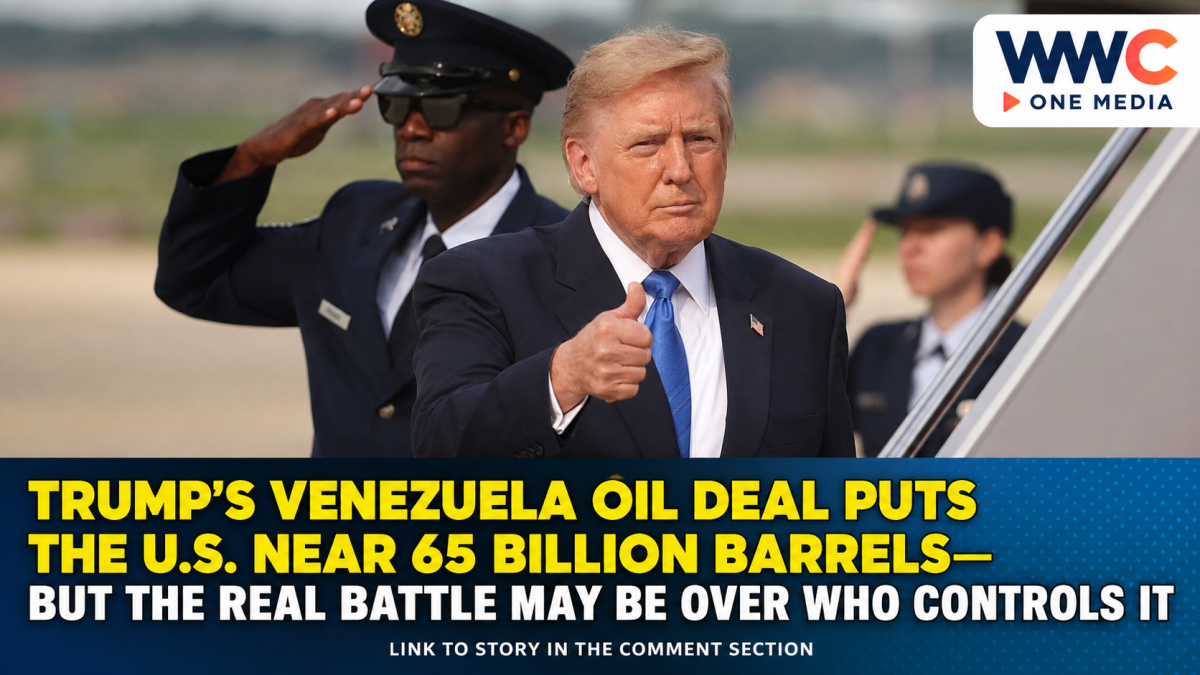
WASHINGTON/CARACAS — The Trump administration is defending a sweeping new oil agreement with Venezuela that could give the United States unprecedented influence over a huge portion of the South American country’s petroleum industry—but the deal is already facing questions over sovereignty, transparency, legality and how quickly it can actually deliver cheaper fuel to Americans.
U.S. officials said Tuesday that the agreement is designed to advance American energy security, weaken Chinese and Russian influence in Venezuela and help rebuild the country’s battered oil industry.
Venezuela’s government-dominated National Assembly has backed the agreement, while U.S. Energy Secretary Chris Wright is expected to travel to Caracas to advance the arrangement. Chevron is also preparing to expand its operations in Venezuela, adding another major American presence to the country’s energy sector.
What exactly did Trump agree to?
President Donald Trump has described the arrangement as the “biggest oil deal in world history.” The agreement gives U.S. interests access to Venezuelan oil fields containing an estimated 65 billion barrels of proven reserves, with Trump saying the United States would obtain majority control through a partnership involving private companies.
At the center of the more detailed structure is North American Blue Energy Partners (NABEP), a company led by Venezuelan businessman Alejandro Betancourt.
The White House says the arrangement will cover 17 oil fields, some of which were previously operated or influenced by Russian and Chinese interests.
Under the structure disclosed by U.S. officials, the Pentagon’s Office of Strategic Capital would hold a 35% stake in NABEP, while Washington would have the right to purchase 20% of the oil produced by the company at cost. U.S. citizens would also make up a majority of the company’s board, giving Washington significant operational influence.
Why Venezuela says it is not giving away its oil
Venezuelan interim President Delcy Rodríguez has pushed back against claims that Caracas is surrendering ownership of its natural resources.
Rodríguez said the bilateral energy agreement will run for 25 years, with an initial goal of increasing production to more than 1.5 million barrels per day from 17 strategic fields.
She has emphasized that Venezuela will retain ownership and sovereignty over its natural resources while using foreign capital, technology and expertise to rebuild an industry devastated by years of underinvestment, mismanagement and sanctions.
The Venezuelan government estimates the agreement could generate roughly US$209 billion in revenue for the state, based on an assumed oil price of US$65 a barrel.
But those figures are projections—not guaranteed returns.
The 100-year question
A major source of confusion surrounding the agreement is its reported duration.
While Rodríguez has described the broader U.S.-Venezuela energy agreement as a 25-year project, the White House has separately detailed a 100-year arrangement giving the newly formed venture long-term operating rights over 17 oil fields.
That distinction is important because the two figures refer to different components of the broader deal rather than necessarily contradicting one another.
The unusually long operating rights have intensified criticism from opponents who fear Venezuela could become excessively dependent on U.S. interests.
Why China and Russia are watching
The agreement is not simply about oil.
U.S. officials have openly described the deal as a geopolitical opportunity to shift Venezuelan energy assets away from Chinese and Russian influence.
Several of the fields covered by the agreement had previously been associated with Russian or Chinese interests. Bringing them under a U.S.-aligned structure would therefore give Washington greater influence over one of the world’s largest oil-producing countries—and potentially reshape the balance of power in the Western Hemisphere.
That could make Venezuela’s oil industry a much bigger strategic issue than its effect on gasoline prices alone.
Could the deal actually lower U.S. gas prices?
This is where the reality may be less dramatic than Trump’s headline.
Venezuela possesses the world’s largest proven crude oil reserves, but its production capacity has deteriorated severely after years of economic turmoil, sanctions, underinvestment and damaged infrastructure.
Reuters reported that the agreement is intended to eventually increase Venezuelan output substantially, while CNA noted that the country currently produces only around 1.25 million barrels per day, far below its potential.
That means Americans should not expect Venezuelan oil to suddenly translate into cheaper gasoline at the pump.
The infrastructure needed to extract, process and transport more crude will require significant investment and time. Reuters has also reported that the United States intends to use Venezuelan crude to help replenish its Strategic Petroleum Reserve, which was sitting at roughly 290 million barrels, close to a 44-year low, as of August 21.
Critics are questioning the deal’s legal and political risks
The agreement has already drawn criticism from Venezuelan opposition figures and some U.S. lawmakers.
One concern is the lack of transparency surrounding the original negotiations and the absence of a conventional competitive bidding process for some of the contracts.
Opposition lawmakers in Venezuela even abstained during the National Assembly vote, arguing that they needed to see the written terms before approving the agreement.
Another controversial element is Betancourt’s role.
The businessman has previously been linked to investigations involving alleged corruption and money laundering. U.S. officials, however, have defended his involvement and said he has not been charged with wrongdoing in the matters being raised.
The bigger gamble
For Trump, the Venezuela oil strategy is about much more than crude.
The administration is attempting to rebuild Venezuela’s energy sector while increasing U.S. access to its oil, reducing the influence of Russia and China, strengthening American energy security and potentially easing pressure on U.S. fuel prices.
For Caracas, the calculation is different: attract the massive investment needed to revive an industry that has lost much of its former capacity while insisting that Venezuela remains sovereign over its natural resources.
And for ordinary Venezuelans and Americans, the biggest question is still unanswered:
Will this extraordinary oil agreement actually deliver cheaper energy and economic recovery—or will the political and legal battles surrounding it become bigger than the oil itself?
For now, the deal is moving forward. But its biggest test may come when billions of dollars of investment have to turn a massive underground resource into barrels that can actually reach the market.
WWC ONE MEDIA MJE




Leave a Reply