
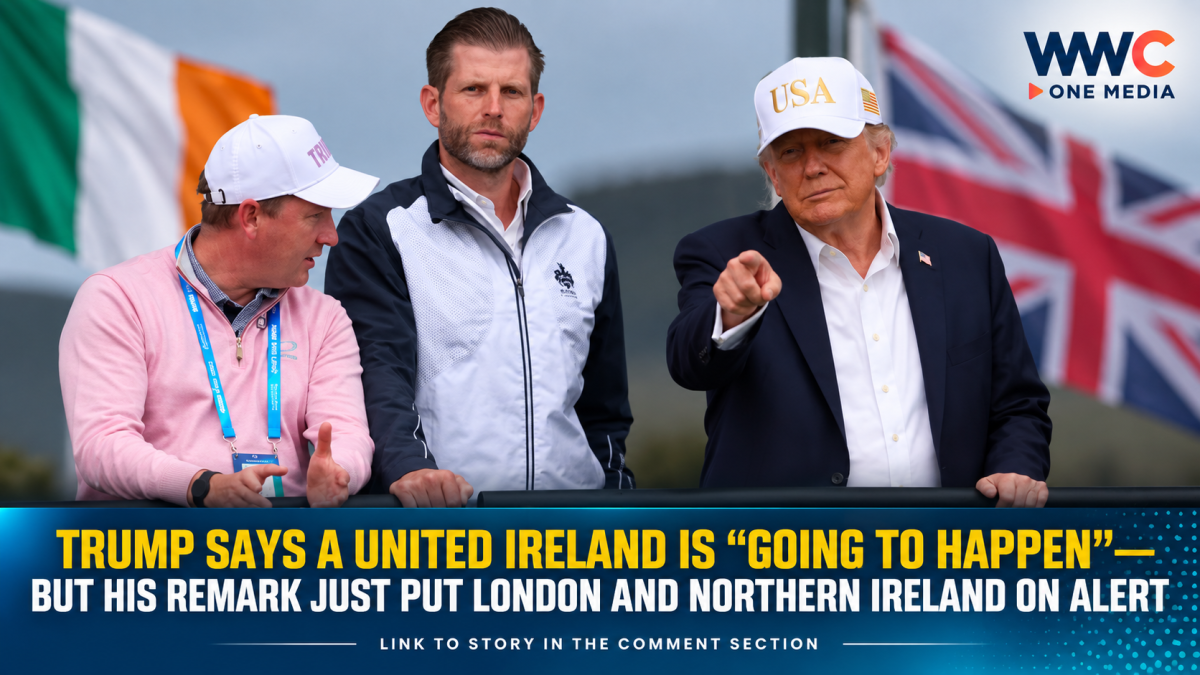
DUBLIN — U.S. President Donald Trump has unexpectedly thrown his support behind the idea of a united Ireland, saying he would “love to see” the Republic of Ireland and Northern Ireland reunified and suggesting the change could happen sooner rather than later.
Speaking alongside Irish Prime Minister Micheál Martin in Dublin on Saturday, Trump said he did not want to create problems but described Irish reunification as something he considered a “fantastic” development.
“I’d love to see it unified,” Trump said, adding that he believes it will happen eventually and asking why it could not happen now.
Trump also pointed toward Martin during the exchange, saying Ireland had the “right man” to help move the issue forward.
But the U.S. president acknowledged that the United Kingdom would have a say in the matter—a recognition of the constitutional and political realities surrounding Northern Ireland.
Trump’s remarks break from traditional U.S. caution
The comments are significant because successive U.S. administrations have generally treated the constitutional future of Northern Ireland with considerable caution, particularly because of the sensitivity surrounding the decades-long conflict between Irish nationalists and unionists.
The 1998 Good Friday Agreement, which helped end the period known as the Troubles, established a framework under which Northern Ireland’s constitutional status can ultimately be determined by the people.
A referendum on Northern Ireland joining a united Ireland can be called when the British government believes there is likely to be majority support for such a change.
That means Trump’s comments do not themselves trigger a referendum or change Northern Ireland’s constitutional status.
London quickly pushes back
Trump’s remarks came at a particularly sensitive moment.
British Prime Minister Andy Burnham has recently said that another referendum on Irish unity is currently “off the table,” arguing that there is no majority public support for holding one at present.
Downing Street subsequently confirmed that the government’s position had not changed following Trump’s comments.
The reaction from Northern Ireland’s unionist politicians was even sharper.
Democratic Unionist Party leader Gavin Robinson rejected the idea that Trump’s comments should influence Northern Ireland’s future, arguing that the decision belongs to the people of Northern Ireland—not politicians in Washington, London or Dublin.
Irish nationalists see an opportunity
Nationalist politicians, meanwhile, viewed Trump’s intervention differently.
Sinn Féin president Mary Lou McDonald said the discussion surrounding Irish unity has shifted and called for the Irish government to begin preparing for the possibility of reunification.
Irish Prime Minister Micheál Martin, however, has taken a more measured approach.
According to The Journal, Martin later said Trump’s position should not come as a surprise because the U.S. president has previously expressed support for Irish unity. Martin emphasized the importance of building stronger communities and shared experiences across the island rather than suggesting that Trump’s comments had changed the government’s immediate policy.
Trump later appeared to acknowledge the controversy
Trump himself appeared aware that his comments could create political waves.
At a later event in Dublin, he joked that he may have gotten himself into trouble by answering the question about Irish reunification, saying it was one of those questions where there was effectively “no good answer.”
The episode highlights how quickly a seemingly off-the-cuff remark from the U.S. president can become an international political story.
Why Irish reunification remains so sensitive
Northern Ireland has been part of the United Kingdom since 1921, while the Republic of Ireland is an independent state and member of the European Union.
The question of whether Northern Ireland should remain in the UK or become part of a united Ireland was at the center of the Troubles, a conflict that lasted roughly three decades and claimed thousands of lives.
The Good Friday Agreement provided a political framework for resolving the constitutional question through democratic consent.
While the debate over reunification has gained renewed attention in recent years—including amid the political consequences of Brexit—Northern Ireland remains divided over its constitutional future.
Trump’s intervention therefore carries political weight even though it does not change the legal process for determining Northern Ireland’s status.
A diplomatic headache for Washington, London and Dublin?
Trump’s comments came during a high-profile two-day visit to Ireland that included meetings with Martin and Irish President Catherine Connolly, as well as a visit connected to the Irish Open golf tournament at his Doonbeg resort.
His remarks on Irish unity also came amid broader tensions between Washington and London over several foreign-policy issues, adding another potentially complicated element to the U.S.-UK relationship.
For now, Trump’s declaration remains a political statement—not a roadmap to reunification.
But by publicly saying he would “love to see” a united Ireland and predicting that it will eventually happen, the U.S. president has injected himself directly into one of the British Isles’ most politically sensitive questions.
And with London insisting that its position has not changed, the bigger question may now be what happens when the debate over Irish unity moves from political rhetoric to the question of whether voters are actually ready to decide.



Leave a Reply