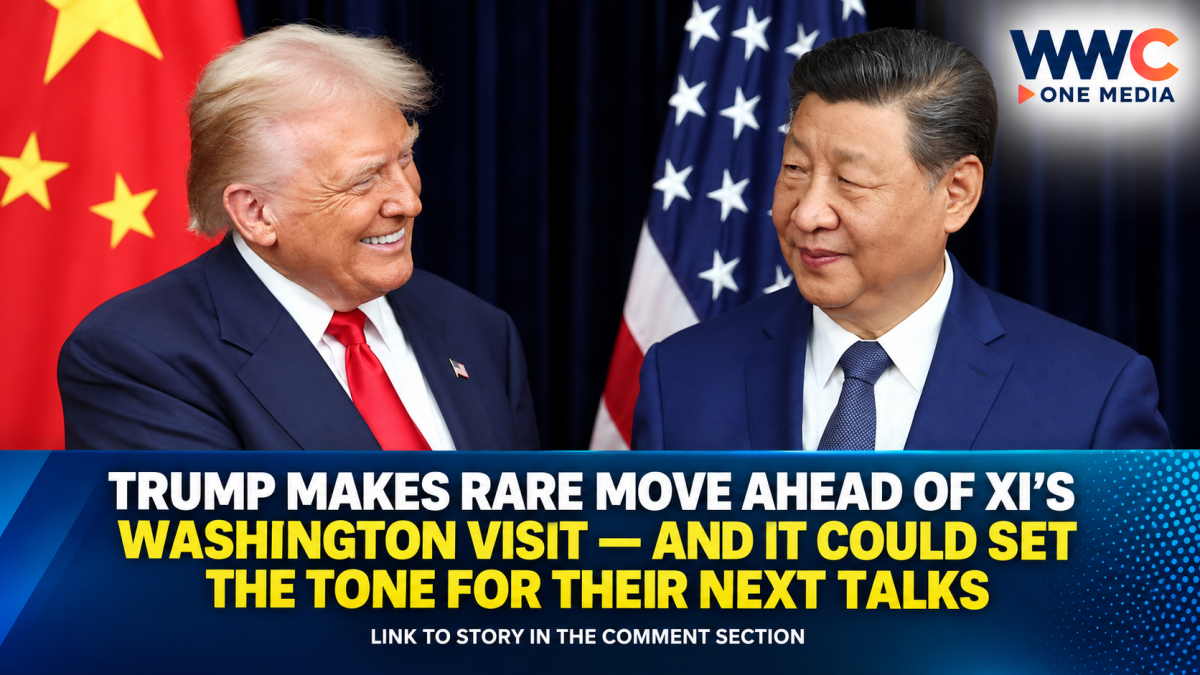
WASHINGTON — U.S. President Donald Trump plans to personally greet Chinese President Xi Jinping when Xi arrives at Joint Base Andrews outside Washington on Sept. 23, a senior U.S. official said, in an unusually high-profile welcome ahead of their closely watched White House summit.
The airport reception is significant because U.S. presidents typically receive visiting foreign leaders at the White House rather than personally meeting them on the tarmac. The plan was first reported by Reuters and has also been reported by The Associated Press and South China Morning Post.
Xi’s visit will mark his first U.S. state visit in more than a decade and comes as Washington and Beijing try to manage tensions involving trade, technology, critical minerals, Taiwan and other geopolitical issues.
A carefully staged welcome
According to U.S. officials, Xi is expected to arrive at Joint Base Andrews on Wednesday, Sept. 23, before the formal events at the White House the following day.
On Thursday, Trump and first lady Melania Trump are scheduled to welcome Xi and his wife, Peng Liyuan, at a formal White House arrival ceremony. The program is also expected to include a military review in the Rose Garden, followed by private talks between the two presidents.
A state dinner is also planned for Thursday evening.
The guest list is expected to include prominent technology and business executives, among them Amazon founder Jeff Bezos, Tesla and SpaceX CEO Elon Musk, Google’s Sundar Pichai, Nvidia CEO Jensen Huang, OpenAI CEO Sam Altman, Dell Technologies CEO Michael Dell and Apple executive Tim Cook, according to AP and Reuters reporting.
Xi and Peng are scheduled to return to the White House on Friday for a private tea with the Trumps and a tour of the National Archives before departing Washington.
Trade tensions remain at the center
The ceremony comes against the backdrop of an uneasy U.S.-China economic relationship.
Trump and Xi are scheduled to meet in Washington on Sept. 24 for their second summit of 2026, following Trump’s May visit to Beijing. Reuters reports that the leaders are seeking greater stability in a relationship still under pressure from tariffs, trade disputes and broader strategic disagreements.
One issue under discussion is whether Washington and Beijing can ease some tariffs on selected non-strategic goods.
U.S. officials have indicated that limited tariff adjustments could be considered, but they have also said Washington is not expected to make a broad relaxation of export controls involving rare-earth minerals.
Rare earths are particularly important because they are used in products ranging from electronics and electric vehicles to advanced military equipment. China occupies a dominant position in global rare-earth supply chains, making the issue an important point of leverage in U.S.-China trade negotiations.
AI competition moves closer to the negotiating table
Artificial intelligence is another major issue hanging over the summit.
Reuters reported that the accelerating U.S.-China race over AI is expected to feature prominently in the discussions, while other analysis has pointed to differences between Washington and Beijing over AI development, safety and regulation.
The presence of major technology executives at the state dinner further highlights the economic and strategic importance of advanced technology to the relationship.
The discussions are not limited to AI. Critical minerals, trade and investment, technology competition and broader strategic stability are also expected to feature in the summit.
Taiwan and global security remain difficult issues
Trade and technology are only part of the agenda.
Reuters has identified Taiwan and Iran among the wider geopolitical issues surrounding the summit. The meeting comes while Washington and Beijing continue to manage competing strategic interests in the Indo-Pacific and beyond.
Analysts cited by the World Economic Forum have described the Washington meeting as an opportunity to stabilize a fragile U.S.-China relationship, rather than necessarily producing a comprehensive reset.
That distinction matters: even if the two governments reach limited agreements on trade or other economic matters, major disagreements between the world’s two largest economies are expected to remain.
Why Trump’s airport welcome matters
The decision for Trump to meet Xi at Joint Base Andrews adds an important symbolic element to the visit.
The South China Morning Post reported that Xi is expected to land at Andrews on Wednesday afternoon and noted that U.S. presidents generally wait to receive visiting leaders at the White House.
The White House has not indicated that the airport welcome by itself represents a substantive policy concession. Rather, it is part of an unusually elaborate state-visit program at a moment when Washington and Beijing are trying to prevent economic and strategic tensions from escalating.
The immediate focus now shifts to what Trump and Xi can actually deliver once the ceremonies end.
With tariffs, rare earths, AI and geopolitical tensions all on the table, their Sept. 24 meeting could provide a clearer indication of whether the current period of U.S.-China engagement produces concrete agreements—or simply another temporary effort to keep tensions under control.