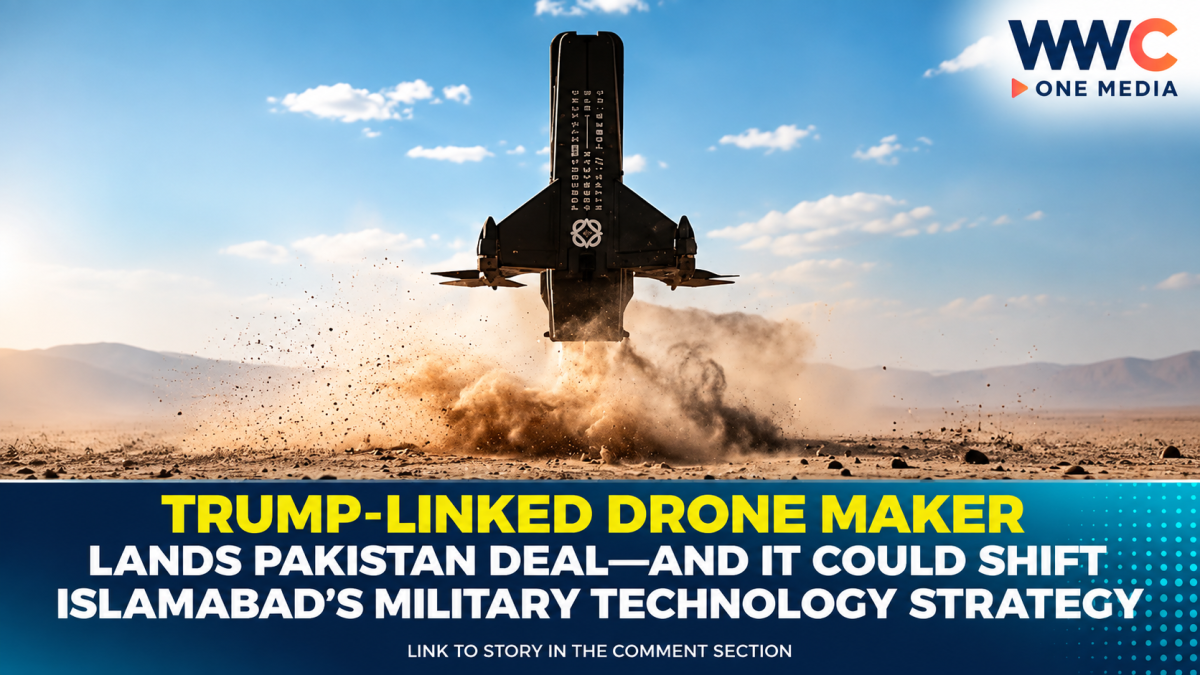
ISLAMABAD — A U.S. drone company backed by investments linked to Donald Trump Jr. and Eric Trump has signed a memorandum of understanding with Pakistan’s military that includes an initial order for unmanned aerial systems, opening a new chapter in Washington-Islamabad defense cooperation.
The company, Powerus, said the agreement with Pakistan provides a framework for expanded cooperation, including potential joint ventures to localize manufacturing inside Pakistan. The value and specific contents of the initial order have not been publicly disclosed.
The agreement comes as Pakistan seeks to strengthen its defense capabilities while maintaining its longstanding military relationship with China—and as Washington and Islamabad work to deepen ties after years of strained relations.
But the deal carries another layer of attention.
Powerus is preparing to merge with Nasdaq-listed Aureus Greenway Holdings, with Trump Jr. and Eric Trump among the investors connected to the transaction through American Ventures. The Trump family connection does not establish that they influenced the Pakistan agreement, and Trump Jr.’s representative has said he had no role in the negotiations or procurement process.
Pakistan’s First Order Is Confirmed—But Details Are Secret
Powerus co-founder Brett Velicovich told Reuters that the company had received an initial order from Pakistan involving unmanned aerial systems.
However, he declined to disclose the specific equipment, value or other commercial details, citing security and confidentiality considerations.
That makes the initial transaction considerably narrower than some of the broader headlines surrounding the announcement.
Pakistan’s military confirmed that a Powerus delegation led by Velicovich met Field Marshal Syed Asim Munir at General Headquarters in Rawalpindi on September 16.
According to Pakistan’s military communications, discussions covered defense procurement, production and long-term capacity building. The military’s statement, however, did not publicly spell out the MoU itself.
Powerus separately announced that its agreement includes a limited procurement order and a strategic MoU covering potential cooperation in unmanned and autonomous systems, subject to further agreements and government approvals.
The Bigger Plan: Build Drones Inside Pakistan
The most consequential part of the agreement could be what happens after the initial order.
The Financial Times reported that the MoU is intended to establish the basis for joint ventures that could localize drone manufacturing in Pakistan, potentially involving Powerus drones and interceptor systems.
Powerus executives have described the proposed relationship as more than a one-time sale, saying the company is exploring ways to build technology in Pakistan and develop a longer-term industrial partnership.
That could eventually mean technology transfer, local production and expanded Pakistani participation in the unmanned-systems industry—but those outcomes are not guaranteed by the current MoU.
The company itself says further definitive agreements and government approvals would be required.
Why China Matters
The agreement is significant partly because of Pakistan’s longstanding dependence on Chinese military equipment.
According to data cited by the Financial Times and other reporting based on the Stockholm International Peace Research Institute, China has supplied roughly 80% of Pakistan’s defense imports by volume in recent years. Pakistan is also among the world’s major arms importers.
That does not mean Pakistan is abandoning China.
Islamabad continues to maintain extensive defense and economic ties with Beijing while simultaneously seeking closer cooperation with Washington.
Powerus executives, however, explicitly presented their Pakistan strategy as an opportunity to provide U.S. technology in a market where Chinese systems have traditionally had a dominant position.
The potential shift is therefore less about an immediate replacement of Chinese equipment and more about Pakistan adding another major source of unmanned and counter-drone technology.
Why Drones Are Becoming a Bigger Military Priority
The timing is also important.
Recent conflicts have demonstrated how relatively inexpensive drones can be deployed in large numbers, creating new challenges for traditional air-defense systems.
Powerus specializes in unmanned aerial systems as well as counter-drone technology. Its product portfolio includes tactical drones, heavy-lift systems and drone interceptors designed to defeat hostile unmanned aircraft.
The company says it currently produces approximately 3,000 drone interceptors per month and is planning a substantial increase in output.
Powerus has also secured a U.S. Air Force contract with a ceiling of up to $90 million for aerial-denial systems, according to company disclosures.
The company has additionally announced a roughly $22.3 million contract involving counter-drone technology for critical energy infrastructure in the Middle East.
These contracts illustrate why Powerus is rapidly expanding beyond its U.S. market.
The Trump Family Connection
The deal’s political sensitivity comes from Powerus’s connection to the family of the sitting U.S. president.
Powerus is preparing to merge with Aureus Greenway Holdings, a Nasdaq-listed company. Regulatory filings identify an investment vehicle associated with Donald Trump Jr. and Eric Trump as an investor in the transaction.
Reuters reported that American Ventures is expected to hold approximately 9.9% beneficial ownership of the combined company after the merger, based on regulatory filings.
The merger is expected to close in early October, subject to the relevant conditions.
Trump Jr.’s spokesperson has said he is a passive investor and has no involvement in Powerus’s management, operations or procurement contracts, and said he had no prior knowledge of the Pakistan agreement. The White House has also said there are no conflicts of interest.
There is currently no evidence establishing that Trump Jr. or Eric Trump intervened in the Pakistan deal.
That distinction matters: the financial connection is documented, while claims that the connection caused or influenced the contract would require evidence that has not been publicly established.
Powerus Is Moving Into a Fast-Growing Defense Market
Powerus is a relatively young company.
It was incorporated in 2025 and has been assembling a portfolio of drone and counter-drone technologies, including technology licensed from Ukraine and systems acquired from other drone businesses.
Its strategy centers heavily on lower-cost autonomous systems and counter-drone technology.
That business model has gained attention as governments confront the growing cost of defending against large numbers of relatively inexpensive drones.
Powerus has said its Guardian interceptor costs approximately $5,000, although its capabilities are intended primarily for drone threats rather than replacing high-end systems designed to intercept ballistic missiles.
That distinction is important because cheap interceptors are not a universal replacement for sophisticated air-defense networks.
A New Phase in U.S.-Pakistan Relations
The Powerus agreement arrives amid a broader improvement in U.S.-Pakistan relations.
Pakistan’s military leadership has pursued closer engagement with Washington while seeking additional economic and defense opportunities.
The relationship has also included high-level contact between Trump and Munir, while Islamabad has simultaneously pursued deals involving areas such as critical minerals and digital finance.
For Washington, greater defense cooperation with Pakistan could create another channel for U.S. technology in South Asia.
For Islamabad, cooperation with American drone companies could provide another source of technology while potentially creating domestic manufacturing opportunities.
For China, however, the development is notable because Pakistan has traditionally been one of Beijing’s important defense partners.
What Happens Next?
For now, the facts are relatively clear:
Pakistan has an initial Powerus order.
The value and exact equipment remain undisclosed.
The two sides have signed an MoU for broader unmanned-systems cooperation.
Potential local manufacturing would require additional agreements and approvals.
Powerus is connected financially to an investment vehicle involving Donald Trump Jr. and Eric Trump, but there is no public evidence that the Trump sons negotiated or directed the Pakistan transaction.
The real significance of the deal will therefore depend on what follows.
If Pakistan eventually moves from buying Powerus systems to producing them domestically, the agreement could become part of a broader effort to diversify its defense-technology supply chain.
And if Washington and Islamabad continue expanding their military relationship, the small initial drone order announced this week could prove to be only the first step in a much larger U.S.-Pakistan defense partnership.
The first deal is already signed. The bigger question is how far Pakistan—and Powerus—take it from here.