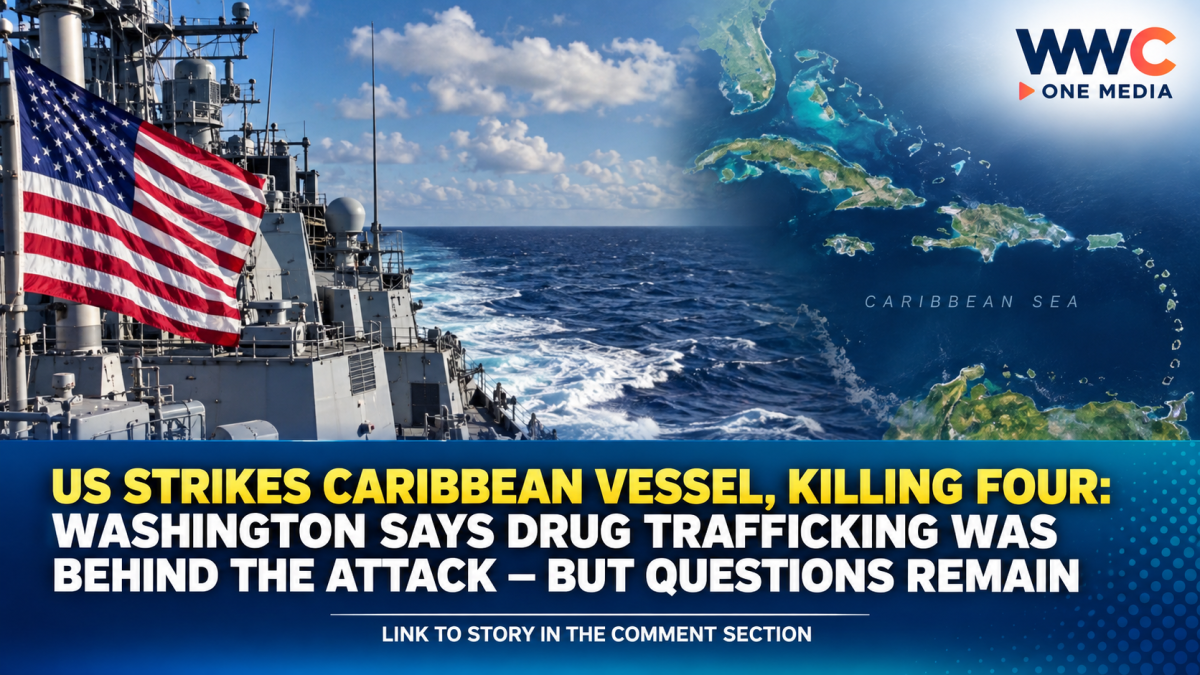
WASHINGTON — The U.S. military says it carried out another deadly strike against a vessel in the Caribbean Sea on Saturday, September 19, killing four people in the latest operation of the Trump administration’s expanding campaign against suspected drug traffickers.
U.S. Southern Command said the strike was conducted by the Joint Task Force Western Hemisphere against a “go-fast vessel” operating along established narco-trafficking routes.
According to the command, intelligence indicated that the vessel was actively involved in drug trafficking. The military described those killed as “narco-terrorists.”
However, U.S. authorities have not publicly released evidence showing that the vessel was carrying drugs, according to reporting by Reuters and The Associated Press. The military has also not disclosed the identities of those killed or the precise location of the strike.
What happened in the Caribbean?
The strike took place on September 19, according to U.S. military records. A short video released by the U.S. government shows a vessel followed by an explosion, but provides little publicly verifiable information about what was aboard the boat.
Southern Command said the operation was conducted under its direction and described the vessel as operating on a known trafficking route.
Reuters reported that the latest attack is part of a campaign that began last year, with the Trump administration portraying its targets as “narco-terrorists.” Rights organizations, meanwhile, have challenged the legality of the strikes and described them as unlawful killings.
A campaign that has now claimed more than 230 lives
The September 19 operation comes after a series of U.S. strikes against suspected drug-trafficking vessels in the Caribbean and eastern Pacific.
The Associated Press reported that, following the latest attack, at least 231 people have been killed in 69 U.S. military boat strikes since the campaign began nearly a year ago.
Independent tracking by Just Security had recorded 69 strikes and about 230 deaths as of September 9, before the latest operation, illustrating the rapid expansion of the campaign.
The strikes have occurred in both the Caribbean and eastern Pacific, with U.S. officials repeatedly saying they are aimed at vessels connected to narcotics trafficking.
Washington says the campaign is part of a broader fight against cartels
The Trump administration has argued that the military campaign is necessary to disrupt drug trafficking networks before narcotics reach the United States.
President Donald Trump has described the United States as being in an “armed conflict” with cartels in Latin America and has presented the operations as an escalation of the fight against drugs and the deaths associated with them.
The administration has also sought closer cooperation with countries across Latin America.
The Associated Press reported that Washington has pursued agreements for joint military operations with regional partners. Colombia, Honduras and Panama have been cited in U.S. statements, although Guatemala has disputed claims that it agreed to such an arrangement. Ecuador has already conducted joint operations with the United States.
The evidence question
One of the most closely watched aspects of the campaign is the evidence used to identify the targeted vessels.
In the September 19 case, Southern Command said intelligence confirmed the vessel’s involvement in narcotics trafficking. But, as Reuters and AP reported, the military has not publicly produced evidence showing that drugs were actually aboard the vessel.
That distinction is significant because many details surrounding individual strikes — including the identities of those killed, the cargo allegedly being transported and the intelligence underpinning the targeting decisions — have not been publicly disclosed.
Independent organizations tracking the campaign have therefore relied heavily on U.S. government statements when compiling casualty figures and incident details. InSight Crime, for example, has noted that much of the information concerning the strikes comes from U.S. authorities and, in many cases, cannot be independently corroborated.
Human rights and legal concerns intensify
The growing number of deaths has also triggered sustained criticism from human-rights organizations and legal experts.
Human Rights Watch, Amnesty International and independent United Nations investigators have raised concerns over whether the strikes comply with international law. Other advocacy groups have argued that suspected drug traffickers should be subject to law-enforcement procedures rather than lethal military action.
The administration, however, maintains that the operations are part of an armed conflict against designated criminal or terrorist organizations and argues that military force is justified.
That legal interpretation remains heavily contested.
What comes next?
The September 19 strike signals that the U.S. campaign remains active despite periods in which attacks appeared to pause.
Southern Command’s own records show that the latest operation followed earlier lethal strikes and separate interdictions involving vessels allegedly connected to drug-trafficking networks.
For Washington, the central objective remains disrupting suspected maritime drug routes. For critics, the unanswered questions concern the evidence behind individual targets, the legal basis for lethal force and the absence of publicly disclosed information about many of those killed.
As the campaign continues, those questions are likely to remain at the center of the debate over how far the United States should go in using military force against suspected drug-trafficking networks.