
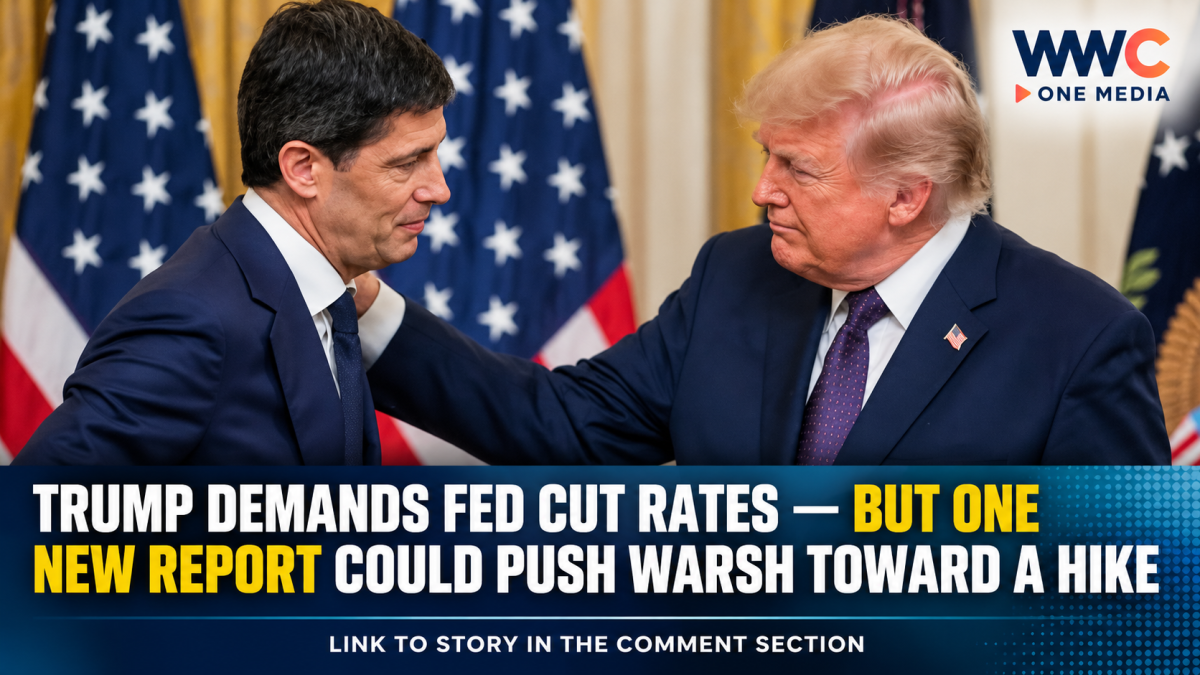
WASHINGTON — President Donald Trump is once again pressing the U.S. Federal Reserve to lower interest rates, but a surprisingly strong jobs report has complicated the outlook and increased market expectations that the central bank could raise rates at its September meeting.
The clash puts new Fed Chair Kevin Warsh at the center of a high-stakes policy test, with Trump demanding cheaper borrowing while inflation remains above the Federal Reserve’s 2% target.
The Federal Reserve is scheduled to meet September 15–16, and investors are now closely watching whether Warsh will follow through on his recent warnings about persistent inflation.
Trump escalates pressure
Trump intensified his campaign for lower interest rates after Friday’s employment report, arguing that high U.S. borrowing costs put the country at a competitive disadvantage.
He also threatened to stop trading with countries with which the United States runs trade deficits unless the Fed cuts rates.
The comments came as markets were moving in the opposite direction.
Rather than strengthening the case for immediate rate cuts, the latest economic data gave investors more reason to consider another rate increase.
Jobs report changes the Fed debate
U.S. employers added 162,000 jobs in August, nearly three times the roughly 56,000 increase economists surveyed by Reuters had expected.
The unemployment rate remained at 4.1%, while labor-force participation increased to 61.6%.
The July employment figure was also revised sharply higher, replacing an initially reported decline of 23,000 jobs with a gain of 21,000.
The numbers suggest that the U.S. labor market remains more resilient than previously thought — giving the Fed greater room to focus on inflation rather than rushing to cut borrowing costs.
Market-based expectations for a September rate hike rose after the jobs report. Reuters reported that futures were implying roughly a 62% probability of an increase, although those odds fluctuated during Friday trading.
Warsh has already opened the door to a hike
The latest jobs figures arrive after Warsh delivered a notably hawkish message at the Federal Reserve’s annual Jackson Hole conference.
Warsh said inflation had cooled somewhat but argued that the underlying trend had not improved enough to give policymakers confidence that inflation was moving toward the Fed’s 2% objective.
His message was effectively that the Fed still has work to do if inflation fails to make sufficient progress.
That changed the market conversation.
Before Warsh’s Jackson Hole remarks, investors had been more focused on the possibility of rate cuts. His comments instead raised the possibility that the Fed could tighten policy again.
But a September hike is far from guaranteed
Despite the growing rate-hike bets, policymakers remain divided.
Fed Governor Christopher Waller said he could support keeping rates unchanged if upcoming inflation data show that price pressures are continuing to moderate.
That makes the next round of inflation figures particularly important.
The August Consumer Price Index and Producer Price Index reports are due before the September Fed meeting and could ultimately determine whether policymakers raise rates or remain on hold.
AP reported that Waller’s comments caused market expectations for a September increase to fall from roughly 65% to around 50% at one point, underscoring just how sensitive the outlook remains to incoming economic data.
Why the decision matters
The Fed currently has its benchmark federal funds rate in the 3.50%–3.75% range, where it has remained since December 2025.
A rate increase would raise borrowing costs across the economy and could affect mortgages, credit cards, auto loans and business financing. It could also put pressure on stocks and other assets whose valuations are sensitive to interest rates.
At the same time, keeping rates high for longer could slow economic activity.
That leaves Warsh facing a difficult balancing act: demonstrate that the Fed remains serious about controlling inflation without unnecessarily weakening an economy that is still producing jobs.
Markets now face a critical week
The September meeting is shaping up as one of the most closely watched Fed decisions of the year.
Trump wants rates lower.
Warsh has warned that inflation remains too high.
The jobs market has shown unexpected strength.
And next week’s inflation reports could determine which side ultimately wins the argument.
For now, investors are increasingly preparing for the possibility that the Federal Reserve could raise rates — even as the White House demands the exact opposite.
The final answer may come not from Trump or Wall Street, but from the inflation numbers released just days before the Fed makes its decision.
WWC ONE MEDIA M.J.E



Leave a Reply