
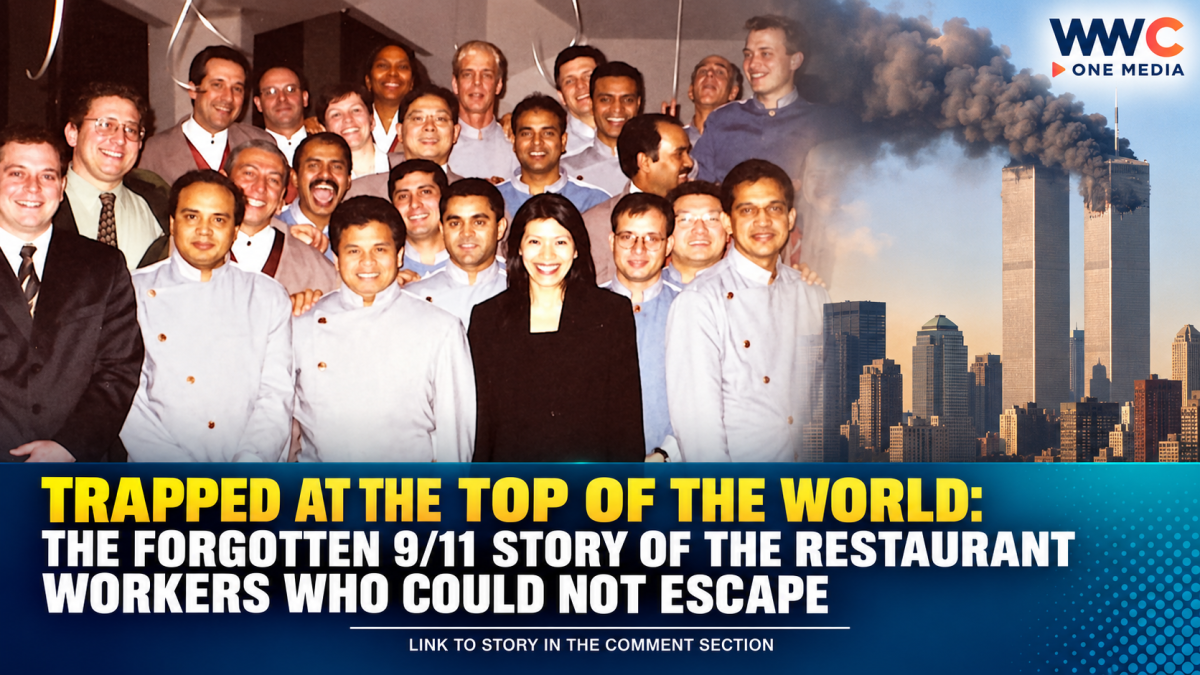
NEW YORK — On the morning of September 11, 2001, breakfast was being prepared more than 1,300 feet above Manhattan.
Workers arrived for another day at Windows on the World, the famous restaurant complex occupying the 106th and 107th floors of the North Tower of the World Trade Center. Some were preparing breakfast. Others were getting ready to serve guests attending a financial technology conference.
Then, at 8:46 a.m., American Airlines Flight 11 struck the North Tower.
Within moments, the people inside Windows on the World found themselves trapped above the impact zone — with no route to safety.
Twenty-five years later, their final hour is being revisited in the CNA documentary “Windows on the World – 9/11’s Forgotten Story,” which pieces together the human stories behind one of the most devastating but lesser-known chapters of the September 11 attacks. The documentary draws on family archives, emergency calls and interviews to reconstruct what happened to those stranded at the top of the North Tower.
A Restaurant in the Sky Became a Death Trap
Windows on the World was more than a restaurant.
Opened in 1976, the landmark occupied the top floors of One World Trade Center and became one of New York City’s most recognizable dining destinations. Its panoramic views, private event spaces, bar and dining rooms attracted tourists, executives and celebrities, while its workforce represented the diversity of New York itself.
According to the National September 11 Memorial & Museum, the restaurant complex and its associated venues employed around 450 people in 2001, with workers speaking more than 60 languages.
By the morning of 9/11, roughly 80 conference participants had gathered at Windows on the World, while dozens of restaurant staff had already arrived to prepare for breakfast service and the day’s events.
When Flight 11 hit the North Tower below them, escape routes were cut off.
Those above the impact zone were suddenly isolated.
The Final Calls for Help
Among those caught inside was Christine Olender, an assistant general manager at the restaurant.
The new CNA documentary reconstructs the increasingly desperate situation using emergency call records and testimony connected to those trapped on the upper floors. According to the documentary’s producers, Olender made repeated attempts to seek help for the people around her as the scale of the disaster became clearer.
For many families, those calls became some of the final traces left by loved ones.
At the time, the people inside the restaurant could not fully see or understand what was unfolding outside. News travelled unevenly. Information was incomplete. And while evacuation orders had helped thousands of people escape from lower floors, those above the impact zone had no accessible route down.
At 10:28 a.m., the North Tower collapsed.
Everyone still trapped above the impact zone was killed.
Why the Number of Victims Is Often Reported Differently
One of the most important details in telling the Windows on the World story accurately is that different sources count different groups of victims.
The National September 11 Memorial & Museum’s collection records state that 72 restaurant staff members were killed, alongside breakfast guests and conference attendees.
Other accounts, including testimony connected to former employees and labour advocates, commonly refer to 73 lost co-workers, while broader accounts of the tragedy include guests and conference attendees as well.
More recent reporting surrounding the documentary Top of the World has described 79 workers and 91 diners killed, illustrating how totals can vary depending on whether reporting counts employees of the wider restaurant operation, contractors and all guests present that morning.
What is not in dispute is the scale of the loss: approximately 170 people — workers and guests combined — were trapped at the restaurant complex on the upper floors on the morning of the attack.
A Life Changed by One Decision
At the heart of CNA’s documentary is Jupiter Yambem, an Indian immigrant and banquet manager at Windows on the World.
According to CNA, Yambem had changed to the morning shift just a week before the attacks so he could spend more time with his young son.
That decision brought him to work on September 11.
The documentary follows his story from Manhattan to Manipur, India, and examines how the destruction of the World Trade Center sent waves of grief far beyond the United States.
His story reflects a larger truth about Windows on the World.
The restaurant was powered by immigrants who had travelled to New York from countries across Asia, Africa, Latin America and beyond — people who came seeking work, opportunity and a future for their families.
For many of them, the World Trade Center was not simply an office complex or tourist attraction.
It was where they worked.
It was where they built friendships.
And for dozens, it became the last place they would ever see.
Some Survived Because of Minutes — or Even Seconds
The tragedy also produced stories of survival determined by seemingly ordinary decisions.
Chef Michael Lomonaco, who led Windows on the World, was expected to be upstairs that morning. Instead, he stopped to have his glasses fixed inside the World Trade Center complex.
That decision kept him from reaching the restaurant before the attack.
Lomonaco later learned that dozens of his colleagues had been killed. His experience was among the stories documented in later oral histories and renewed reporting ahead of the 25th anniversary of the attacks.
Former kitchen worker Sekou Siby also survived after a change in his work schedule. More than 70 of his colleagues did not.
In the years after 9/11, Siby became associated with advocacy for restaurant workers — part of a wider effort by survivors and former employees to rebuild lives shattered by the attacks.
These stories are reminders of how narrow the line between survival and death became that morning.
A changed shift.
A missed elevator.
A visit to an optometrist.
A decision to stop for breakfast.
For some, those moments meant life.
For others, there was no escape.
The Immigrant Story of Windows on the World
The human story of the restaurant did not end when the towers fell.
Former workers and advocates helped establish support networks for employees and families affected by the attacks. The aftermath also exposed the vulnerability of immigrant workers, including people who feared seeking assistance because of their immigration status.
PBS reporting from the months after 9/11 documented how immigrant families connected to restaurant workers faced uncertainty while trying to locate missing relatives and access support.
That legacy continues to shape how former employees and filmmakers remember Windows on the World today.
A separate 2026 documentary, “Top of the World,” has also returned attention to the restaurant’s workforce and its cultural impact, focusing on the immigrant community that helped make the landmark one of New York’s most celebrated restaurants. CNN announced the project as part of programming marking both the 25th anniversary of the 9/11 attacks and the 50th anniversary of Windows on the World’s opening.
More Than a Restaurant, More Than a Number
For many people, the image of 9/11 is defined by the burning towers, collapsing buildings and desperate evacuation below.
But the story of Windows on the World happened at the very top.
It happened in kitchens.
In banquet rooms.
At breakfast tables.
On emergency phone lines.
And in the final conversations between people who were trying to understand whether anyone could still save them.
Twenty-five years later, the story remains deeply personal.
Behind every disputed statistic is a name.
Behind every name is a family.
And behind the famous windows that once looked out across New York City were workers who represented dozens of countries and thousands of dreams.
They came to work at one of the most spectacular restaurants in the world.
On September 11, 2001, many never came home.
The Story the World Is Still Discovering
The renewed attention surrounding CNA’s “Windows on the World – 9/11’s Forgotten Story” comes at a significant moment: the 25th anniversary of the attacks.
The documentary does not change the history of 9/11.
Instead, it changes the perspective.
It asks viewers to look upward.
To remember not only what happened below the impact zone, but what happened above it.
To remember the restaurant workers who were preparing another ordinary morning.
To remember the families who waited for calls that never came.
And to remember that, even a quarter-century later, some of the most powerful stories of September 11 are still being told.
Because at the top of the North Tower, behind the windows that once gave New York one of its greatest views, dozens of workers and guests spent their final hour waiting for a rescue that would never arrive.




Leave a Reply