
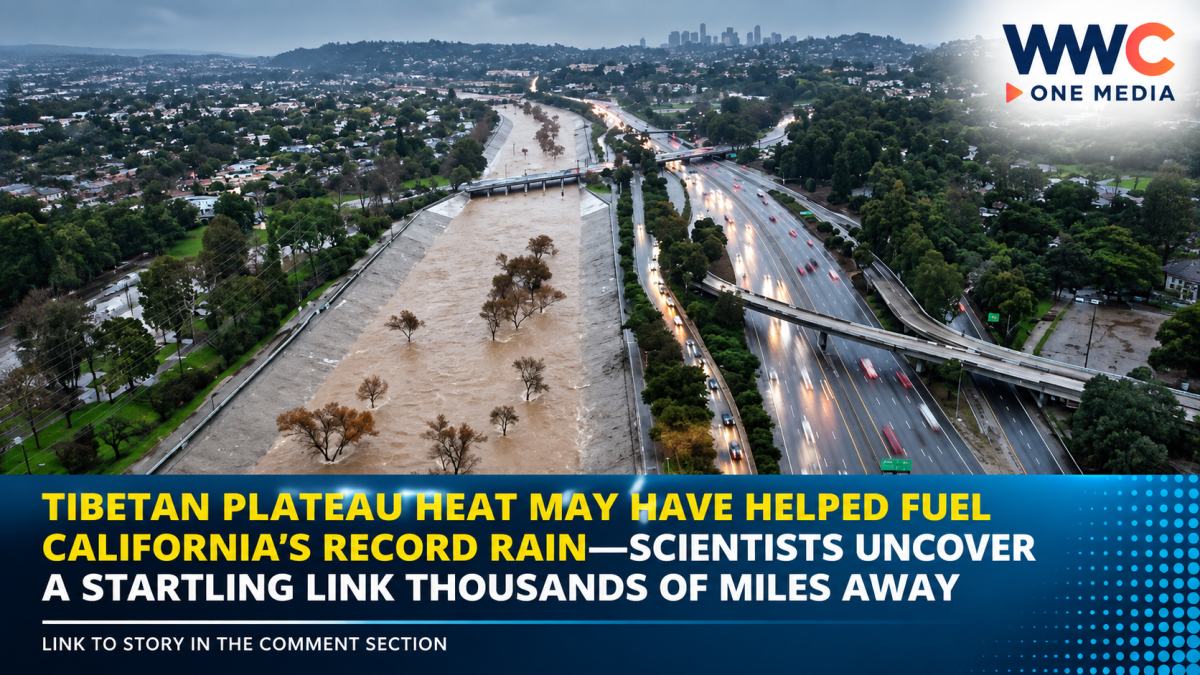
BEIJING/LOS ANGELES — A climate connection spanning more than 7,000 miles could change how scientists forecast extreme winter weather in California.
New research led by scientists at the University of California, Los Angeles (UCLA) has found evidence that unusually warm land temperatures over the Tibetan Plateau in early winter played a key role in driving the extraordinary rainfall that struck California and surrounding regions during the winters of 2016–2017 and 2022–2023.
The findings, published in the peer-reviewed journal Science Advances, identify a previously underappreciated link between warming over one of the world’s highest regions and powerful atmospheric rivers that can unleash extreme precipitation over the U.S. West Coast.
The surprising connection
At first glance, the Tibetan Plateau and California appear to have little to do with one another.
The plateau is more than 7,200 miles (11,600 kilometers) from California and averages roughly 4,500 meters (14,800 feet) above sea level. Yet researchers found that unusual early-winter heating there can disturb the atmosphere in ways that eventually influence weather over the Pacific and North America.
The researchers found a statistically significant relationship between early-winter Tibetan Plateau land temperatures and late-winter precipitation in California.
They then used Earth-system model experiments to investigate whether the relationship could reflect an actual physical mechanism rather than simply a statistical coincidence.
The results indicated that Tibetan Plateau heating could help produce atmospheric conditions favorable for stronger atmospheric rivers along the U.S. Pacific Coast.
How heat in Tibet can influence storms in California
The mechanism involves a chain reaction in the atmosphere.
When the Tibetan Plateau becomes unusually warm, the heated land affects the atmosphere above it and changes large-scale temperature gradients.
That disturbance can influence the jet stream and generate a large-scale atmospheric wave pattern known as the Tibetan Plateau–Rocky Mountain wave train.
As the wave travels eastward, it can eventually affect atmospheric conditions over the northeastern Pacific.
Researchers say the resulting changes can contribute to the strengthening of atmospheric rivers—long, narrow corridors that transport enormous amounts of water vapor through the atmosphere.
When powerful atmospheric rivers reach California, they can produce intense rainfall, heavy mountain snow and dangerous flooding.
Why the 2017 and 2023 storms were so unusual
The discovery is particularly important because California’s extreme precipitation during those two winters occurred under conditions that normally would not have suggested such an exceptionally wet outcome.
Both winters were associated with La Niña, a climate pattern traditionally associated with relatively dry conditions across California and parts of the western United States.
Yet California and neighboring areas experienced record-breaking precipitation.
The 2016–2017 winter helped bring California’s prolonged drought to an end, while the 2022–2023 winter produced widespread flooding and other severe impacts.
According to reporting on the study, the two events together caused roughly US$6.6 billion in damage and at least nine deaths. The 2016–2017 event alone produced approximately US$2 billion in property damage, while the 2022–2023 precipitation event was associated with about US$4.6 billion in damage.
A warning for weather forecasters
One of the most important implications of the research is what it says about seasonal forecasting.
Forecast systems traditionally place considerable emphasis on ocean conditions, particularly El Niño and La Niña.
But the study suggests that ocean temperatures do not tell the entire story.
Researchers reported that global models driven primarily by sea-surface temperatures failed to reproduce the extreme California precipitation observed during the two events.
When Tibetan Plateau land temperatures were incorporated into the model’s initial conditions, however, the simulations were able to reproduce both the unusual early-winter warming over the plateau and the subsequent California precipitation pattern.
That could be significant because seasonal forecasting is inherently difficult. Adding land-surface conditions from high-altitude regions such as the Tibetan Plateau could potentially provide forecasters with another signal to watch months before an extreme precipitation season unfolds.
What this could mean for California
California is particularly vulnerable to atmospheric rivers.
These storms can be essential to the state’s water supply because they deliver a large share of annual precipitation, but the most powerful events can also cause catastrophic flooding, landslides, infrastructure damage and loss of life.
Researchers therefore believe that monitoring Tibetan Plateau temperatures alongside ocean and atmospheric conditions could eventually improve assessments of the risk of extreme West Coast precipitation.
The findings could be especially useful for water managers, emergency planners and communities vulnerable to flooding, giving them another potential early-warning signal.
Climate change adds another layer
The discovery also comes as the Tibetan Plateau itself experiences significant warming.
Scientists have increasingly studied the plateau as a major component of the climate system because its enormous elevation and geographic size allow changes in land temperature to influence atmospheric circulation well beyond Asia.
Earlier UCLA research has also demonstrated that temperature variations across the Tibetan Plateau can affect large-scale circulation patterns, including the Asian monsoon.
The new study expands that picture, suggesting that the plateau’s influence can extend across the Pacific and affect weather in North America.
However, scientists are not saying that every heat event over Tibet will cause a California flood.
The research identifies a physical climate connection and shows that Tibetan Plateau heating played an important role in the specific extreme precipitation events studied. Weather outcomes remain dependent on multiple interacting factors.
The bigger message
The study offers a striking reminder that extreme weather can have global fingerprints.
A temperature anomaly thousands of miles away may alter atmospheric waves, which can reshape conditions over the Pacific and help strengthen storms that eventually reach California.
For a region where a single atmospheric river can mean either desperately needed water or devastating flooding, that new information could prove valuable.
The next breakthrough may not come from looking only at the Pacific Ocean. Scientists may also be watching the temperature of a mountain plateau on the other side of the world.




Leave a Reply