
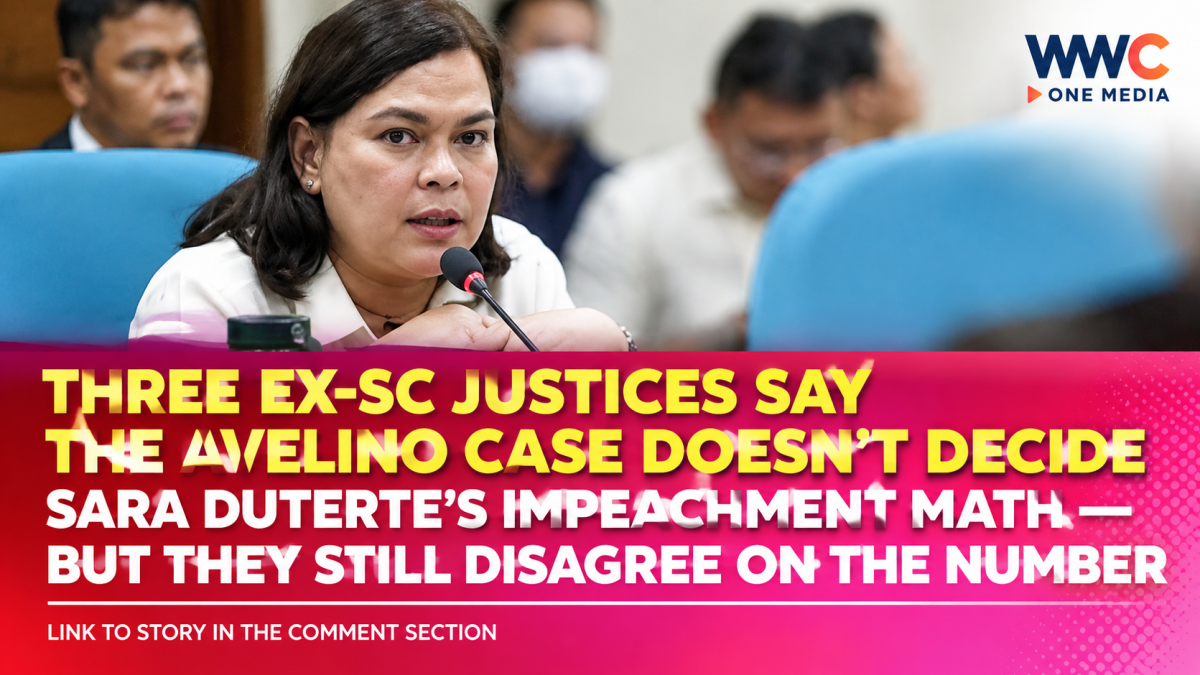
MANILA, Philippines — A Supreme Court ruling that has survived for 77 years has suddenly become central to Vice President Sara Duterte’s impeachment trial—but three retired members of the country’s highest court say it cannot simply be transplanted into the Senate’s current dilemma.
Former Chief Justices Reynato Puno and Hilario Davide Jr. and retired Associate Justice Adolfo Azcuna told the Senate impeachment court on Wednesday, September 16, that the landmark 1949 case Avelino v. Cuenco dealt with a fundamentally different constitutional question: how many senators were necessary to form a quorum.
Duterte’s trial raises another question entirely.
How many senator-judges must vote to convict when the Constitution says conviction requires the concurrence of “two-thirds of all the Members of the Senate,” but several sitting senators are currently unable or unavailable to participate?
For decades, the arithmetic looked simple.
There are 24 senators.
Two-thirds of 24 is 16.
Senate impeachment court Presiding Officer Francis “Chiz” Escudero therefore ruled when Duterte’s trial began that 16 votes would be required for conviction.
But the present Senate does not have all 24 senator-judges actively participating.
And that has turned what once looked like basic arithmetic into one of the biggest constitutional disputes of the trial.
Why Avelino suddenly matters
The controversy revolves around a case decided in 1949, when Jose Avelino challenged Mariano Cuenco’s assumption of the Senate presidency.
The Senate constitutionally had 24 seats, but Senator Tomas Confesor was in the United States and beyond the Senate’s practical coercive reach.
The Supreme Court ultimately recognized 12 senators as sufficient to constitute a majority of the 23 senators then capable of participating, for purposes of determining a quorum.
The decision distinguished between constitutional language referring to a majority of “the Senate” or “each House” and provisions specifically using the phrase “all the members.”
That distinction is now crucial.
Some participants in Duterte’s impeachment proceedings have asked whether the same practical principle should apply when senators cannot participate because of detention, absence abroad or other circumstances.
In other words:
If a senator is effectively beyond the Senate’s power to compel attendance, should that senator still count when calculating the number required to convict?
That is where the retired justices began to separate.
Puno: Avelino isn’t the ‘perfect precedent’
Retired Chief Justice Reynato Puno told senator-judges that Avelino does not directly answer the impeachment question.
The 1949 decision interpreted the constitutional requirement for a Senate quorum, he noted, while Duterte’s case requires interpretation of Article XI, Section 3(6) of the 1987 Constitution—the specific provision governing impeachment convictions.
Puno also emphasized that Avelino was decided under the earlier constitutional framework and that its reasoning emerged from multiple opinions rather than a simple rule written specifically for impeachment.
Still, he did not say the case should be ignored entirely.
Puno said Avelino could have value as one interpretive tool when considering the Constitution in context rather than reading the impeachment clause in complete isolation.
That distinction is significant.
Saying Avelino is not directly controlling is not the same as saying its reasoning has no relevance whatsoever.
Azcuna: ‘All’ is the key word
Retired Associate Justice Adolfo Azcuna took the clearest position in favor of maintaining the traditional calculation.
For Azcuna, the constitutional wording itself matters most.
The 1987 Constitution says no impeached official can be convicted without the concurrence of two-thirds of “all” the members of the Senate.
With 24 Senate seats, that means 16 votes under Azcuna’s interpretation.
He argued that Avelino cannot change that because the 1949 case concerned a differently worded quorum provision.
The old case interpreted what constituted a majority of the Senate for purposes of doing business—not what “two-thirds of all the members” means in an impeachment judgment.
Azcuna had already expressed the same view earlier in the trial, telling GMA News that suspension or detention might affect whether a senator can help form a quorum, but does not necessarily alter the constitutional denominator for conviction.
His basic position is textual:
“all” means the full membership.
Davide agrees Avelino isn’t controlling — then reaches a different conclusion
Former Chief Justice Hilario Davide Jr. also said Avelino was not directly applicable.
But unlike Azcuna, Davide argued that the Constitution’s two-thirds requirement should be calculated from senators who are legally and practically capable of exercising their functions, rather than automatically from all 24 seats.
Davide served as presiding officer during the impeachment trial of former President Joseph Estrada and was also a member of the 1986 Constitutional Commission that drafted the present Constitution.
In his memorandum to the Senate impeachment court, he argued that senators who cannot participate because of circumstances such as legal detention, serious incapacity or absence beyond the Senate’s effective reach should not necessarily remain part of the denominator used to compute the two-thirds requirement.
Davide described Avelino not as binding precedent for the impeachment issue but as having persuasive value because it illustrates the constitutional relevance of whether legislators are actually capable of performing their functions.
So Davide and Azcuna agree on one important point—Avelino itself does not resolve the impeachment question—but disagree sharply over what follows from that conclusion.
Panganiban also questions treating 16 as immutable
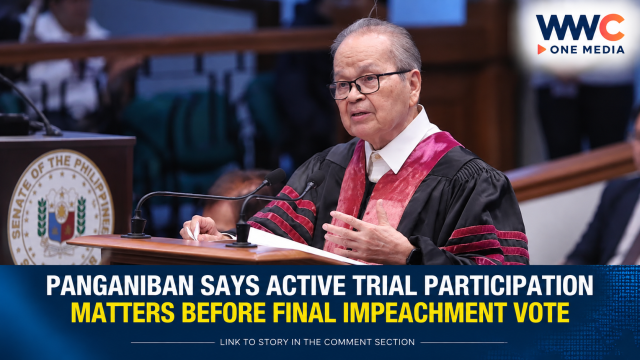
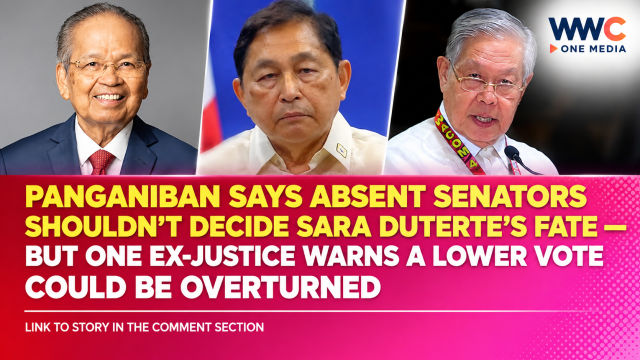
Retired Chief Justice Artemio Panganiban similarly argued against treating the number 16 as automatically fixed regardless of circumstances.
Panganiban said two-thirds of 24 is unquestionably 16 “in the abstract,” but contended that interpreting an impeachment provision cannot always be reduced to arithmetic without considering whether senator-judges actually participated in and evaluated the trial.
He emphasized the senator-judges’ role as elected representatives exercising the Senate’s unique constitutional impeachment authority rather than serving simply as ordinary judges.
Like Davide, Panganiban viewed earlier cases such as Avelino as part of a larger body of jurisprudence that may help the Senate interpret the unusual circumstances before it rather than as a single decision that dictates the answer.
That leaves Azcuna as the clearest advocate among the four amici for retaining the fixed 16-vote requirement.
The other three, while using different reasoning, expressed views under which the conviction threshold might depend on which senators legally form part of the body capable of judging the case.
Why this debate is happening now
Under ordinary circumstances, a 24-member Senate would make the calculation straightforward.
But four senator-judges have been unable to attend the impeachment proceedings for extended periods.
Senators Jinggoy Estrada and Rodante Marcoleta are detained while facing separate plunder cases. Senator Ronald “Bato” dela Rosa has remained out of public view amid an International Criminal Court arrest warrant, while Senator Loren Legarda has been abroad on extended medical leave.
Those circumstances prompted Senator Erwin Tulfo to formally ask the impeachment court to reconsider how “all members of the Senate” should be interpreted if some senators cannot take part in the eventual judgment.
Tulfo cited Avelino because that decision recognized the practical significance of senators who were beyond the chamber’s coercive jurisdiction.
Senator Pia Cayetano disputed the analogy, arguing that a quorum precedent should not automatically be presented as the rule for impeachment.
Escudero then agreed to have the constitutional issue formally examined.
Why a lower denominator can change the outcome
The constitutional text requires two-thirds concurrence, not merely a simple majority.
If the denominator is 24, conviction requires 16 votes.
But if the impeachment court eventually concludes that fewer senators legally form the relevant voting body, the mathematical requirement could also change.
That is why the issue is consequential even though no vote on Duterte’s guilt or innocence is being taken yet.
It defines the rules under which that future judgment would occur.
The disagreement also produces an unusual imbalance between conviction and acquittal.
Under a fixed 24-member denominator, fewer than 16 votes for conviction would mean the constitutional threshold had not been reached.
Those advocating a revised calculation argue that permanently counting senators who cannot participate could effectively operate as votes against conviction without those senators ever hearing all the evidence or casting ballots themselves. That is an argument made by supporters of reconsidering the denominator, not an established constitutional rule.
Those supporting the 16-vote requirement respond that the Constitution deliberately uses the words “all the Members of the Senate”, and that practical difficulties cannot simply erase that explicit protection. Azcuna and Duterte’s political allies have advanced versions of that textual argument.
What exactly does the Constitution say?
Article XI, Section 3(6) provides that the Senate has the sole power to try and decide impeachment cases, and that no person may be convicted without the concurrence of two-thirds of all the members of the Senate.
The dispute is therefore not over whether two-thirds is required.
All sides accept that.
The disagreement concerns the denominator:
Two-thirds of whom?
Is “all the members” constitutionally fixed at all 24 Senate seats?
Or does it refer to the senators legally capable of exercising the impeachment power when judgment is rendered?
That specific situation is not expressly spelled out in the constitutional text.
It is the gap the Senate impeachment court is now being asked to interpret.
Puno raises another major issue: Who gets the final say?
The debate also opened a second constitutional front.
Puno argued Wednesday that the Senate impeachment court is not subordinate to the Supreme Court in the same manner as ordinary courts.
He pointed to the Constitution’s grant to the Senate of the “sole power to try and decide all cases of impeachment.”
According to Puno, that grant gives the impeachment court authority to settle questions about its proceedings and judgment, including the disputed threshold.
Other lawmakers and legal commentators have argued that the Supreme Court could eventually be asked to interpret the constitutional phrase “all the Members of the Senate,” particularly if an actual controversy arises. House prosecutors themselves have previously expressed differing views on when—or whether—that issue would become ripe for judicial review.
That institutional question remains unresolved.
The Supreme Court has reviewed constitutional limits involving congressional action in other contexts, while impeachment itself is expressly assigned to Congress under Article XI. Past jurisprudence has therefore involved continuing debates over where the boundary lies between judicial review and powers committed to the political branches.
Avelino itself is more complicated than the slogan
The modern political debate can make Avelino v. Cuenco sound like it established a simple rule:
“Do not count senators who cannot attend.”
The actual case was more complicated.
It arose out of a dispute over the Senate presidency and initially involved questions over whether the Supreme Court should intervene at all in what appeared to be an internal Senate controversy.
The Court eventually recognized the existence of a quorum and treated the senator outside the country differently when calculating the number of senators capable of acting.
Later Supreme Court cases have discussed Avelino primarily in connection with legislative quorum and the judiciary’s power to review actions of Congress.
That history explains why the amici repeatedly warned against treating it as an automatic answer to Duterte’s impeachment vote.
A precedent can offer a principle without controlling a materially different constitutional provision.
Even the former justices do not have one answer
That may be the biggest takeaway from Wednesday’s hearing.
The four amici were invited because of their legal experience, not because they were expected to deliver a single unanimous formula.
And they did not.
Azcuna: the wording “all the members” supports retaining the 16-vote threshold.
Davide: the denominator should reflect senators qualified and capable of performing their duties; 16 therefore need not always be required.
Panganiban: 16 is the mathematical result for 24 seats, but the Constitution should not necessarily be applied as abstract arithmetic divorced from actual participation.
Puno: the provision can be interpreted contextually, and the Senate impeachment court has broad constitutional authority to decide questions arising from its own trial.
Their disagreement is itself evidence of how legally unusual the Senate’s current situation has become.
September 23 is now the critical date
The amici hearing does not itself change the threshold.
Escudero’s existing ruling requiring 16 votes remains in place unless the impeachment court modifies it.
The Senate impeachment court has scheduled oral arguments between the prosecution and defense for September 23, after which senator-judges are expected to address the challenge to the existing 16-vote rule.
The House prosecution has said it will focus on presenting its evidence regardless of what threshold the Senate ultimately adopts.
Duterte, meanwhile, has publicly said the constitutional threshold is already stated in the Constitution and questioned why it needs to be changed or revisited.
Those are the opposing positions that now move toward a decision.
The 1949 case did not settle the 2026 problem
That is ultimately where Wednesday’s hearing leaves the controversy.
Avelino v. Cuenco can help explain how Philippine constitutional law has historically dealt with legislators who are beyond a chamber’s effective reach.
But three former Supreme Court justices told the Senate that the case concerned a quorum in an ordinary legislative session, not the constitutionally distinct voting requirement for an impeachment conviction.
And removing Avelino as an automatic answer does not make the current question disappear.
It makes the question harder.
The Senate still has 24 constitutionally allotted seats.
Several senator-judges are not currently participating.
The Constitution still requires two-thirds of “all the Members of the Senate.”
And some of the country’s most experienced former jurists disagree over exactly what those words require under circumstances the Constitution does not explicitly describe.
So the pivotal development on September 16 was not that the Senate discovered a precedent capable of settling Duterte’s impeachment arithmetic.
It was almost the opposite.
A 77-year-old Supreme Court ruling that appeared capable of answering the 16-vote question has now been sharply limited by the very former justices invited to clarify it—and the Senate must still decide what “two-thirds of all” actually means before the final judgment arrives.


Leave a Reply