
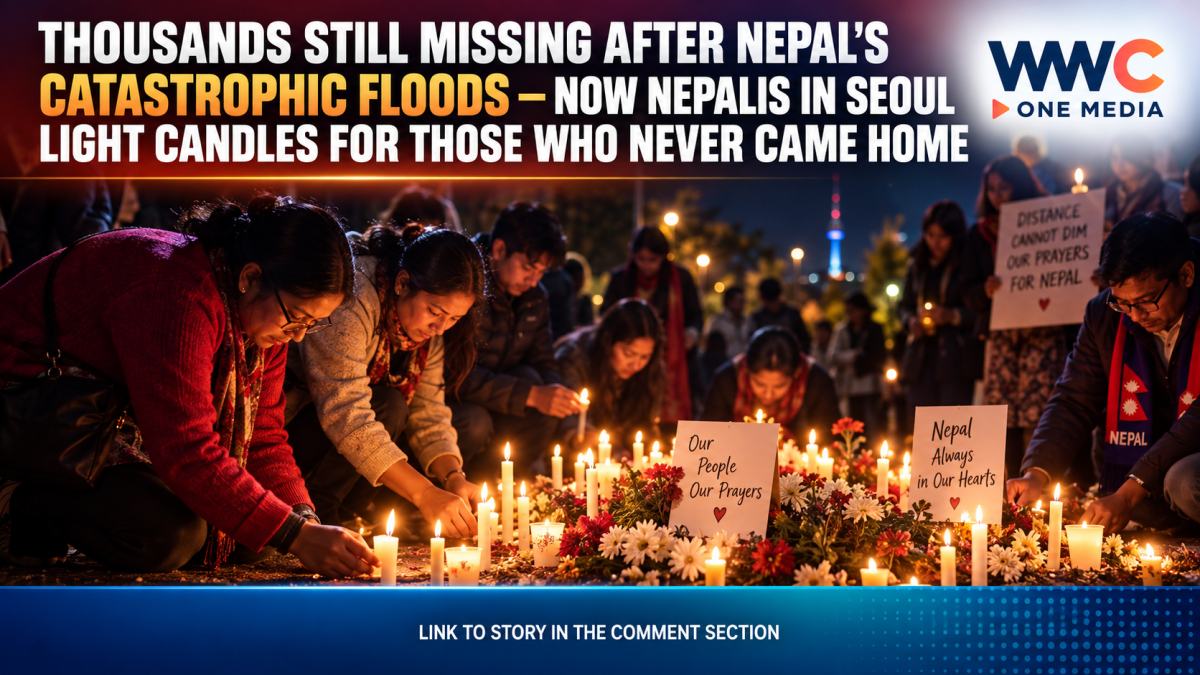
A sea of candles lit up Seoul as members of South Korea’s Nepali community gathered to mourn victims of the catastrophic floods that devastated northern Nepal.
The September 5 memorial in Seoul brought together Nepali residents who wanted to honor those killed and remember families still waiting for news of missing loved ones. The gathering came as rescue operations continued in Nepal, with the disaster’s death toll and number of missing people continuing to rise.
The Korea Herald reported that Nepalis living in South Korea gathered for a candlelight ceremony in Seoul on Saturday, turning their grief into a public tribute to victims back home.
A community thousands of kilometers from home mourns together
For many Nepalis living and working in South Korea, the disaster has been painfully personal.
The Korean media outlet Chosun reported that roughly 100,000 Nepalis live in South Korea, with sizeable communities in Gyeonggi, Chungcheong and Gyeongsang provinces. Nepali residents have organized fundraising and relief efforts alongside memorial events.
The community’s response has extended beyond memorial services. Nepali groups in South Korea have raised money for emergency supplies and recovery, while Korean universities, religious organizations and aid groups have also launched fundraising efforts.
Nepal is still searching for thousands
The Seoul memorial comes as the situation in Nepal remains extremely serious.
The floods and landslides struck on August 26, with particularly severe destruction reported in areas near the Nepal-China border. Rescue teams have been searching for survivors and people still missing, including workers at hydropower projects.
Reuters reported that Nepal faces the need to rebuild approximately 20,000 homes, while rescue teams continue searching for people trapped in tunnels and other damaged areas.
By September 5, international reports were putting the death toll at more than 1,300, while thousands remained unaccounted for. Exact totals have varied as authorities continue identifying victims and updating missing-person figures.
That distinction is important: the number of missing remains fluid, and figures should be treated as provisional while search-and-rescue operations continue.
South Korean rescue teams are also in Nepal
The tragedy has also directly affected South Korea.
South Korean authorities have been involved in efforts to locate missing Korean nationals and assist Nepal’s rescue operation. Yonhap reported that Foreign Minister Cho Hyun traveled to Nepal as Seoul continued discussions over the flood response.
South Korea has also sent specialized disaster-response personnel to assist with difficult search operations.
In one of the latest breakthroughs, rescuers in Nepal successfully pulled survivors from flood-damaged areas, including a Chinese worker trapped inside a hydropower-project tunnel. South Korean rescue specialists were involved in the wider operation alongside Nepalese, Chinese and Indian teams.
Hope remains despite the scale of the destruction
The latest rescues have provided a rare moment of hope amid an otherwise devastating disaster.
AP reported that rescuers pulled two people alive from the wreckage on September 5—one Chinese worker found inside a hydropower tunnel and a 64-year-old Nepali woman rescued from a damaged house.
Rescue teams are continuing to focus on hydropower facilities where workers remain unaccounted for. The Guardian reported that around 900 workers across 12 hydropower projects were still missing, with hundreds believed to be trapped in tunnels.
But damaged bridges, unstable rivers and destroyed infrastructure are making the search increasingly difficult.
Seoul’s candles carry a message beyond borders
The memorial in Seoul therefore represents more than a ceremony.
For Nepalis living abroad, the candles symbolize families waiting for answers, communities trying to support survivors and a country facing an enormous rebuilding challenge.
As rescue teams continue working in the disaster zone, the Nepali community in South Korea is showing that physical distance does not separate them from the tragedy unfolding at home.
The rescue operation continues—and for thousands of families, the wait for news is far from over.




Leave a Reply