
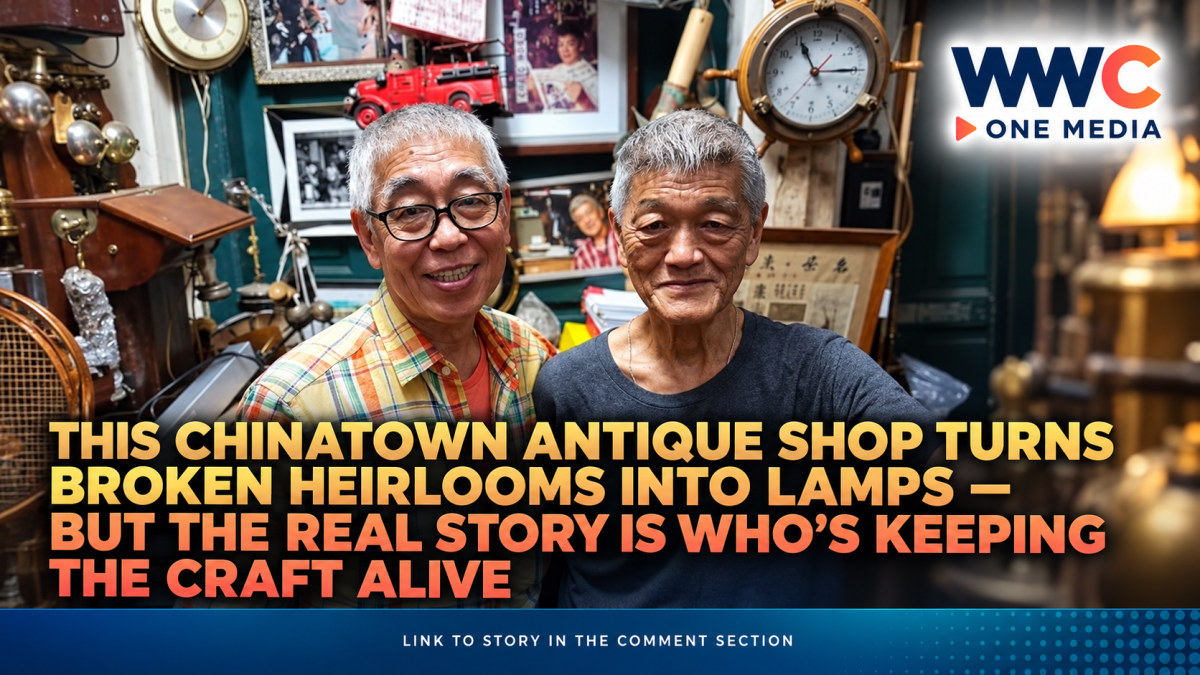
In the middle of Singapore’s fast-changing Chinatown, one shop is betting that an old object does not have to remain trapped in the past.
At East Inspirations, a decades-old antiques and lifestyle business along South Bridge Road, 72-year-old founder Cheong Poh Kwai, better known as PK, and his 37-year-old son Jacob Cheong are keeping old objects relevant by transforming some of them into functional pieces for modern homes.
That can mean turning damaged porcelain into a table lamp. Or giving an old iron, an abacus — even biscuit moulds once used by PK’s mother — an entirely new purpose.
The result is more than an unusual home accessory. For the Cheongs, it is a way of keeping the cultural stories attached to those objects alive.
A Chinatown Business That Has Survived More Than Three Decades
PK opened East Inspirations in 1993, after years spent collecting antiques and working in the lighting trade. The business initially operated from the former Handicraft Centre at Chinatown Point before moving to its present South Bridge Road shophouse in 1997, according to CNA Lifestyle.
Today, the shop at 256 South Bridge Road is packed with a mixture of Chinese porcelain, vintage household objects, furniture, teaware, decorative pieces and contemporary products inspired by Chinese and Southeast Asian culture. The company’s own website confirms the current South Bridge Road location and continues to offer antiques, vintage pieces, furniture and teaware.
Its setting is fitting.
South Bridge Road has been connected with trade for almost as long as modern Singapore itself. Singapore’s National Heritage Board notes that some of the country’s earliest shophouses were built in the area, with merchants, retailers, godowns and goldsmiths clustering around the major thoroughfare because of the traffic it attracted.
East Inspirations is therefore selling history from a neighbourhood already layered with it.
The Lamp Business Came Before the Antiques
PK’s fascination with turning old objects into lamps did not begin as an Instagram-era upcycling experiment.
After National Service, he worked during the 1970s as a machinist at a factory producing table lamps. He initially manufactured steel components before learning more about how lamp bases and shades were constructed.
Then, in 1981, PK and his wife joined several friends to establish their own table-lamp business. PK concentrated on designing the bases and shades, while his wife made lampshades by hand.
A business trip to China that same year changed his direction.
PK told CNA that seeing warehouses filled with antiques sparked an obsession with old Chinese objects and their craftsmanship. He began collecting, studying pieces and learning from dealers.
Some purchases were expensive enough that he reportedly asked to pay in instalments. His collection eventually grew so extensive that, according to CNA, his home as well as his shop became filled with antiques. PK says some of the oldest pieces in his personal collection date to China’s Tang and Song dynasties.
Then He Saw Value in What Other People Considered Damaged
The pivotal moment came in 1985, when a friend brought damaged porcelain from Guangzhou.
Where others might have seen broken merchandise, PK saw lamp bases.
Drawing on his machining and lighting experience, he devised ways to convert fragile porcelain pieces into functional lamps. That philosophy — salvaging an object rather than throwing it away — eventually became one of East Inspirations’ signatures.
The approach continues today.
The shop’s website has featured lamps made from vintage Chinese ceramics, including a Cizhou-style piece converted into a table lamp by PK and offered at S$180 before selling out.
But some of his most interesting creations are far less conventional.
CNA photographed lamps built around a vintage iron, abacuses and old biscuit moulds. One design used two moulds that belonged to PK’s mother: one displaying a fish associated with abundance and another bearing a lotus motif.
Another lamp uses a bamboo-shaped ventilation block that PK reportedly recovered after coming across more than 200 such pieces at a property being demolished in Guangzhou. Rather than allowing them to disappear with the building, he bought the lot and found another function for them.
And his definition of what can become a lamp is unusually broad.
As PK told CNA, technically even a piece of stone could be transformed into one.
The Son Who Wasn’t Supposed to Take Over
The second half of East Inspirations’ story almost did not happen.
Jacob grew up surrounded by his father’s antiques, but joining the family business was not his original career plan. He studied business finance and administration before taking a banking job.
Around 2016, after deciding the corporate path was not working for him, he joined East Inspirations.
That decision may prove crucial to the shop’s longevity.
While PK brings decades of collecting knowledge and a craftsman’s eye, Jacob has taken greater responsibility for social media, marketing and the company’s online presence. He has also developed structured tea-appreciation sessions inside the shop, giving visitors another way to interact with the traditions surrounding many of the objects being sold.
Other lifestyle publications have highlighted that evolution. 8Days previously described East Inspirations as a long-running treasure trove of antique, vintage and modern Oriental pieces and specifically pointed visitors toward its tea-appreciation experience. Honeycombers, meanwhile, included the shop in its 2024 guide to Singapore’s vintage and second-hand furniture stores.
It is a subtle but important shift: East Inspirations is no longer simply asking younger consumers to buy an antique.
It is giving them a story, an experience and, increasingly, a functional reason to bring an old object home.
Cheap Online Goods Are Now the Bigger Challenge
Surviving for decades does not mean the business is insulated from changing consumer habits.
PK acknowledged that demand for traditional vase lamps has declined. One reason, he said, is changing tastes; another is competition from inexpensive goods available online from China.
That makes the shop’s reinvention more significant.
East Inspirations is competing in a retail world where mass-produced décor can arrive at a customer’s doorstep after a few taps on a phone. What it cannot easily beat on price, it can attempt to beat through provenance, craftsmanship, personalisation and storytelling.
Its current online catalogue reflects that combination. Alongside contemporary ceramics and tea accessories are vintage furniture, antique porcelain, reclaimed materials and upcycled objects, with prices ranging from relatively accessible decorative items to antique furniture listed in the thousands of Singapore dollars.
The Real Product May Be the Story
That may ultimately explain why East Inspirations has lasted.
The Cheongs are not simply preserving objects behind glass. They are trying to make people use them again.
A cracked or unwanted vase can illuminate a room. A ventilation block removed from an old building can become part of someone’s home. Biscuit moulds once handled by a mother can carry a family memory into another generation.
And now the same principle applies to the business itself.
PK gave forgotten objects another life.
Jacob may be doing the same for the shop his father built.
WWC ONE MEDIA M.J.E




Leave a Reply