
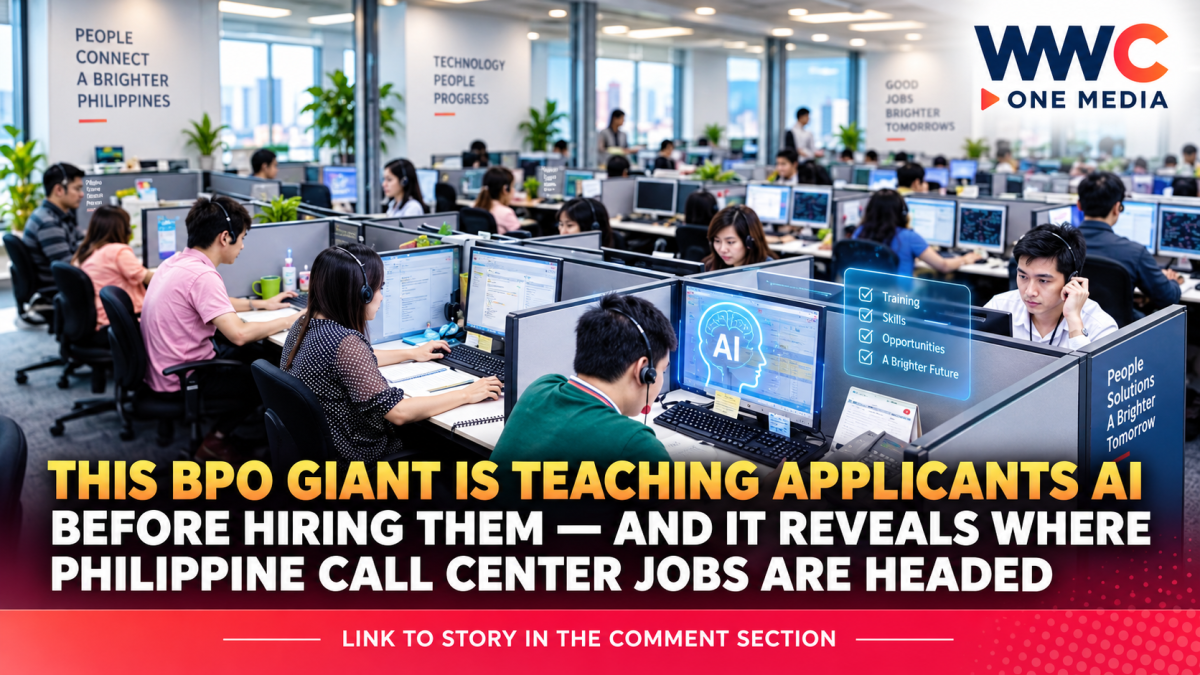
MANILA, Philippines — One of the country’s biggest business-process outsourcing employers is putting artificial intelligence into its pre-employment training, a move that highlights how quickly the qualifications for Philippine BPO jobs are changing.
TP in the Philippines, formerly known as Teleperformance, has expanded its Skills Training to Employment Program (TP STEP) to include AI literacy and readiness lessons for prospective workers. The initiative is aimed at “near-hires” preparing to enter the information technology-business process management sector rather than only at employees already inside the company.
The development goes beyond teaching applicants how to use a chatbot. The updated program covers fundamental and practical AI knowledge, digital responsibility and emerging workplace technologies, reflecting an industry where customer-service agents increasingly work alongside AI-powered systems.
And the timing is significant: Philippine outsourcing companies are under growing pressure to produce workers who can work with AI rather than simply perform tasks AI can increasingly automate.
AI IS NOW PART OF THE 15-DAY TRAINING
TP STEP participants undergo a 15-day training journey combining employability and customer-experience skills with the newly added AI literacy and readiness modules.
The expanded program is being implemented with CyberGuardiansPH, a nonprofit organization focused on cybersecurity and digital responsibility. It incorporates material from AI Ready ASEAN, an ASEAN Foundation regional initiative supported by Google.org.
Participants in the program are introduced to how artificial intelligence works, responsible use of digital technology and AI’s growing role in everyday business operations.
The 14th batch of TP STEP participants attended AI-focused sessions at the Pasig City Library, according to reports on the program.
TP Vice President for Human Resources Rachel Cacabelos said workforce-development programs have to change as AI reshapes industries, with applicants increasingly needing exposure to technologies already being incorporated into customer experience and business-services operations.
Importantly, the program should not be interpreted as a guarantee of employment. It is designed to improve the job readiness of participants and create pathways into the IT-BPM sector.
THIS PROGRAM ACTUALLY STARTED BEFORE THE AI BOOM REACHED TODAY’S LEVELS
TP STEP itself is not new.
The company launched the initiative in 2023 as part of its impact-sourcing strategy, initially focusing on people who faced barriers to employment, including members of underserved communities, persons with disabilities, long-term unemployed workers and former overseas Filipino workers.
By 2024, TP had partnered with the Pasig City government on the program.
TP reported that its Pasig initiative achieved an 88% hiring rate among participants during that period, and STEP later received a Gold Anvil Award in the corporate social responsibility/public relations category.
The company has worked with more than 25 community organizations, local governments, NGOs and TESDA training centers on the broader program.
The addition of AI therefore represents a significant evolution: a program originally intended to bridge traditional employability gaps is now also trying to address the technological skills gap.
WHY AI SKILLS ARE BECOMING CRITICAL FOR PHILIPPINE BPO WORKERS
The shift is happening because the economics of outsourcing are changing.
An International Monetary Fund working paper published in 2025 estimated that roughly one-third of Philippine workers are highly exposed to AI, meaning a substantial share of their tasks could potentially be performed or transformed by artificial-intelligence systems.
About 61% of those highly exposed jobs were also considered highly complementary to AI — meaning technology could enhance workers’ productivity rather than necessarily replace them.
But the study estimated that jobs representing around 14% of the Philippine workforce were highly exposed while having low complementarity, putting them at greater potential risk of displacement.
BPO stood out.
The IMF study identified the outsourcing industry as the Philippine sector with the highest proportion of occupations classified as highly exposed to AI with low complementarity. Contact-center information clerks made up a particularly large share of that exposure.
That does not mean Philippine call centers are about to disappear.
It does mean routine work — answering common inquiries, processing standardized information, summarizing conversations and handling repetitive back-office functions — is becoming easier to automate.
Human workers may increasingly be expected to handle the parts AI struggles with: complex problem-solving, judgment, empathy, escalation management, sales, relationship-building and oversight of automated systems.
That is precisely why AI literacy is becoming less of a specialist technology skill and more of a basic workplace competency.
THE INDUSTRY’S GROWTH TARGETS HAVE ALREADY CHANGED
The changing technology landscape is also appearing in industry forecasts.
In July, the IT and Business Process Association of the Philippines revised its 2028 expectations following a midpoint review of the industry’s roadmap.
The organization said the Philippine IT-BPM industry generated about $40 billion in revenue and employed around 1.9 million people in 2025.
Its best-case 2028 projection now calls for approximately $50.5 billion in revenue and 2.14 million workers, below the original forecasts of $59 billion and 2.5 million employees set several years earlier.
IBPAP President and CEO Jack Madrid described the industry’s evolution as a move from measuring success primarily through headcount toward creating more value per employee.
“The next chapter will increasingly be defined by the value every Digital Filipino Worker creates,” Madrid said.
AI, changing buyer behavior and intensifying international competition were among the challenges cited by the industry group.
That makes TP’s decision to train potential recruits in AI more than a corporate training update.
It is part of a much broader race to reposition the Philippine outsourcing workforce for jobs that may demand higher productivity, greater digital fluency and more complex skills from fewer workers than the industry’s traditional model required.
TP ITSELF IS ALREADY USING MORE AI
TP officially shortened its Teleperformance brand to TP in 2025, as the global company increasingly positioned itself as a digital business-services provider rather than a conventional call-center operator.
Its Philippine operation reported around 60,000 employees across 26 sites nationwide as of May 2026, making it one of the country’s major IT-BPM employers.
The company says its services increasingly incorporate AI-enabled systems across customer care, back-office processes and digital-transformation work. Its newly opened Taguig campus, for example, was described as using AI-driven systems and digitally enabled workstations.
So teaching job candidates about AI before hiring them brings the recruitment pipeline closer to what employees may actually encounter on the operations floor.
THE GOVERNMENT IS MOVING IN THE SAME DIRECTION
TP is not alone.
In May, TESDA and STI College launched a nationwide AI Readiness Training Program covering areas such as data collection and annotation, AI prompting for automation and data analytics.
TESDA said the initiative was expected to train 3,273 learners nationwide between April and December 2026, with displaced workers, unemployed Filipinos, returning OFWs and out-of-school youth among the priority groups.
That parallel push by government and private employers points to the same conclusion:
The debate in the Philippine labor market is rapidly moving beyond “Will AI take jobs?”
The more immediate question for millions of workers may be:
“Will I know how to work in a job where AI is already part of the team?”
For aspiring BPO employees, TP’s latest training expansion suggests that the answer could increasingly matter before the first interview is even finished.



Leave a Reply