
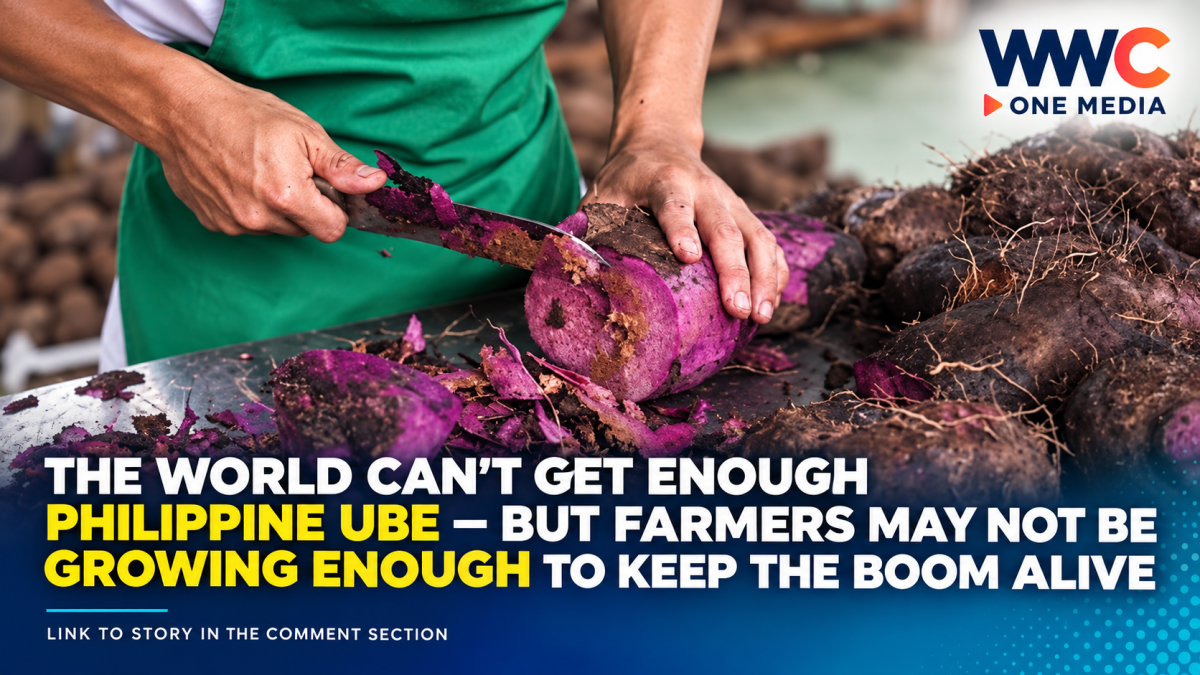
MANILA, Philippines — Ube may have become one of the Philippines’ most recognizable food exports, appearing in cafés, bakeries, ice cream, drinks and desserts around the world. But just as the purple yam moves closer to becoming a mainstream global flavor, the Philippine industry is confronting a problem that could stop the boom in its tracks: there may not be enough ube to meet the demand.
Research firm BMI, a unit of Fitch Solutions, warned that persistent supply shortages, limited farmland and cautious planting decisions by Filipino farmers could prevent the country from fully capitalizing on the international appetite for purple yam.
The concern is becoming serious enough that the Department of Agriculture has indefinitely suspended exports of fresh ube and propagative planting materials, including shipments intended for consumption, planting or research.
Agriculture Secretary Francisco Tiu Laurel Jr. said the Philippines itself faces a severe shortage of planting materials and wants to keep those resources at home while domestic production expands. The Bureau of Plant Industry had already instructed quarantine offices to stop issuing phytosanitary certificates for affected exports.
That makes the ube story increasingly unusual: global demand is rising so quickly that the Philippines is restricting exports of the raw crop in order to produce more of it later.
Ube demand is growing faster than the farms
The problem did not emerge overnight.
In June, the DA and the Department of Trade and Industry gathered 249 farmers, processors, exporters, traders, cooperatives and other stakeholders to discuss how to turn the fragmented ube sector into a coordinated export industry.
Government officials acknowledged that demand was accelerating while production systems, quality standards and supply-chain organization were struggling to keep pace.
Ube is still often cultivated on relatively small or seasonal plots, and farmers must decide whether converting limited land to purple yam will generate better and more dependable income than other crops.
BMI said that “wait-and-see” behavior among growers is one reason supply has not expanded as fast as demand.
The dilemma is straightforward: farmers may be reluctant to plant substantially more ube unless prices and buyers justify the investment. Yet processors and exporters need dramatically more raw material before they can confidently expand sales abroad.
Even the export ban carries a risk
Keeping fresh ube inside the Philippines should preserve more planting material and could help farmers expand future harvests.
But BMI highlighted an unintended possibility.
Restricting exports may reduce demand for raw ube in the short term. If that pushes farmgate prices lower, farmers could actually have less financial motivation to shift more land into ube cultivation.
BMI said the government’s suspension preserves planting stock, but noted that the measure by itself does not provide additional financial incentives for farmers to switch scarce farmland to purple yam.
That exposes the central challenge facing the industry: the Philippines does not simply need to keep more ube at home. It has to make growing more ube economically attractive.
Production is rising — just not fast enough
There are signs of progress.
Philippine ube production reached 5,658 metric tons in the first half of 2026, up around 17% from 4,838 metric tons during the same period a year earlier, according to Philippine Statistics Authority figures cited by The Philippine Star. It was the strongest first-half output in two years.
BusinessMirror reported that wider government promotion, increased local-government participation and work on resilient planting materials helped boost production. New or previously undercounted growing areas are also being identified in provinces across Luzon, Bicol, Mindanao and other regions.
But rising production has not eliminated the bottleneck.
Food processors have already complained that the supply of quality raw material is insufficient. Philfoodex president Ruben See previously said the industry must increase ube volume if Philippine exporters are to capitalize on booming foreign demand.
The supply squeeze has even produced an unusual situation for a country trying to market ube as a distinctly Filipino product.
The Philippines imported 54,064.97 kilograms of frozen ube in 2025, according to PSA data cited by The Philippine Star, while another 10,482 kilograms entered during the first four months of 2026. Fresh ube imports, however, remain prohibited under Philippine plant-quarantine rules.
Government is putting ₱300 million behind the industry
The Marcos administration is now betting that greater public investment can help solve the production problem.
President Ferdinand Marcos Jr. approved ₱300 million in additional funding for the ube industry under the proposed 2027 national budget, with the DA planning investments in nurseries and other programs designed to expand the supply of planting materials.
The department is also pursuing several technical solutions, including:
- tissue-culture propagation
- community-based ube nurseries
- mini-set propagation techniques
- development of higher-yielding and more resilient varieties
- additional production areas in provinces such as Quezon, Laguna, Pangasinan and Aurora
- potential processing hubs in Mindanao.
More than 60,000 planting materials have already been distributed to around 900 farmers belonging to more than 60 farmer organizations in Leyte and Bohol under a Bureau of Plant Industry and PhilRootcrops initiative.
The government has also helped organize the United Ube PH Association Inc., bringing farmers, cooperatives, processors, traders, exporters, academics and researchers into a national industry organization intended to improve coordination.
There is another fight brewing: protecting “Philippine ube”
Increasing output is only part of the strategy.
The DA and researchers from the University of the Philippines Los Baños are genetically mapping Philippine ube varieties for registration — an effort meant to protect native varieties, improve traceability and guard against what officials describe as potential biopiracy.
Government officials are also working on common quality and color standards so exporters can offer buyers a more consistent product.
That matters because the Philippines is not guaranteed permanent ownership of the global ube trend simply because ube has deep roots in Filipino cuisine.
Other producers in Southeast Asia can expand cultivation, processors can develop cheaper alternatives and consumers can move to the next fashionable ingredient.
Agriculture Secretary Tiu Laurel has explicitly said the bigger competition is not between Filipino ube farmers themselves, but between the Philippine industry and producers elsewhere in ASEAN.
From Filipino dessert to global food category
Despite those risks, BMI believes the forces behind ube’s international rise remain strong.
Consumers continue to seek unusual flavors, premium ingredients and foods associated with cultural authenticity. Ube benefits from all three — while its unmistakable purple color gives it an advantage in the highly visual world of Instagram, TikTok, café menus and specialty desserts.
Philippine ube products were already reaching markets including the United States, United Kingdom, Italy, the Middle East and Canada, with government and industry officials eyeing additional opportunities in Europe, South Korea and other Asian markets. Philippine exports of ube and ube products were valued at about $3.06 million in 2025, according to Department of Trade and Industry data previously reported by The Philippine Star.
The opportunity therefore looks real.
But so does the constraint.
The Philippines has successfully helped turn ube from a familiar Filipino ingredient into an internationally recognizable flavor. The next phase is more difficult: building enough nurseries, farms, planting stock, processing capacity, quality standards and farmer incentives to transform that popularity into a durable agricultural export industry.
Because in the global ube race, creating demand may have been the easy part.
Now the Philippines has to grow enough purple yam to satisfy it.




Leave a Reply