
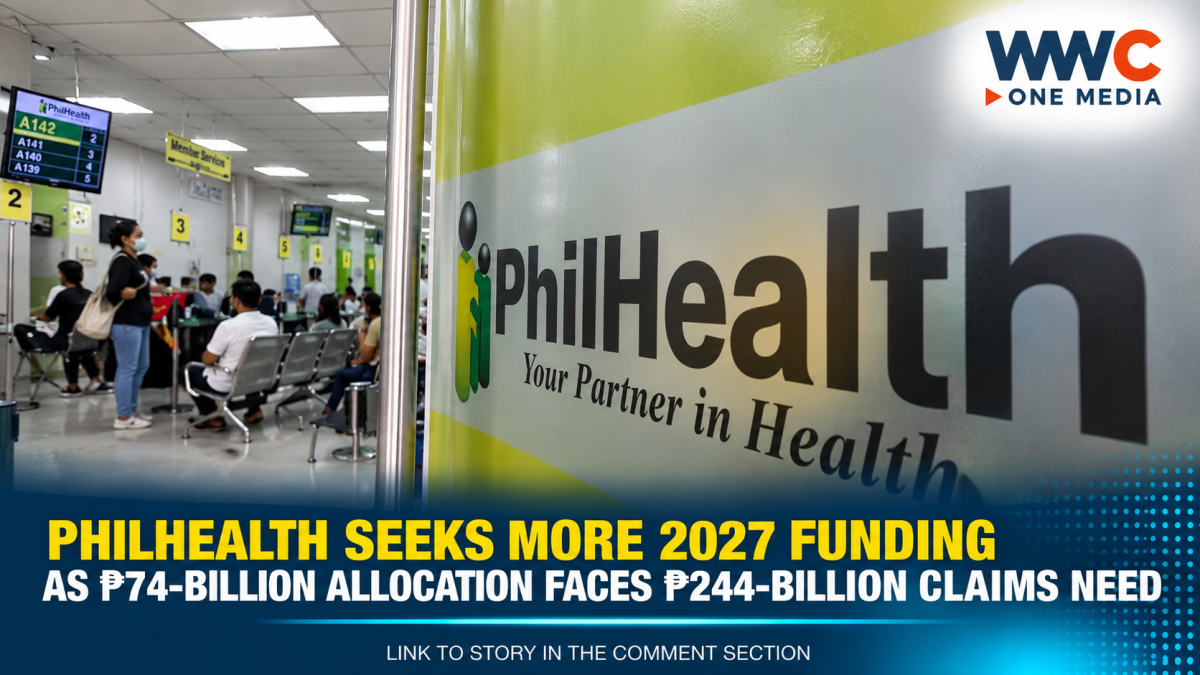
MANILA — The proposed 2027 national budget for PhilHealth is facing a major funding gap, with the Philippine Health Insurance Corp. seeking an additional ₱170 billion on top of the ₱74 billion currently included in the National Expenditure Program (NEP).
PhilHealth President and CEO Beverly Lorraine Ho told lawmakers that the agency expects payments for claims of indirect contributors to reach roughly ₱244 billion, prompting the request for additional government funding.
That means the headline figure of ₱74 billion represents the current allocation in the proposed budget, rather than the total amount PhilHealth says it needs to cover projected claims.
Why PhilHealth wants another ₱170 billion
During a Senate Finance Committee briefing, Ho said PhilHealth’s projected payments for indirect contributors next year could reach about ₱244 billion.
With only ₱74 billion currently provided in the NEP, PhilHealth is asking for another ₱170 billion.
The additional funding would help cover projected insurance claims and support efforts to expand benefits and increase PhilHealth’s contribution to national health spending.
PhilHealth said it currently accounts for around 19% of total health expenditure and aims to increase its share to as much as 30%.
The agency also said it hopes to reduce the proportion of health expenses paid directly by patients—from about 41% at the end of 2025 toward a target of 37% by 2028.
₱19 billion proposed for LGU hospitals and other programs
Another figure attracting attention is the proposed ₱19 billion allocation associated with PhilHealth programs.
However, PhilHealth clarified that this amount is not exclusively for zero-balance billing or benefit increases.
Ho said the funding would primarily cover 368 local government unit hospitals, while also supporting programs involving areas such as mental health and severe malnutrition.
PhilHealth currently covers roughly 80% to 85% of hospital bills in LGU hospitals, according to the corporation.
The additional funding is intended to help make expanded coverage and payment arrangements more workable, although details still need to be finalized with participating hospitals.
Zero-balance billing remains a major focus
PhilHealth is also seeking to expand its no-balance-billing (NBB) program, particularly in government hospitals.
Under current policy, 90% of beds in public hospitals, excluding government-owned and controlled corporation hospitals, are supposed to be covered by NBB, while the requirement applies to 10% of beds in private hospitals.
PhilHealth estimates that this translates into a target of about 66,055 NBB beds nationwide—59,790 in government hospitals and 6,265 in private facilities.
The corporation acknowledged that implementation has been challenging because hospital reimbursements have not always matched the cost of providing services.
PhilHealth said it is working with hospitals on reimbursement rates and payment arrangements to improve implementation.
DOH also says more money is needed
The funding debate extends beyond PhilHealth.
The Department of Health has proposed a ₱358.8-billion budget for 2027, but Secretary Edwin Mercado told the House Appropriations Committee that the agency needs additional funding for PhilHealth, hospital operations and its Health Facilities Enhancement Program.
The DOH is seeking an additional ₱170 billion for PhilHealth, ₱15 billion for health-facility improvements and ₱12 billion for DOH hospital operations.
The proposed DOH budget is about 21% lower than its ₱448-billion appropriated budget for 2026, according to GMA News.
What patients could see if funding is increased
The funding debate could directly affect how much patients pay for medical treatment.
PhilHealth’s stated objectives include increasing its share of national health expenditure, expanding no-balance-billing coverage and strengthening benefit packages.
But the proposed figures remain part of the 2027 budget process. The final amount will depend on congressional deliberations and the eventual national budget approved for 2027.
For patients, the key issue is therefore not simply how large PhilHealth’s budget becomes, but how much of that funding ultimately translates into actual claims payments, expanded benefits and lower out-of-pocket medical costs.
With PhilHealth seeking ₱170 billion more than its current proposed allocation, the next stage of the 2027 budget deliberations could determine how much additional financial protection Filipino patients receive.
The ₱74-billion figure may be only the starting point—the bigger question now is whether lawmakers will provide the additional funding PhilHealth says it needs to cover its projected claims and expand patient benefits.




Leave a Reply