
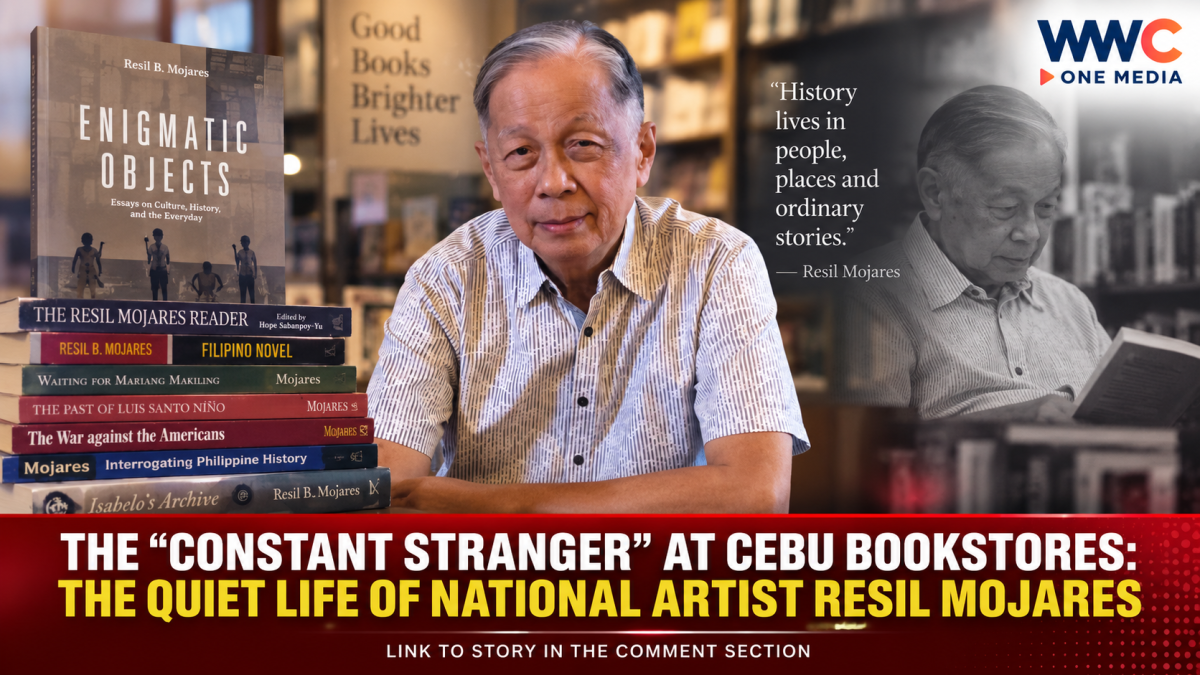
CEBU CITY — Long before his name became synonymous with Philippine cultural history and before he was formally recognized as a National Artist, Resil Mojares could often be encountered in an unexpectedly ordinary setting: quietly browsing bookshelves.
For some readers, he was the distinguished scholar whose books helped explain Cebu and the Philippines. For others, he was simply the familiar yet almost mysterious man they occasionally spotted at bookstores or seated quietly in a coffee shop, absorbed in his writing.
That image of Mojares as the understated intellectual now carries a deeper poignancy following his death at age 80 on September 5, 2026.
The Ateneo de Manila University Press described Mojares as one of its “most treasured authors,” remembering him not only for his scholarship but also for his generosity, warmth and seemingly endless curiosity.
A National Artist who never seemed distant from books
Mojares was conferred the title National Artist for Literature in 2018, becoming the first Cebuano to receive the country’s highest recognition for artists in the field.
But despite the distinction, accounts of his life frequently portrayed him as someone who remained remarkably approachable and unassuming.
A 2018 Philippine Daily Inquirer profile recalled how he could be seen writing quietly in coffee shops. One chance encounter involved a Cebuano family who recognized him while he was working at a coffee shop in Manila. The family reportedly had to confirm his identity before approaching him because of how inconspicuous he was.
That understated personality also helps explain the enduring image of Mojares as the “constant stranger” encountered in bookstores—someone surrounded by books but seemingly uninterested in celebrity.
He was, after all, a man whose life revolved around reading, research, writing and teaching.
From Zamboanga del Norte to Cebu
Born in Polanco, Zamboanga del Norte, on September 4, 1943, Mojares grew up as the son of public-school teachers.
His mother came from Ginatilan, Cebu, strengthening his lifelong connection to the province. He eventually studied at the University of San Carlos, where he earned his bachelor’s degree in English and master’s degree in literature before completing his doctorate in literature at the University of the Philippines Diliman.
His connection to Cebu would become central to his life’s work.
In 1975, Mojares founded the Cebuano Studies Center, an institution dedicated to preserving and studying Cebuano history, literature, language and culture. He served as its director until 1996.
The center became an important repository of historical and cultural materials and helped establish Cebu as a major site for scholarship on Philippine regional history.
He wrote Cebu into the national story
Mojares’ importance extended far beyond Cebu.
His scholarship explored Philippine history, literature, cultural identity and the formation of modern Filipino society. Among his widely recognized works are The War Against the Americans: Resistance and Collaboration in Cebu, 1899–1906, Brains of the Nation, Waiting for Mariang Makiling, Isabelo’s Archive and Enigmatic Objects.
His work demonstrated that understanding the Philippines required more than looking at Manila or the country’s most famous historical figures.
Regional histories, local communities and ordinary people were equally important pieces of the national story.
That approach became one of his most enduring contributions.
A writer shaped by history
Mojares did not begin his career solely as a historian.
He initially wrote fiction and published stories in Philippine literary publications, including the Philippine Free Press. His early literary career was eventually affected by the political realities of martial law.
According to the Inquirer, Mojares was detained during the Marcos dictatorship because of his work as a columnist and his anti-Marcos position.
The experience influenced his intellectual trajectory and deepened his interest in understanding why Philippine society had developed as it had.
In a statement quoted by the Inquirer, Mojares described his commitment to cultural and historical studies as something that developed organically—from growing up in a community-oriented family, becoming a teacher and writer, experiencing detention during martial law, and developing an increasingly urgent desire to understand society.
Even after becoming a National Artist, he kept working
Recognition did not appear to slow him down.
The University of the Philippines continued to honor Mojares’ contribution to Philippine culture in 2026. In February, UP’s third Tanghal Tertulia featured him alongside fellow National Artists Benedicto Cabrera and Agnes Locsin. The program celebrated their continuing influence on Philippine artistic and cultural life.
The recognition was significant because it came years after Mojares had already reached the highest institutional honors available to a Filipino writer.
Yet the image remained familiar: a scholar still reading, still writing and still engaging with ideas.
The stranger people kept seeing
Perhaps that is why the stories about encountering Mojares in bookstores resonate so strongly.
He was a National Artist, a respected historian, a professor emeritus and an internationally recognized scholar—but to many people, he could simply be the quiet man scanning the shelves.
A person might pass him without realizing that the man looking through books had spent decades documenting the history of Cebu and examining how Filipinos came to understand themselves.
The stranger at the bookstore was, in fact, one of the country’s most influential cultural historians.
And perhaps there was something fitting about that.
For a man who dedicated his life to books, archives, history and the search for meaning in the Filipino experience, being remembered beside a bookshelf seems almost inevitable.
A legacy that will remain on the shelves
Mojares leaves behind a body of work that will continue to introduce generations of readers to the complexity of Philippine history and culture.
The Cebuano Studies Center, which he founded more than five decades ago, remains part of that legacy.
His books likewise ensure that the stories he spent a lifetime researching will not disappear.
The man who once seemed like a “constant stranger” in bookstores is no longer there to be unexpectedly recognized among the shelves.
But his words are.
And for readers who encounter his books today, the stranger is no longer a stranger at all.
He is Resil Mojares—National Artist, scholar, teacher, historian and one of the most important voices in the preservation of Cebuano and Philippine cultural memory.
WWC ONE MEDIA J.M.S



Leave a Reply