
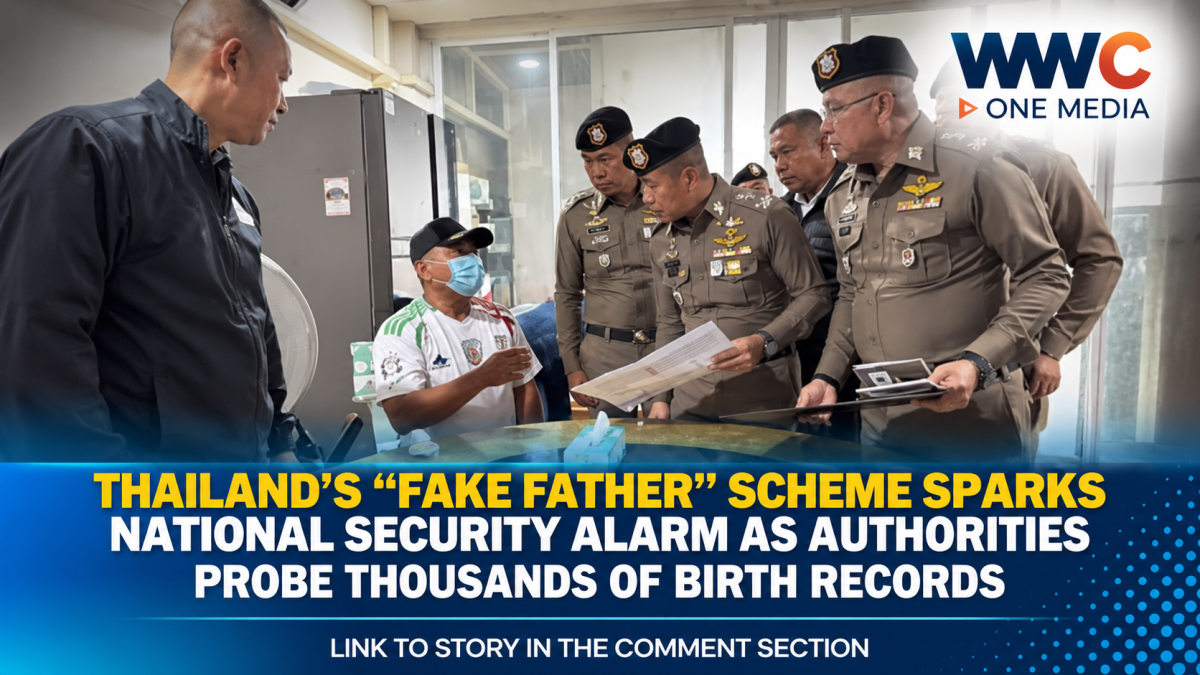
A widening investigation into alleged false paternity registrations is raising questions about Thailand’s civil-registration system, citizenship controls and the possible role of brokers, hospitals and officials.
Thailand’s investigation into an alleged “fake father” network has grown into a much larger national-security and civil-registration issue, with authorities examining thousands of birth records for possible irregularities.
The warning came from the House of Representatives’ Public Health Committee, which has urged agencies to intensify investigations into suspected false-parentage registrations involving foreign mothers and men recorded as Thai fathers. The committee says the issue could have implications beyond individual birth certificates if fraudulent registrations are used to obtain Thai nationality or facilitate other activities.
But there is an important distinction: the number of suspicious records is not the same as the number of confirmed fraudulent cases.
Thousands of records now under scrutiny
A review presented to the House committee found more than 10,000 records requiring further examination involving cases in which the father was recorded as Thai and the mother as foreign, according to The Nation‘s September 3 report.
Officials stressed that these are suspected or flagged cases—not 10,000 proven fraud cases. Each record must be investigated individually.
The distinction is particularly important because Thailand’s Department of Provincial Administration (DOPA) previously cautioned that the widely circulated 10,000 figure had not been officially verified as fraudulent cases.
In August, DOPA said approximately 1,000–1,500 high-risk records connected to eight Bangkok private hospitals were being examined, while the nationwide 10,000 figure remained unconfirmed.
How the alleged scheme works
The investigation centres on allegations that some Thai men were falsely recorded as fathers of children whose biological parents were foreign nationals.
In the most serious cases under investigation, authorities allege that Thai men were recruited or paid to acknowledge paternity despite having no biological relationship with the children.
Police have also investigated suspected intermediaries, foreign parents, hospital personnel and government officials who may have helped facilitate birth registrations.
The alleged motivation is particularly significant.
Authorities say obtaining Thai nationality for a child could potentially provide access to rights and opportunities that are unavailable to foreign nationals, including the ability to hold assets or participate in transactions subject to restrictions on foreigners.
Investigators have therefore been examining whether some cases could connect to property ownership, nominee arrangements or money laundering.
🇹🇭 “Operation Dragon Scale” exposed the first major network
The investigation intensified in July under a police operation known as Operation Dragon Scale.
Thai authorities announced dozens of arrest warrants targeting people allegedly connected to false-paternity arrangements, including Thai men accused of falsely claiming to be fathers, foreign mothers, alleged biological fathers and suspected public- and private-sector facilitators.
One investigation focused on Thon Buri, where police arrested a private-hospital medical-records employee and a district-office official.
Investigators alleged that Chinese clients were offered a childbirth package costing around ฿70,000, with Thai men allegedly arranged to appear as fathers during the registration process.
The Straits Times independently reported the case, including allegations that a hospital employee helped arrange deliveries and documentation for Chinese clients.
The allegations remain subject to investigation and court proceedings.
Hospitals are now under the microscope
The investigation has also moved into Thailand’s private healthcare sector.
Health authorities have examined birth and medical records at private hospitals after police identified potentially suspicious registrations involving foreign mothers and claimed Thai fathers.
In one earlier review, six private hospitals were examined after authorities flagged approximately 200 birth records for possible irregularities.
Authorities are looking not only at whether false information appeared on registration documents, but also at how that information entered the system.
That is crucial because birth registration involves hospitals, medical personnel and government registration offices.
If investigators find deliberate participation by healthcare workers or officials, those individuals could face criminal and professional consequences.
Bangkok orders a much wider review
Bangkok authorities have already responded by ordering all 50 district offices to strengthen checks on birth registrations and marriages involving foreign nationals.
The review covers birth records dating back to January 1, 2017, particularly cases involving foreign mothers and Thai men listed as fathers. Officials have also been instructed to look for unusual patterns—for example, Thai men appearing as fathers on multiple registrations involving different foreign mothers.
Authorities have also tightened scrutiny of marriages between Thai citizens and foreigners because investigators fear that sham marriages could potentially be used alongside other registration schemes.
Could DNA testing become more important?
DNA testing is emerging as one of the government’s potential tools for resolving disputed parentage.
DOPA has said DNA testing can be used when documentary evidence and other information indicate that scientific verification is necessary. It has not said that every parent-child registration should automatically require DNA testing.
The House Public Health Committee has now suggested establishing clearer criteria for when DNA verification should become mandatory in high-risk cases.
However, officials have also stressed that any such system must protect children and people who have no connection to wrongdoing.
Thailand wants birth registration to go digital
Another weakness highlighted by lawmakers is the continued use of handwritten birth-registration records at some private hospitals.
The committee argues that electronic systems can improve traceability and make suspicious alterations easier to identify.
Government hospitals already use electronic birth-registration systems, while lawmakers are pushing for wider adoption by private hospitals.
The aim is not simply to digitise paperwork.
It is to create a system in which hospitals, district offices and law-enforcement agencies can better identify unusual patterns before questionable documents become part of the official civil registry.
Why authorities call it a security issue
The investigation has become particularly sensitive because civil-registration records are the foundation for proving a person’s legal identity and nationality.
The anti-corruption working group Zero Corruption: JSCCIB and Friends Won’t Tolerate It has warned that alleged schemes involving false paternity, sham marriages, fabricated birth records and identity manipulation could potentially intersect with nominee businesses, illicit property ownership, money laundering and transnational crime.
That does not mean everyone whose record is being reviewed is involved in criminal activity.
Rather, authorities are concerned that weaknesses in the registration system could be exploited by organised networks.
The number everyone should watch
The headline figure is 10,000.
But the more important number may ultimately be the number of cases investigators can actually prove were fraudulent.
DOPA has already warned against treating the 10,000 figure as a confirmed nationwide fraud total. Meanwhile, the latest parliamentary review has identified more than 10,000 records requiring further examination.
That distinction matters enormously.
A flagged record is not proof of a crime.
Authorities must still establish whether the parents genuinely have the relationships recorded, whether documents are authentic, whether officials followed proper procedures and—where necessary—whether DNA evidence supports the claimed parentage.
What happens next?
Thailand’s investigation is now moving beyond individual arrests.
Authorities are looking at the entire chain:
Who recruited the alleged fathers?
Who found the foreign clients?
Were hospitals knowingly involved?
Did officials manipulate registration procedures?
Where did the money go?
And how many registrations were actually fraudulent?
Those questions could determine whether Thailand is dealing with isolated cases of registration fraud—or a much larger organised network exploiting weaknesses in its civil-registration and nationality systems.
For now, the investigation is still developing.
And one thing is clear:
Thailand isn’t just checking birth certificates anymore. It is investigating whether the system itself has been exploited.
WWC ONE MEDIA J.M.D




Leave a Reply