
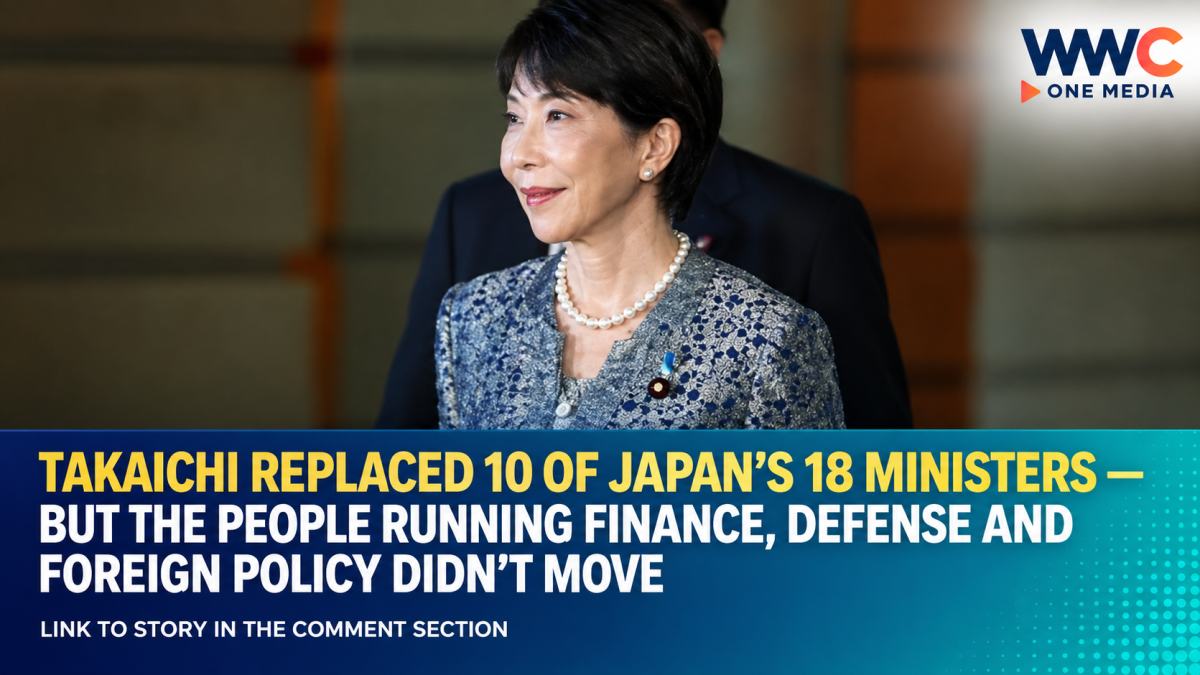
TOKYO — September 17, 2026 — Japanese Prime Minister Sanae Takaichi reshuffled her Cabinet on Thursday, replacing 10 of its 18 ministers but keeping the officials handling Japan’s biggest economic, diplomatic and security challenges firmly in their posts.
Finance Minister Satsuki Katayama, Foreign Minister Toshimitsu Motegi, Defense Minister Shinjiro Koizumi, Economy Minister Minoru Kiuchi, Economy, Trade and Industry Minister Ryosei Akazawa, and Chief Cabinet Secretary Minoru Kihara were retained. The lineup points to substantial policy continuity even though more than half of the ministerial seats technically changed hands.
And one appointment carries particular political significance: Hiroshi Nakatsuka of the Japan Innovation Party, or JIP, entered the Cabinet as minister in charge of regulatory reform, becoming the first JIP politician to receive a Cabinet position since the party formed a governing coalition with Takaichi’s Liberal Democratic Party last October.
That means the headline may be “reshuffle,” but the message from the most powerful ministries is much closer to continuity.
Takaichi changed more than half the Cabinet — but not the people driving her biggest policies
Reuters described the reshuffle as signaling little change in Takaichi’s core economic program, particularly after she retained Kiuchi, a supporter of expansionary policies, alongside Katayama, a former Finance Ministry bureaucrat associated with a more cautious approach to fiscal management.
Kiuchi said after his reappointment that the government would seek both economic strength and fiscal sustainability, adding that it would not engage in uncontrolled fiscal expansion. His continued presence matters because Takaichi is pushing an ambitious spending agenda while Japan’s government finances are coming under greater scrutiny from investors.
Katayama’s retention sends another continuity signal. She played a central role in negotiations with U.S. Treasury Secretary Scott Bessent surrounding the rare coordinated U.S.-Japan yen-buying intervention in late July. Reuters previously reported that government officials saw continuity in the Finance Ministry as particularly important while currency and bond markets remained volatile.
The yen was trading around ¥155 to the dollar on Thursday, while Japan’s government continued warning against excessive currency moves. Katayama and Kihara both retained their posts as markets awaited the Bank of Japan’s latest policy decision.
Shinjiro Koizumi and Toshimitsu Motegi stay too
Two of the most recognizable figures in the government also survived the reshuffle.
Shinjiro Koizumi remains defense minister, while Toshimitsu Motegi stays on as foreign minister. Both competed in the LDP leadership contest that eventually brought Takaichi to power.
Keeping Koizumi provides continuity at the Defense Ministry as Japan works on revisions to its national-security strategy and considers further increases in defense spending. Motegi, meanwhile, remains responsible for foreign policy at a time of heightened tensions in East Asia and shifting relations among Japan, the United States and China.
The Japan Times had noted before the reshuffle that keeping possible future LDP leadership contenders inside government also carries a party-management consequence: Cabinet ministers are expected to support the administration’s policies while serving. That is an analysis of the political effect of the appointments, rather than an announced reason from Takaichi herself.
But one former leadership rival is out
Not everybody stayed.
Yoshimasa Hayashi, who had been internal affairs and communications minister and also ran against Takaichi in the 2025 LDP leadership race, left the Cabinet. Hisayuki Fujii was named the new internal affairs minister.
Hayashi’s treatment had been closely watched in the weeks before the reshuffle because Japanese political coverage had identified him as another possible participant in the next LDP leadership election. Takaichi’s current term as party president runs through September 2027.
That makes this reshuffle particularly important even though Japan is not facing an immediate national election.
It may be Takaichi’s final major opportunity to rearrange the Cabinet before the next scheduled LDP presidential contest.
The JIP finally gets a seat at the Cabinet table
The appointment of Hiroshi Nakatsuka could be the reshuffle’s biggest institutional change.
The JIP entered a coalition with Takaichi’s LDP in October 2025, after longtime LDP partner Komeito left the governing arrangement. JIP support was important to Takaichi’s initial election as prime minister when the new coalition lacked a Lower House majority.
The political balance changed dramatically after February’s snap Lower House election.
Takaichi’s LDP won 316 of the chamber’s 465 seats, giving the party a two-thirds majority by itself. Combined with the JIP, the governing bloc secured 352 seats.
But the government still does not control a majority in the Upper House, meaning cooperation with other parties remains necessary for legislation that cannot simply be resolved through the Lower House’s numerical strength.
Bringing a JIP lawmaker formally into the Cabinet therefore gives the junior coalition partner a direct role in government decision-making at a moment when the two parties need to coordinate on another difficult legislative agenda.
The next fight is the food-tax cut
One of the biggest tests awaiting the new Cabinet is Takaichi’s proposed temporary cut in Japan’s consumption tax on food.
The government approved an outline this week to reduce the food tax rate from 8% to 1% for two years beginning in April 2027, while also planning additional payments intended to offset the remaining tax burden.
The plan could reduce government revenue by approximately ¥5 trillion, but the outline did not specify fully how the lost revenue would be replaced. Katayama has said the government does not intend to finance the measure through additional deficit-financing bonds.
That funding question matters because Japan already has government debt roughly twice the size of its economy, the highest ratio among advanced economies, while the cost of servicing that debt is rising as interest rates move higher.
Japan’s benchmark 10-year government bond yield climbed above 3% this week, reaching levels not seen in roughly three decades as investors weighed Takaichi’s spending plans and the prospect of further monetary tightening by the Bank of Japan.
Takaichi is trying to combine tax relief with a bond ceiling
The prime minister has also pledged to keep new government bond issuance for fiscal 2027 at around ¥40 trillion, even as ministries submit large spending requests and Japan prepares for additional defense expenditures.
That creates a difficult arithmetic problem.
The government wants to reduce the food tax, support households coping with higher living costs, invest heavily in strategic sectors and increase security spending — while simultaneously reassuring bond investors that public debt will remain manageable.
Retaining both Kiuchi and Katayama effectively preserves the two sides of that policy debate inside the Cabinet: stimulus and growth on one side, fiscal discipline on the other. Reuters cited economist Keiji Kanda of Daiwa Institute of Research as saying Katayama’s presence could help the government manage growing market sensitivity to fiscal risk.
Japanese companies broadly support Takaichi’s growth strategy — but not every policy
A Reuters corporate survey conducted by Nikkei Research between August 26 and September 4 found 68% of responding Japanese companies either strongly or somewhat approved of Takaichi’s economic policies. The poll contacted 510 companies and received 224 anonymous responses.
Among companies supportive of her policies, 70% selected her investment-centered growth strategy as a favored measure. But among respondents who opposed her economic program, 68% identified the proposed food consumption-tax cut as a policy they disliked, with some citing concern about debt and yen weakness.
That contrast illustrates why keeping both the government’s pro-growth and fiscally cautious figures in place could matter during the coming parliamentary session.
The reshuffle comes just days after an Okinawa win for the government-backed candidate
Takaichi also enters the reshuffle following a significant regional election result.
In Okinawa’s September 13 gubernatorial contest, government-backed Genta Koja won about 59% of the vote, defeating incumbent Denny Tamaki and ending 12 years of administrations opposed to parts of Tokyo’s military-base policy.
The result could reduce political resistance to some aspects of Tokyo’s defense buildup in Okinawa, although disputes over the U.S. military presence and the relocation of Marine Corps Air Station Futenma remain politically sensitive.
Separately, public polling in August showed substantial variation depending on the survey: four major Japanese media polls placed Takaichi Cabinet approval between 41% and 56%. Those are snapshots from individual polls rather than a single nationwide consensus measure.
This reshuffle changes faces — but not Japan’s immediate direction
On paper, replacing 10 of 18 ministers looks like a substantial overhaul.
But the ministries handling finance, economic policy, trade, foreign affairs and defense remain under familiar leadership.
Katayama still controls the Finance Ministry.
Kiuchi remains responsible for economic policy.
Akazawa stays at the trade ministry and continues overseeing sensitive economic relations with Washington.
Motegi remains foreign minister.
Koizumi stays at defense.
And Kihara continues as the government’s chief spokesperson and Cabinet coordinator.
The most consequential new face may therefore be Nakatsuka — because his appointment moves the JIP from coalition partner outside the Cabinet into the Cabinet itself.
For Takaichi, the bigger test begins after the photographs of the new ministers are taken.
Her government must now try to pass a costly food-tax cut, compile the next budget, manage rising bond yields and the yen, revise Japan’s security policies and navigate an Upper House where the ruling coalition still lacks a majority.
So although Thursday brought ten new ministerial appointments, Japan’s most important economic, foreign-policy and defense officials stayed exactly where they were.
That may be the clearest signal of what Takaichi wants from her first reshuffle: new personnel around the edges, but continuity at the center.



Leave a Reply