
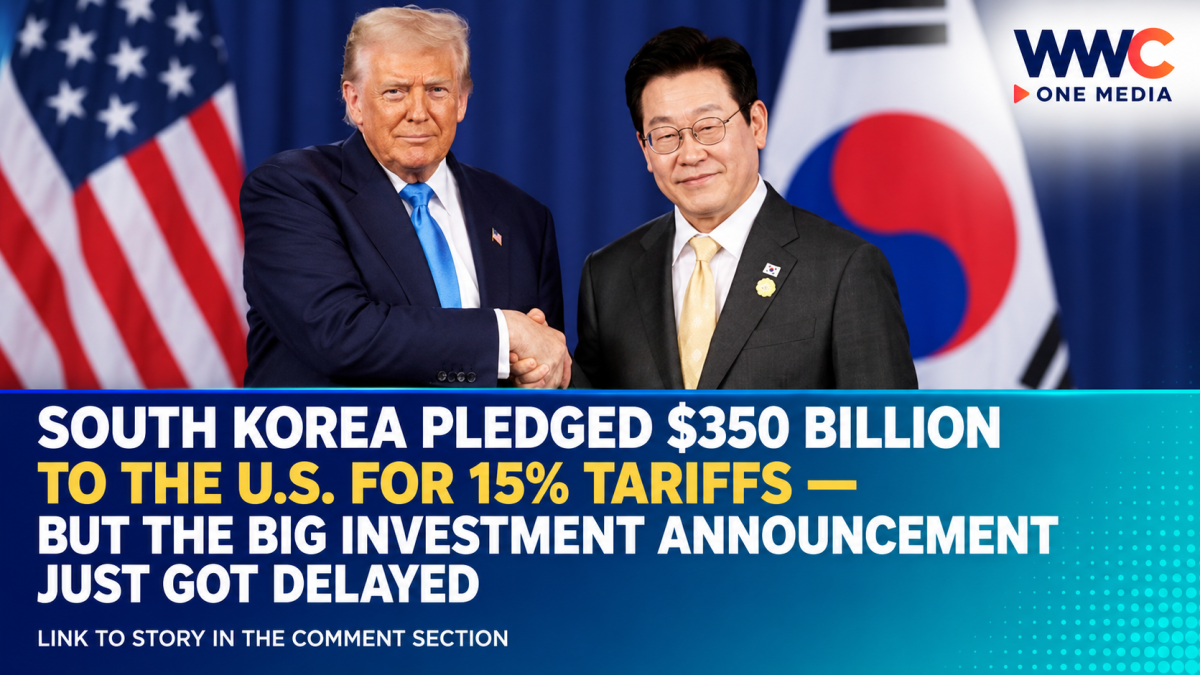
South Korea’s massive U.S. investment programme has hit another delay just as Seoul and Washington appeared close to unveiling the first major projects under their landmark trade agreement.
The South Korean government postponed a planned September 17 briefing to the National Assembly on how it intends to deploy part of its $350 billion U.S. investment commitment, according to officials and reporting by Reuters and Yonhap.
The briefing had been viewed by lawmakers as one of the final domestic steps before Seoul and Washington could settle terms and announce specific investments. It has been tentatively pushed to September 22, although two South Korean officials told Reuters that neither the parliamentary briefing nor a final announcement date had been firmly fixed.
That is an important distinction.
The entire agreement has not been formally cancelled.
But an announcement that appeared imminent is no longer moving on the timetable officials and lawmakers had expected.
Foreign Minister Cho Hyun said the delay was related to the need to clarify procedural issues. Before leaving for Washington on September 17, he said he understood the postponement to concern domestic procedures rather than a fundamental disagreement between South Korea and the United States.
Still, the delay matters because the deal is enormous.
And after months of negotiations, Washington has already shown that it is willing to use tariffs as leverage if implementation does not move quickly enough.
What Is the $350 Billion Deal?
The investment commitment is part of the trade arrangement reached between South Korean President Lee Jae Myung and U.S. President Donald Trump in 2025.
Under the agreement, South Korea committed $350 billion in U.S.-focused investments while Washington agreed to cap tariffs on many Korean imports at 15%.
The White House later broke the package into two major components:
$150 billion for investments connected to U.S. shipbuilding, and another $200 billion for strategic investments under a separate memorandum of understanding.
The White House said the broader investment partnership could cover sectors including shipbuilding, energy, semiconductors, pharmaceuticals, critical minerals, artificial intelligence and quantum computing.
The trade component is equally important for South Korea.
The agreement set a 15% tariff framework for Korean goods and brought U.S. tariffs on Korean automobiles and auto parts down to that level rather than leaving exporters exposed to higher rates.
For an economy heavily dependent on exports — especially automobiles, electronics, machinery and advanced manufacturing — the tariff terms carry enormous commercial significance.
That is why delays in the investment side of the agreement matter far beyond the projects themselves.
$150 Billion Is Already Reserved for Shipbuilding
One part of the package is relatively straightforward.
Approximately $150 billion has been earmarked for shipbuilding cooperation, an industry where South Korea has some of the world’s largest and most technologically advanced companies.
Korean shipbuilders have already been expanding cooperation with U.S. companies.
In 2025, HD Hyundai Heavy Industries and U.S. shipbuilder Huntington Ingalls announced plans to explore cooperation on U.S. Navy auxiliary vessels and possible joint investment in American shipbuilding facilities.
Washington has made rebuilding domestic shipbuilding capacity a strategic priority.
South Korea, meanwhile, has deep expertise in commercial vessels, LNG carriers, naval construction and shipyard management.
That makes the shipbuilding portion of the agreement relatively easy to understand strategically.
The more complicated question is what Seoul will do with the remaining $200 billion.
A $22 Billion Texas Gas Plant Could Be the First Major Project
One of the most widely reported proposals is a massive gas-fired power project in Encinal, Texas.
Current reporting puts the project’s estimated value at about $22 billion, with planned generating capacity of roughly 6.3 gigawatts.
The plant would help provide electricity for rising power demand associated with artificial-intelligence data centres.
The proposed project has repeatedly been described as the likely first investment under the $200 billion strategic-investment portion of the deal.
But there is an important qualification.
South Korea’s Industry Ministry has previously pushed back against media reports suggesting that final terms were already settled.
When Reuters reported earlier this month that Seoul and Washington had agreed on a Texas project worth more than $20 billion, the ministry said negotiations were still continuing and that no final decision had been announced.
That caution remains relevant now.
Until Seoul and Washington issue formal project agreements, headline investment amounts should be treated as proposals under negotiation rather than completed investments.
Then There Are Up to Eight Nuclear Reactors
The nuclear component could be much larger.
Reuters reported that plans under discussion could involve the construction of up to eight new nuclear reactors in the United States.
Recent South Korean media reports cited by Reuters say six could use technology from Westinghouse Electric, while two could potentially use a South Korean reactor design.
That would tie South Korea’s investment strategy directly to Washington’s effort to dramatically expand U.S. electricity generation as AI data centres and advanced manufacturing increase power demand.
It would also place Korean engineering and energy companies inside one of America’s most ambitious infrastructure build-outs.
But once again, the negotiations are not finished.
Reuters reported on September 10 that South Korea’s trade ministry said details surrounding the investments had not been finalized, while a White House official cautioned against treating unannounced project reports as settled agreements.
Seoul Is Even Considering Buying Into Westinghouse
Another potentially significant piece of the package involves Westinghouse itself.
South Korean media have reported that Seoul is considering using part of its strategic-investment fund to acquire a minority stake in the U.S. nuclear technology company. Reuters confirmed that several Korean outlets had reported the proposal as part of the ongoing negotiations.
That possibility is especially noteworthy because relations between South Korean nuclear companies and Westinghouse have long included disputes over reactor technology and intellectual property.
Korean experts quoted by The Korea Times have argued that simply buying a financial stake would not necessarily solve those issues unless the investment also produced meaningful governance rights or commercial advantages.
So even if a Westinghouse investment becomes part of the package, the structure could matter almost as much as the price.
Alaska LNG Is Still on the Table
South Korea is also examining possible participation in an Alaska liquefied natural gas project, Reuters and Korean media report.
The proposal fits Washington’s goal of increasing U.S. energy exports to Asia.
For South Korea, one of the world’s largest LNG importers, additional American supply could potentially diversify energy sourcing.
But Alaska LNG has faced longstanding questions about construction costs, financing and whether the economics can compete with other global LNG suppliers.
The broader Alaska project would require moving gas roughly 1,300 kilometres from Alaska’s North Slope to a liquefaction facility near Nikiski, according to Korean reporting.
That means Seoul must decide not merely whether the project suits U.S. strategic goals, but whether it offers acceptable commercial returns.
South Korean Prime Minister Han Seong-sook stressed that point earlier this month, saying investments under the $350 billion framework must be commercially viable and beneficial to both countries.
Parliament Matters Because Seoul Has to Explain Where the Money Is Going
This week’s postponed parliamentary briefing was important because South Korean lawmakers have been seeking details on exactly which projects the government plans to finance.
During questioning of finance minister nominee Lee Hyoung-il on September 15, ruling Democratic Party lawmaker Yoon Hu-duk raised several projects that had been discussed in Korean media.
They included the Texas gas project, eight nuclear reactors and Alaska LNG.
Yoon also referred to possible nuclear-material reprocessing and carbon-capture projects.
Lee declined to confirm details while negotiations were continuing.
Crucially, he was also asked whether the projects could exceed the $200 billion ceiling for the strategic-investment portion of the agreement.
Lee said the government intended to remain within the agreed limit and was negotiating accordingly.
That could force Seoul to make choices.
If the Texas gas project, nuclear projects, Alaska LNG and other proposals together become more expensive than the available $200 billion envelope, not every proposal can automatically be funded at its maximum reported value.
A Trump Announcement Had Been Expected on September 18
The delay is particularly striking because, only two days earlier, some South Korean lawmakers believed a major announcement was imminent.
Yoon said during the September 15 parliamentary hearing that Trump was expected to announce South Korea’s U.S. investment details on September 18.
Finance minister nominee Lee responded more cautiously, saying negotiations were still underway and that the government would comment once discussions were complete.
Then the September 17 parliamentary briefing was postponed.
Reuters now reports that Newsis, citing a South Korean parliamentary official, said the two countries could potentially hold a memorandum-of-understanding signing ceremony on September 23.
But Reuters also noted that officials in Seoul say final dates have not been fixed.
So the timeline has become considerably less certain.
Cho Hyun Is Heading Straight to Washington
The diplomatic calendar may now become important.
Foreign Minister Cho departed South Korea on September 17 for Washington, where he is scheduled to meet U.S. Secretary of State Marco Rubio on Friday.
The investment deal is expected to be part of a much broader agenda.
According to Yonhap, Cho said the two countries would discuss bilateral issues as well as the Korean Peninsula, regional security and the wider international situation.
Talks are also expected to involve the Strait of Hormuz, where Seoul is weighing questions around maritime security amid instability affecting global energy routes.
North Korea is another major issue.
The investment talks are therefore taking place inside an alliance that is simultaneously dealing with trade, nuclear energy, maritime security and tensions on the Korean Peninsula.
That gives both governments strong incentives to keep the economic negotiations moving.
Why Washington Has Been Impatient
This is not the first delay.
Implementation of the 2025 trade agreement has moved more slowly than Washington initially wanted.
Reuters reports that Trump has already threatened South Korea with higher tariffs because of delays in putting the investment programme into effect.
That creates pressure on Seoul.
South Korea secured the 15% tariff framework partly by committing to enormous U.S. investments.
But Seoul must also ensure that investments on this scale are financially defensible at home.
The tension between those two priorities is central to the negotiations.
Washington wants rapid deployment of capital into U.S. industrial and energy projects.
Seoul wants to ensure the projects are viable, stay within the agreed investment ceiling and can survive domestic political scrutiny.
Those objectives are not necessarily incompatible.
But they can produce difficult negotiations over project ownership, expected returns, financing structures and who absorbs cost overruns.
The Texas Project Shows Why the Details Matter
The proposed Texas gas plant is a good example.
Initial Korean reports placed its cost at roughly $19.8 billion.
Later estimates moved above $22 billion, and Korean reporting has said Washington suggested that total costs could potentially rise even further because of additional infrastructure requirements such as water supply.
For a project on that scale, a few billion dollars of additional cost is not a minor accounting adjustment.
It affects expected returns.
It affects how much money remains available for other projects.
And it affects how readily Seoul can defend the investment to lawmakers and taxpayers.
The same issue applies to nuclear construction, where delays and overruns can dramatically change project economics.
The Nuclear Plans Could Be Bigger Than the Gas Plant
Reuters reported that the broader package currently under discussion could exceed $100 billion in energy projects alone, largely because of the proposed nuclear build-out.
If up to eight reactors are eventually built, South Korea’s participation could become one of the most significant overseas energy-investment programmes in its history.
But the reactors would likely be built over many years.
That means the headline $350 billion commitment should not be misunderstood as a single cheque being transferred immediately from Seoul to Washington.
The White House’s own framework describes different investment categories and sectoral commitments, while Reuters says proposed investments would unfold over time.
The final structure — including loans, equity, guarantees and direct project financing — will therefore be critical.
This Is About More Than Tariffs Now
The original bargain was straightforward enough:
South Korea would invest heavily in the United States.
Washington would give Korean exporters more favorable tariff treatment.
But the emerging project list shows how the deal has expanded into a much larger industrial strategy.
Shipbuilding addresses U.S. maritime capacity.
Gas generation addresses electricity demand.
Nuclear reactors address long-term baseload power.
AI data centres need that electricity.
Alaska LNG connects U.S. energy production to Asian buyers.
And a potential Westinghouse stake could bind American and South Korean nuclear industries more closely together.
The result is no longer just a tariff negotiation.
It is becoming a restructuring of parts of the U.S.-South Korea economic relationship.
But First, Seoul Has to Get Through Parliament
That is why the postponed September 17 briefing matters.
On paper, $350 billion is the headline.
In practice, lawmakers want to know which projects will receive the money, who owns them, how profits are shared, how risks are allocated and whether South Korea’s national interests are protected.
Foreign Minister Cho says the current delay is procedural.
Officials have not announced that the agreement itself is in danger.
But until the parliamentary briefing happens and the first investments are formally confirmed, one of the biggest promises in last year’s U.S.-South Korea trade deal remains just that:
a promise waiting to become projects.


Leave a Reply