
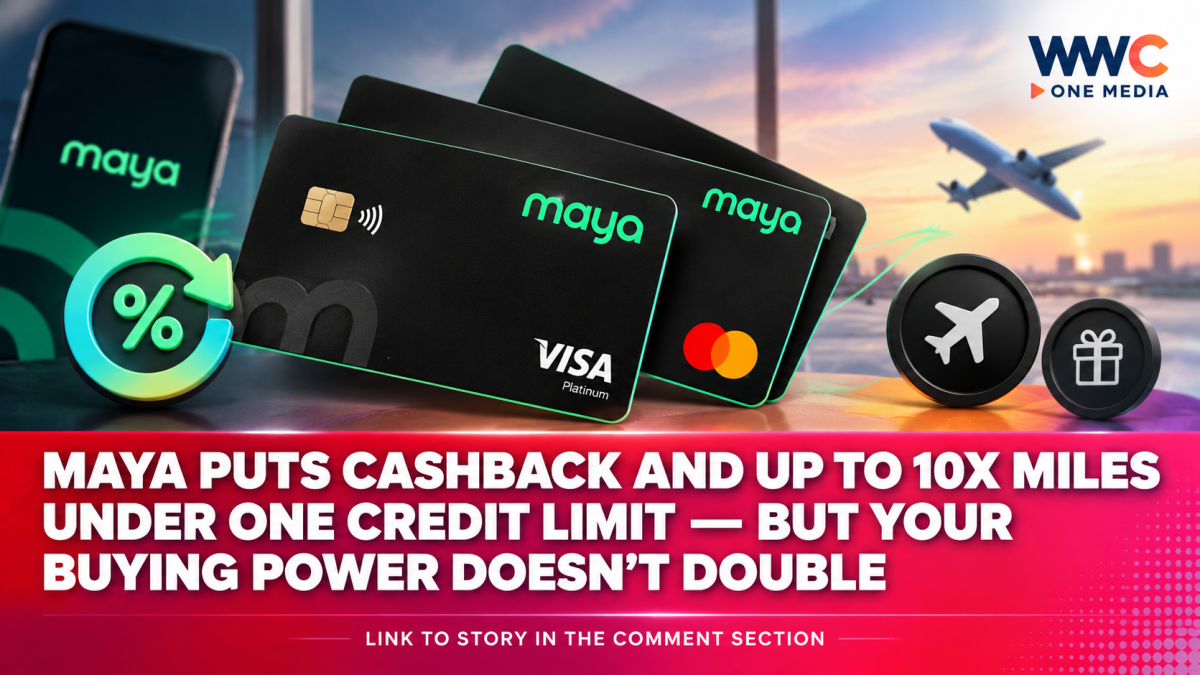
MANILA — September 17, 2026 — Maya is giving eligible Filipino customers a way to carry two very different credit cards at the same time — one built around cashback and another centered on travel and lifestyle rewards — without giving them two separate pools of credit.
Under Maya Bank’s newly introduced shared credit limit, eligible customers who hold both the Landers Cashback Everywhere Credit Card and Maya Black Credit Card can choose which card to use depending on the reward they want.
Buying groceries at Landers? The cashback card may make more sense.
Spending at a Maya Black Preferred merchant or building up travel rewards? The Maya Black card may offer the stronger reward.
But there is one crucial catch:
Both cards draw from the same total credit limit.
If a customer has ₱100,000 of shared available credit and spends ₱30,000 using one card, the remaining available credit across the arrangement effectively falls to ₱70,000 — it does not leave another independent ₱100,000 waiting on the second card. Maya Bank formally defines the arrangement as one total credit limit shared across two or more eligible accounts.
That makes the new feature less about increasing how much people can borrow and more about giving customers more ways to earn rewards from the credit they already have.
Two Cards, Two Reward Systems — One Pool of Credit
The two Maya cards target very different spending habits.
The Landers Cashback Everywhere Credit Card currently offers:
up to 5% cashback at Landers Superstore, depending on monthly accumulated credit-card spending;
2% cashback on eligible dining transactions;
and 1% on most other eligible retail purchases.
The Landers cashback structure is progressive.
For qualifying Landers spending, Maya’s current promotional mechanics provide a 3% tier when total monthly card spending is ₱20,000 or below, 4% on the next qualifying tier when accumulated spending exceeds ₱20,000, and up to 5% once spending progresses beyond ₱50,000. The rewards are calculated progressively rather than simply applying 5% to every Landers transaction once the top threshold is reached.
One Landers cashback point is worth ₱1 when redeemed, and the points can be used for purchases at Landers under Maya’s redemption system.
Maya Black, meanwhile, takes a different approach.
Its standard rewards structure awards Maya Miles based on qualifying spending, while selected Maya Black Preferred merchants can earn customers up to 10x Maya Miles. Miles can then be used for travel and lifestyle rewards offered through Maya’s ecosystem.
Maya Bank’s current terms show the regular mileage earning structure beginning at one Maya Mile for every ₱40 of qualifying spend, with higher tiers potentially improving that to one mile for every ₱30 or ₱20 spent, subject to the customer’s applicable tier displayed in the app.
So the new setup essentially lets one customer choose between cashback economics and miles economics transaction by transaction.
But the Credit Limit Does Not Multiply
This is the part most likely to be misunderstood.
Suppose Maya assigns a cardholder a shared credit limit of ₱100,000.
That does not mean:
₱100,000 on Maya Black
plus
₱100,000 on the Landers card.
Instead, both cards compete for the same ₱100,000.
Spend ₱25,000 using Maya Black and, before considering payments or other adjustments, only ₱75,000 remains available across the shared arrangement.
Spend another ₱20,000 using the Landers card and the remaining shared availability drops further.
InsiderPH said the model allows Maya to broaden its range of credit-card rewards without automatically extending a second full line of credit to the same customer.
That distinction is significant from both the consumer and lender perspective.
Customers obtain more reward flexibility.
Maya does not necessarily double its credit exposure simply because someone holds a second card.
There’s Another Important Detail: The Bills Stay Separate
One credit limit does not mean one combined monthly credit-card statement.
Maya says each card maintains its own statement of account, showing the transactions and amount due on that particular card. Customers can monitor spending on both cards and their remaining shared credit through the Maya app.
That creates an important payment rule.
Maya Bank’s terms state that when cards operate under a shared-credit-limit arrangement, a payment made to one specific credit-card account is applied only to that account.
It is not automatically transferred, offset or applied against the outstanding balance of the other card.
For example, if someone owes ₱15,000 on Maya Black and ₱10,000 on the Landers card, paying ₱25,000 to one card does not necessarily settle both bills.
Customers therefore still have to watch two statements and two respective amounts due, even though the borrowing capacity behind them is shared.
That may be the most important practical detail for cardholders.
Why Would Someone Want Both Cards?
The attraction is straightforward: different spending categories can produce very different rewards.
A customer buying regularly from Landers Superstore may prefer the Landers card because of its cashback structure.
Dining can produce 2% cashback under that card’s current mechanics.
A customer booking travel, shopping or spending at participating Maya Black Preferred businesses may instead choose Maya Black to accumulate miles, particularly where boosted rewards of up to 10x Maya Miles are available.
Instead of choosing one reward philosophy permanently, an eligible customer can switch cards depending on the transaction.
That is what makes the shared-credit feature different from simply issuing another conventional credit card.
The second card expands the reward menu, not automatically the debt ceiling.
The Cashback Headline Also Comes With Fine Print
“Up to 5% cashback everywhere” would be inaccurate.
The Landers card offers up to 5% specifically on qualifying Landers purchases, while dining currently earns 2% and most other eligible retail transactions earn 1%.
Certain transactions do not qualify for cashback.
Maya lists exclusions including categories such as wallet top-ups, cash advances, quasi-cash transactions, gambling, certain fuel and supermarket transactions, pharmaceuticals, utilities, telecommunications and government payments, subject to its detailed merchant-category rules.
And because rewards depend partly on the merchant category code assigned to a transaction, the merchant someone thinks they are paying and the category recognized by the payment network do not always produce identical reward treatment.
That is common across rewards cards, but it matters when consumers are deciding which of their two cards to use.
Maya Black’s ‘10x Miles’ Is Also Not Every Transaction
The same qualification applies to Maya Black.
Maya advertises up to 10x Maya Miles at Maya Black Preferred merchants — not 10x miles across every purchase made anywhere.
The card’s regular earning rate starts from its standard miles framework, with enhanced earnings dependent on tier, merchant partnerships or promotional conditions.
So customers deciding between the two cards need to look at where they are spending, rather than assuming that Maya Black always produces 10x rewards or that Landers always generates 5% cashback.
Maya Is Building More Features Around the Same Two Cards
The shared-limit arrangement is part of a broader effort by Maya to make its cards operate as extensions of its banking app rather than traditional standalone pieces of plastic.
Both Maya Black and the Landers card can be managed through the Maya app, including reviewing transactions, statements and card controls.
Maya has also introduced Mini Payments, allowing eligible qualifying purchases to be converted into installment plans of 3, 6, 9 or 12 months, with the bank advertising rates starting from around 1% monthly interest depending on the applicable offer.
And the shared-limit concept follows through there too.
Maya Bank’s terms say Mini Payment transactions across multiple credit-card accounts sharing a limit are subject to a combined usage ceiling of up to 90% of the available shared credit limit.
That further demonstrates how Maya is treating the customer’s cards as different products sitting on top of a single underlying credit relationship.
Maya Black Is Relatively New
Maya officially unveiled the Maya Black Credit Card and Maya Black Preferred rewards ecosystem in August 2025, positioning the product as its flagship branded credit card after previously expanding into lending, savings and payments.
The Landers Cashback Everywhere card followed a different strategy by combining a credit product with a Landers membership and rewards program.
Maya says an active Landers membership is required for the Landers card, and the credit card itself can double as the customer’s Landers membership card.
Now, instead of making customers choose one ecosystem or the other, Maya is connecting the two products through the shared limit.
Why Maya Would Prefer One Shared Limit
From Maya’s perspective, the design solves a basic problem.
Banks want customers to use more of their products.
But giving someone two completely independent credit lines can also mean significantly increasing the lender’s total exposure to that customer.
Under Maya’s model, an eligible cardholder can access two sets of perks while the bank can continue managing credit exposure through one overall ceiling.
That becomes increasingly relevant as credit-card borrowing expands in the Philippines.
Bangko Sentral ng Pilipinas data show credit-card receivables at universal banks reached about ₱1.292 trillion at the end of June 2026, up from roughly ₱1.227 trillion in March. Nonperforming credit-card receivables also increased over that period, from about ₱61 billion to ₱68.3 billion.
Those figures cover the broader universal-bank sector rather than Maya specifically, but they show why lenders have reason to balance aggressive card growth with credit-risk controls.
A shared limit lets Maya broaden rewards without necessarily doubling a customer’s approved borrowing capacity.
Two Cards Could Still Mean More Temptation to Spend
For customers, there is another side to the flexibility.
Having two cards can make rewards easier to optimize.
But the fact that both cards use the same line means users need to watch their total utilization closely.
A purchase made to earn cashback can reduce the available credit needed later on the miles card.
A travel purchase made with Maya Black can reduce how much remains available for Landers spending.
And because each card generates a separate statement, cardholders also have to make sure payments are directed to the correct account.
The feature therefore simplifies reward choice, but not necessarily credit management.
The Bigger Strategy: One App, More Financial Products
Maya’s broader strategy has increasingly centered on keeping financial activity inside a single ecosystem.
Its app now spans wallet payments, savings, lending, credit cards, investments and merchant payments.
The shared-credit arrangement extends that model one step further.
Instead of asking customers:
“Do you want cashback or miles?”
Maya can increasingly ask:
“Which reward do you want for this transaction?”
That may be a much more powerful proposition.
The Landers card can remain focused on groceries, dining and everyday cashback.
Maya Black can emphasize travel, lifestyle experiences and miles.
And both can sit on top of the same approved credit capacity.
For eligible customers, that creates more flexibility.
For Maya, it creates another reason to keep spending — and the customer relationship — inside its own app.
But consumers should remember the central rule:
two Maya cards may now give you two reward systems, but they do not automatically give you twice the money to spend.




Leave a Reply