
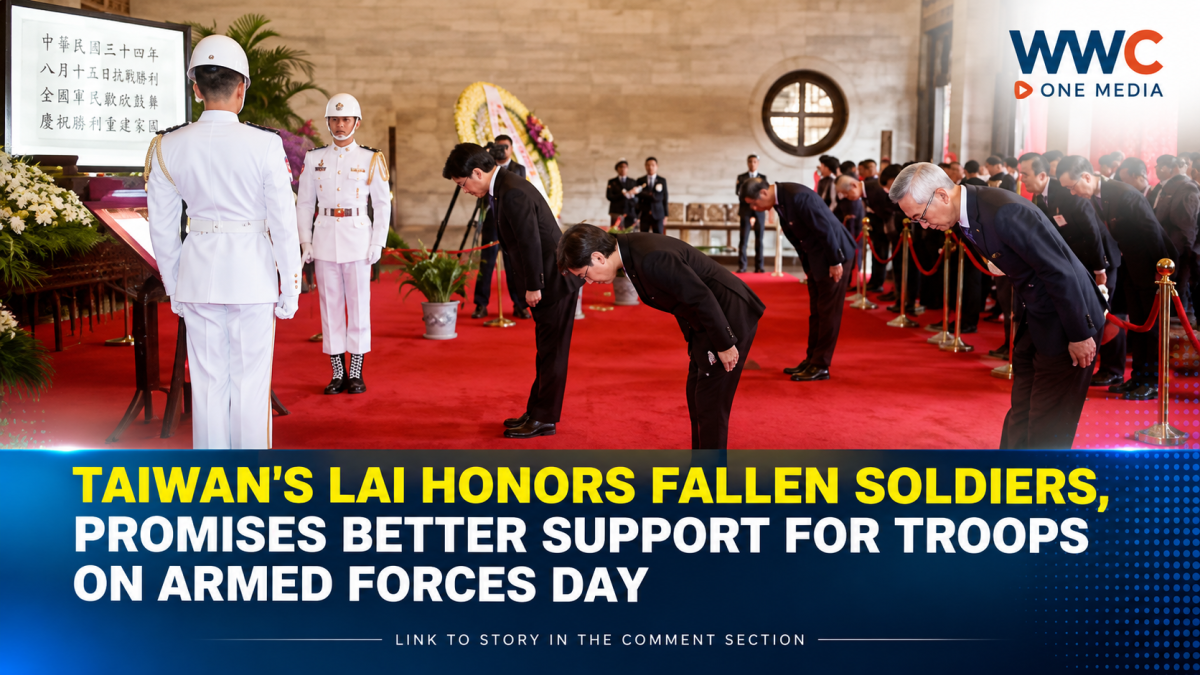
TAIPEI, Taiwan — Taiwan President Lai Ching-te has paid tribute to the island’s fallen military personnel while pledging stronger support for active-duty service members and their families as Taiwan marked Armed Forces Day.
Lai laid flowers at the Martyrs’ Shrine in Taipei on September 3, honoring soldiers who died in service, while also thanking Taiwan’s armed forces for protecting the country’s security and sovereignty.
The ceremony came as Taiwan continues to place national defense and military readiness at the center of government policy amid heightened security concerns in the Taiwan Strait.
Lai honors nearly half a million fallen soldiers
During the ceremony in Taipei’s Zhongshan District, Lai joined senior government officials and descendants of fallen soldiers at the annual Fall Martyrs’ Commemoration Ceremony.
The Martyrs’ Shrine commemorates nearly 500,000 soldiers who died fighting during World War II for the Republic of China, according to Taiwan’s Central News Agency.
Lai’s appearance carried both a commemorative and political message: while remembering those who died in past conflicts, the president emphasized the importance of supporting the military personnel currently responsible for Taiwan’s defense.
Earlier in the day, he thanked members of the armed forces for protecting Taiwan’s national security and sovereignty.
Military pay set for another increase
One of the most significant announcements highlighted by Lai was a planned 4% salary increase beginning next year for military personnel, civil servants and teachers.
The president said his administration had already improved military compensation and benefits during the past year, including increases to combat and professional allowances earlier in 2026.
The planned pay increase comes as Taiwan seeks to make military service more sustainable and strengthen support for personnel tasked with increasingly demanding defense responsibilities.
Lai has repeatedly argued that Taiwan’s security depends not only on weapons and technology but also on the people operating them.
Families to receive greater support
Lai also pledged improvements to the living and training conditions of military personnel.
His government plans to strengthen support for service members’ families, including childcare assistance, with the goal of allowing troops to concentrate more fully on their military responsibilities.
The focus on family welfare is significant as Taiwan attempts to maintain a capable volunteer military and address the practical pressures associated with military careers.
Taiwan’s defense push goes beyond salaries
The Armed Forces Day message comes as Lai’s administration pursues a broader expansion of Taiwan’s defense capabilities.
Taiwan’s government has said its defense spending, measured according to NATO standards, has surpassed 3% of GDP, with the administration targeting 5% by 2030.
Lai has also backed an eight-year special defense budget of about US$40 billion, aimed at strengthening Taiwan’s asymmetric capabilities and accelerating military modernization.
That strategy includes greater investment in areas such as drones, unmanned systems and other advanced defense technologies.
Armed Forces Day carries a historical message
Taiwan observes Armed Forces Day every September 3.
The occasion honors the Republic of China armed forces and commemorates the victory over Japan in World War II.
This year’s observance also featured a range of public activities designed to strengthen connections between Taiwan’s military and civilians.
Taiwan’s Ministry of National Defense said the 2026 Armed Forces Day program included recognition ceremonies for exemplary military personnel, military-family activities, public exhibitions and events intended to encourage broader public support for the armed forces.
Why the message matters now
Lai’s pledge comes at a particularly sensitive moment for Taiwan.
The island continues to face pressure from China, which claims Taiwan as part of its territory and has increased military and other forms of activity around the island.
Taiwan’s defense ministry has described China’s military and maritime activities as part of an increasingly complex security environment, while Lai has repeatedly framed stronger self-defense capabilities as necessary to preserve peace rather than provoke conflict.
That makes the president’s Armed Forces Day message more than a ceremonial tribute.
It is also a reminder that Taiwan’s defense strategy increasingly combines military modernization, personnel welfare and whole-of-society resilience.
A tribute to the past—and a message about Taiwan’s future
For Lai, the ceremony ultimately connected Taiwan’s military history with the challenges facing its armed forces today.
The fallen were remembered at the Martyrs’ Shrine, while current service members were promised better pay, improved working conditions and stronger family support.
The administration’s broader defense agenda suggests that Taiwan intends to invest not only in weapons and military technology, but also in the personnel expected to operate them.
As tensions around Taiwan continue to shape the region’s security landscape, Lai’s message was clear: honoring those who served also means strengthening the people serving today.
WWC ONE MEDIA J.M.D




Leave a Reply