
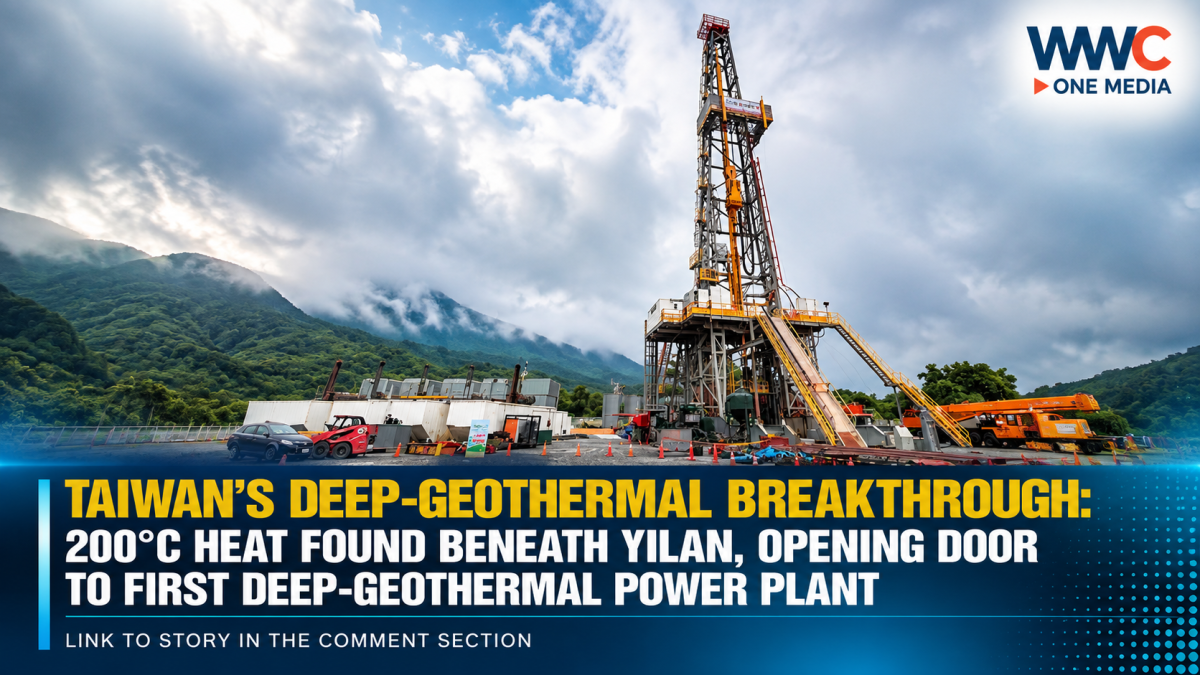
TAIPEI — September 4, 2026 — Taiwan’s long-running search for commercially viable deep geothermal energy has received a major boost after state-owned CPC Corp. discovered temperatures of about 200°C at a depth of 3,361 meters in Dongshan, Yilan County.
The finding does not yet mean Taiwan has approved or begun construction of a new geothermal power plant. Instead, it gives CPC enough reason to move into the next phase of exploration—testing whether the underground heat reservoir is large and productive enough to support commercial electricity generation.
If those tests succeed, Dongshan could become the site of Taiwan’s first deep-geothermal power plant, marking a potentially important step in the island’s effort to diversify its electricity supply.
🔥 The discovery 3.3 kilometers underground
CPC’s Dongshan No. 1 exploratory well was drilled vertically to a final depth of 3,361 meters.
The well, which began drilling on October 21, 2025, was completed on April 21, 2026, with underground temperatures reaching approximately 200°C. CPC’s initial assessment is that the site has potential for deep-geothermal power generation.
That temperature is significant because geothermal power depends not simply on finding heat, but on finding sufficient underground heat and fluid resources that can be developed economically and sustainably.
The 200°C reading is therefore promising—but it is not yet proof that a commercially viable reservoir exists.
CPC plans to find out through additional drilling and reservoir testing.
The next test could determine everything
The next stage is expected to involve two horizontal confirmation wells.
Unlike the existing vertical well, the horizontal wells would allow CPC to investigate a much wider underground area and determine whether the high temperature found at Dongshan represents a broader, usable geothermal reservoir rather than an isolated hot spot.
CPC plans to conduct water-injection and pumping tests as part of the evaluation.
The confirmation work is expected to begin in 2027, subject to the necessary legal and administrative framework, and could be completed by the end of 2028. At that point, CPC expects to have enough information to determine whether building a deep-geothermal power plant at Dongshan is commercially feasible.
If the answer is yes, the project would move into a much larger drilling program.
CPC has outlined plans for eight additional production wells, with the subsequent drilling phase expected to take roughly 2½ to three years. The company says that work could be completed around the end of 2031, after which development of the power plant could proceed.
Taiwan already tried once—and the results were disappointing
The Dongshan result is particularly important because CPC’s first deep-geothermal exploration project in Yilan did not produce the temperature needed for commercial-scale development.
CPC began its deep-geothermal exploration program in Yuanshan Township in cooperation with Academia Sinica in 2024.
The Yuanshan well eventually reached roughly 4,000 meters, but the underground temperature was insufficient for a commercial-scale geothermal plant. CPC subsequently converted the well into an observation well rather than abandoning the broader deep-geothermal program.
CPC then shifted attention toward Dongshan, on the southern side of the Lanyang Plain.
That second attempt has now produced a substantially more encouraging result.
Why deep geothermal could matter to Taiwan
Unlike solar and wind generation, geothermal power does not depend directly on whether the sun is shining or the wind is blowing.
That gives geothermal energy an important potential advantage for an electricity system that needs dependable generation alongside intermittent renewable sources.
Taiwan’s government has identified geothermal as one of the renewable-energy technologies it wants to develop as part of its longer-term energy transition. CPC says geothermal and other forward-looking energy technologies are part of Taiwan’s 2050 net-zero pathway.
The attraction is particularly strong for Taiwan because the island sits in a geologically active region with significant geothermal resources.
But developing deep geothermal is technically difficult and expensive. Finding a hot underground zone is only the first step; developers must also determine whether the reservoir contains enough usable heat and fluid, whether wells can be drilled efficiently, and whether the project can operate commercially over the long term.
Taiwan has ambitious geothermal targets
According to CNA, Taiwan’s Energy Administration has set long-term geothermal deployment targets of 200 MW by 2030 and 450 MW by 2035 in its electricity-resource planning.
As of the latest figures cited by CNA, completed geothermal projects totaled 14.02 MW, with another 8.65 MW under development.
That highlights both the opportunity and the challenge.
Taiwan has ambitious goals, but deep-geothermal projects require considerably more exploration before they can contribute meaningful generating capacity.
The Dongshan project could therefore become an important test case for whether Taiwan can move beyond relatively shallow geothermal resources toward much deeper, potentially larger reservoirs.
But there is a legal hurdle underground
One of the most unusual challenges facing the project is property rights.
Horizontal or directional wells can travel underground beneath land owned by people other than the company operating the well.
That creates a difficult question: How can Taiwan expand geothermal exploration without requiring developers to obtain individual permission from every affected landowner underground?
Taiwan’s Energy Administration is seeking changes to the Renewable Energy Development Act to address the issue.
Energy Administration Director-General Wu Chih-wei said the proposed direction is that landowners would not be able to block geothermal drilling conducted more than 300 meters underground, while other safeguards and regulatory requirements would remain. The Executive Yuan has approved the proposed amendment and sent it to the Legislative Yuan for review.
This is an important distinction: the proposed legal change is not the same thing as unrestricted drilling rights already being in force.
Taiwan’s existing geothermal regulations require exploration and development permits and include environmental, water-resource and other regulatory requirements.
The bigger energy picture
The government is increasingly looking for renewable sources that can complement solar and wind.
CPC has already been involved in geothermal projects in Yilan and elsewhere. Its existing development work includes the Tuchang geothermal project, while the company has also been investigating deeper resources across Taiwan.
The company’s strategy has effectively developed along two tracks:
Shallow and existing geothermal resources: developing projects where commercially usable heat is already better understood.
Deep geothermal exploration: drilling several kilometers underground to find much larger and hotter resources.
Dongshan belongs firmly in the second category.
And that makes the latest 200°C result potentially far more significant than a single successful drilling operation.
What happens next?
The timeline is relatively straightforward:
2026: CPC completes procurement and prepares for the next drilling phase.
2027: Planned drilling of two horizontal confirmation wells, subject to the necessary legal framework.
By late 2028: Testing should establish whether the Dongshan reservoir can support commercial power generation.
If viable: CPC plans to drill another eight production wells.
Around 2031: The additional development wells could be completed, potentially paving the way for construction of Taiwan’s first deep-geothermal power plant at the site.
There is still a considerable distance between finding 200°C heat and switching on a commercial power station.
But after the disappointment at Yuanshan, Dongshan has given Taiwan something it badly needed:
evidence that commercially promising deep heat may actually exist beneath the island.
The bottom line
Taiwan has not yet found a confirmed commercial geothermal power plant at Dongshan.
What it has found is potentially more important at this stage: a 3,361-meter-deep well registering 200°C, enough to justify a much larger exploration effort.
If the upcoming horizontal wells confirm that the heat extends across a sufficiently large reservoir—and if water-flow and economic tests prove favorable—Taiwan could be on the road to its first deep-geothermal power plant.
The answer may come by 2028.
WWC ONE MEDIA J.M.D

Leave a Reply