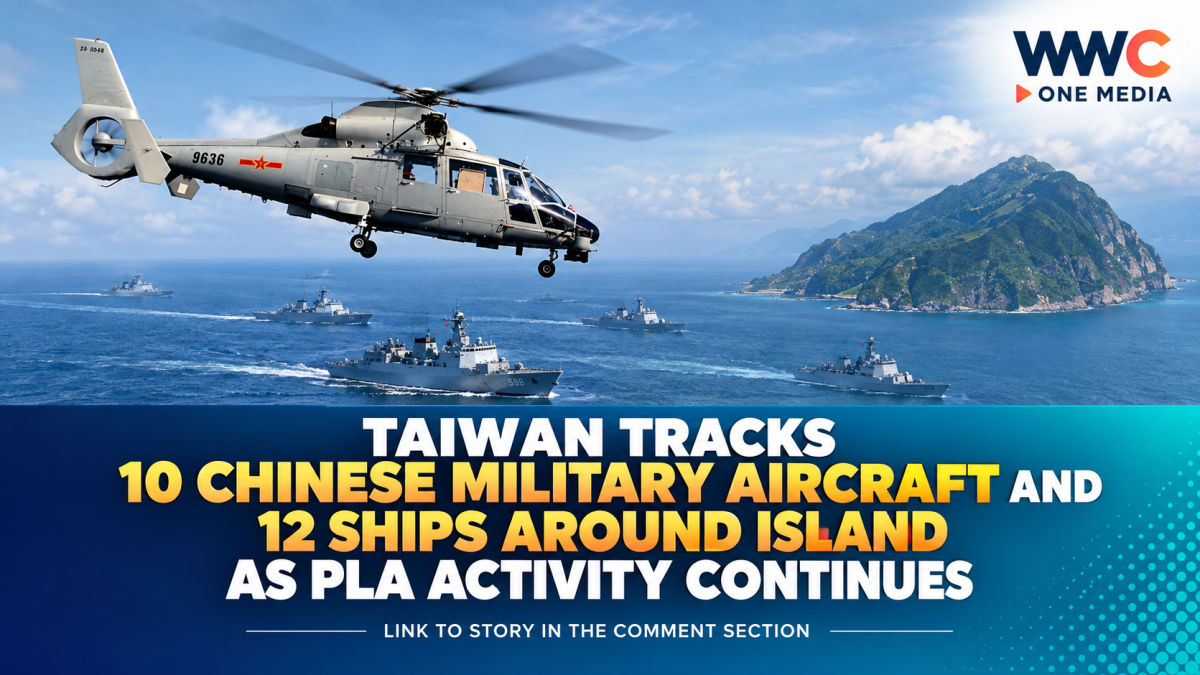
TAIPEI — Taiwan’s Ministry of National Defense tracked 10 Chinese military aircraft, six naval vessels and six official Chinese ships around Taiwan over a 24-hour period, as Beijing’s military activity near the island continues to be closely monitored by Taipei.
The activity was recorded from 6 a.m. Wednesday to 6 a.m. Thursday, September 24, according to Taiwan’s Ministry of National Defense. Five of the 10 Chinese military aircraft were reported to have crossed the Taiwan Strait median line and entered Taiwan’s northern and central air defense identification zones, or ADIZs.
Taiwan said its armed forces responded by deploying aircraft, naval vessels and coastal-based missile systems to monitor the activity.
Five Chinese Aircraft Crossed the Taiwan Strait Median Line
The latest figures show continued Chinese military activity around Taiwan, although the number of aircraft detected was lower than on some days earlier this month.
Taiwan reported 10 PLA aircraft, six Chinese naval vessels and six official ships during the latest 24-hour monitoring period. The MND’s daily reports distinguish military aircraft and naval vessels from official ships, which can include Chinese government vessels.
The five aircraft that crossed the median line entered Taiwan’s northern and central ADIZs, according to the MND.
An ADIZ is not the same as sovereign airspace. It is an area in which authorities request aircraft identification and other information for security purposes, meaning an aircraft being detected inside an ADIZ does not necessarily mean it entered Taiwan’s territorial airspace.
Military Activity Has Continued Throughout September
The latest activity comes after several days of similar reports.
On September 23, Taiwan said it had detected 10 Chinese military aircraft, six naval vessels and six official ships. Nine of those aircraft were reported to have crossed the Taiwan Strait median line and entered Taiwan’s southwestern and eastern ADIZs.
The previous day, Taiwan reported four Chinese military aircraft, seven naval vessels and four official ships around the island. Three of the aircraft were reported to have crossed the median line.
Earlier in September, the numbers were considerably higher on some days. On September 6, for example, Taiwan reported 21 Chinese military aircraft, 10 naval vessels and five official ships, with 13 aircraft crossing the median line.
These daily totals can fluctuate substantially, so individual 24-hour reports should not automatically be interpreted as a sustained increase or decrease in military activity.
Taiwan Calls the Pattern “Gray-Zone” Activity
Taiwan has described the broader pattern of Chinese military and government activity around the island as part of what it calls gray-zone tactics.
The term generally refers to actions that seek to advance security or political objectives without crossing into an openly declared armed conflict. Taiwan has been publishing regular reports on Chinese military activity since 2020, when the MND began publicly documenting PLA aircraft movements around the island.
Taiwan’s defense ministry said it has detected 208 instances involving Chinese military aircraft and 247 involving ships so far in September, based on the latest report.
Those figures represent Taiwan’s own monitoring records and should be understood within that context.
Why the Strait Median Line Matters
The Taiwan Strait median line has historically served as an unofficial buffer between the two sides.
China has increasingly sent military aircraft across the line in recent years. Taiwan and outside analysts have viewed the trend as part of a broader change in military activity around the island.
The line itself is not an internationally recognized border, but its crossing by military aircraft has become an important indicator in Taiwan’s daily reporting.
Recent reporting also shows that Chinese military activity is not limited to fighter aircraft. Taiwan has tracked aircraft, naval vessels and government ships operating around the island, with the scale changing from day to day.
No Indication of an Immediate Attack in the Latest Report
Despite the military activity, the latest MND report does not say that an attack is imminent or that the detected movements represented preparations for an attack.
Taiwan said its forces monitored the activity and deployed aircraft, naval vessels and coastal missile systems in response.
The distinction matters because increased military activity around Taiwan has become relatively routine, while determining the intent behind individual PLA movements requires additional information that is not contained in the daily tracking reports.
Reuters, in broader background reporting published this week, described Taiwan as a highly sensitive issue in U.S.-China relations, with Beijing maintaining its claim over the island while Taiwan maintains its own political system and security posture.
The Bigger Picture
The latest report highlights the continuing military pressure and surveillance environment around Taiwan, where aircraft and ships are frequently monitored near the island.
For Taipei, the challenge is maintaining awareness of these movements while distinguishing routine or recurring military activity from developments that could represent a significant change.
For now, the September 24 report records 10 Chinese military aircraft, six naval vessels and six official ships, with five aircraft reported crossing the Taiwan Strait median line.
The activity remains part of a wider pattern that Taiwan has been documenting throughout September — but the daily figures alone do not establish what Beijing intends to do next.
WWC ONE MEDIA G,A