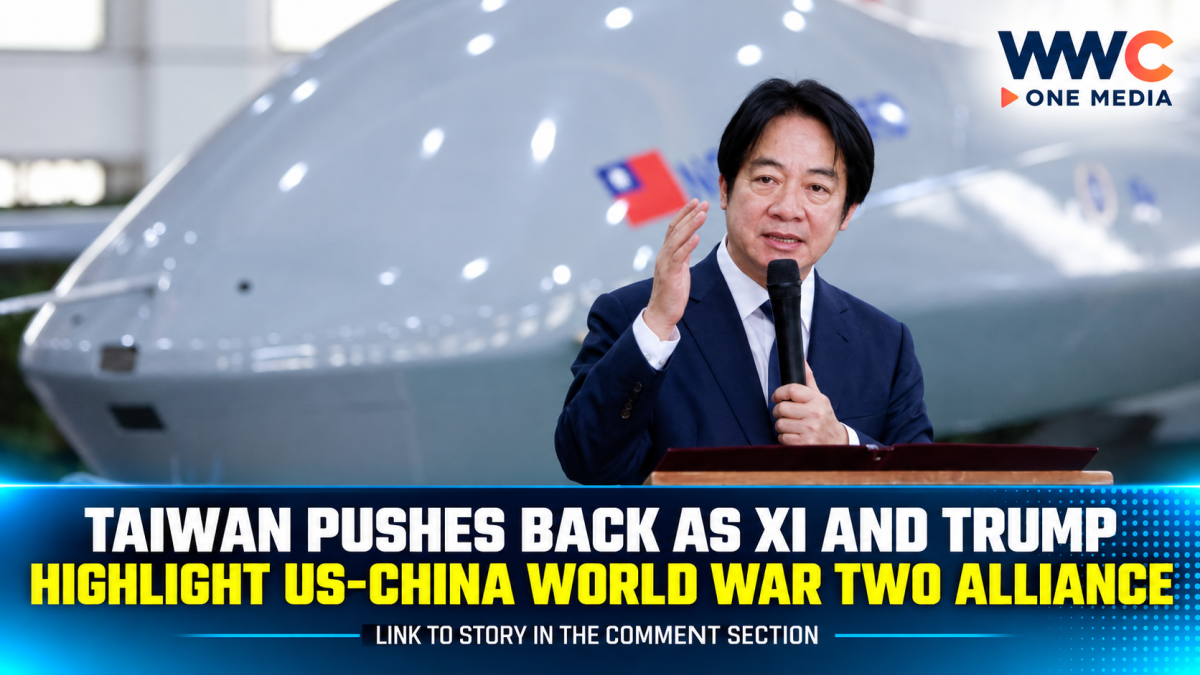
Taiwan is pushing back against what it describes as Beijing’s effort to reshape the historical narrative surrounding World War Two after Chinese President Xi Jinping and US President Donald Trump emphasized the wartime alliance between the United States and China during their recent summit.
The dispute is significant for Taipei because Taiwan argues that the government representing China during World War Two was the Republic of China, which fought alongside the Allied powers. The Republic of China government later relocated to Taiwan in 1949 after losing the Chinese civil war to Mao Zedong’s communist forces.
At a state dinner in Washington last week, Xi and Trump highlighted the cooperation between the two countries during the war. A White House fact sheet subsequently said the United States and China had been allies and fought side by side to win the conflict.
Taiwanese officials argue that this wording risks giving the impression that the People’s Republic of China, which was established in 1949, was the Chinese government allied with the United States during World War Two.
Shen Yu-chung, deputy head of Taiwan’s Mainland Affairs Council, said Taipei would continue communicating with Washington to emphasize the Republic of China’s role as an American ally throughout the war. Deputy Foreign Minister Francois Wu likewise accused Beijing of seeking to replace the Republic of China’s historical role with its own account.
Beijing’s historical account places greater emphasis on communist forces, describing them as the backbone of resistance against Japan, while giving less prominence to the Nationalist government that formally represented China during the war.
The disagreement comes as Taiwan remains concerned about the broader direction of US-China relations. Taipei relies heavily on Washington for political support and military equipment, making any shift in how American policymakers view Beijing and Taiwan strategically important to the island.
The historical dispute is also complicated by Taiwan’s own contested relationship with its wartime past. Taiwan was a Japanese colony from 1895 until 1945, while the island’s current political debate includes competing interpretations of the Republic of China’s historical identity and its relationship with China.
Taiwan’s opposition Kuomintang, the party that governed the Republic of China during World War Two, has also criticized the current government’s handling of the issue. The KMT argues that the administration invokes the Republic of China’s pre-1949 history selectively when confronting Beijing and competing over the historical narrative.
The dispute therefore extends beyond competing descriptions of wartime events. It touches on how the United States, China and Taiwan frame the historical foundations of their relationships — and how those narratives influence contemporary diplomacy.
For Taipei, the immediate task is to ensure that Washington continues to recognize the historical role Taiwan says the Republic of China played during the war. For Beijing, maintaining its interpretation of China’s wartime resistance remains part of its broader historical narrative.
The latest clash shows that World War Two history remains politically relevant more than eight decades after the conflict ended, with competing interpretations now intersecting with the increasingly sensitive relationship between Washington, Beijing and Taipei.