
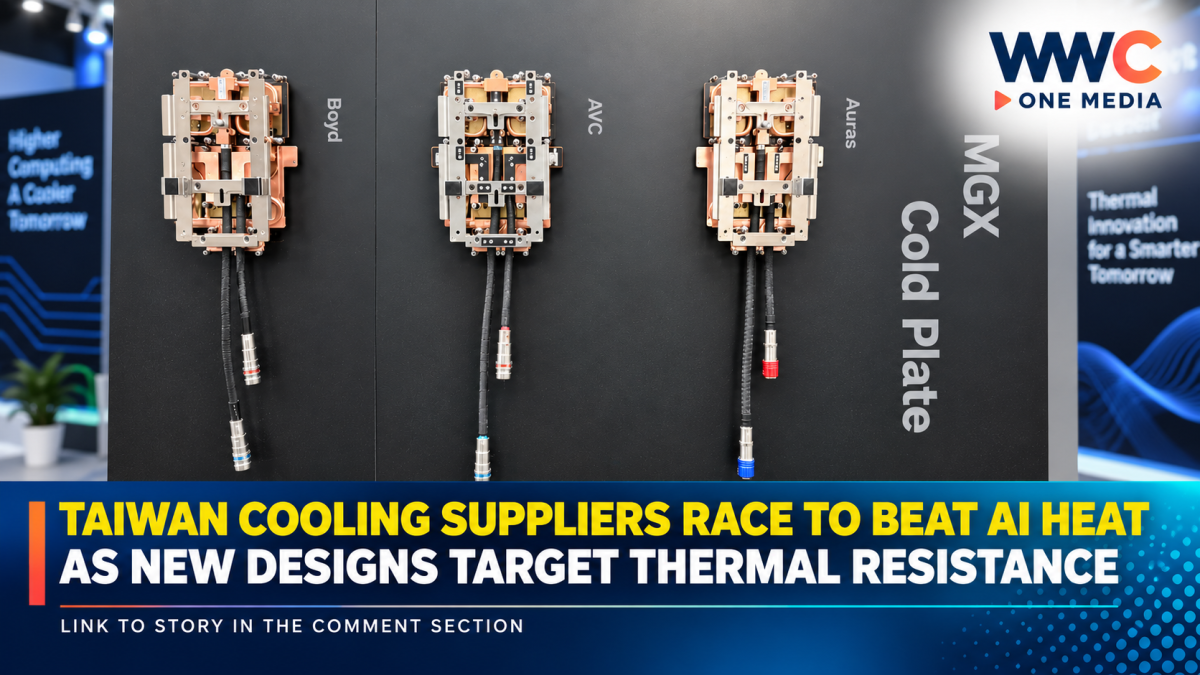
TAIPEI, Taiwan — Taiwan’s thermal-management industry is entering a new phase as the rapid rise of artificial intelligence pushes processors, servers and data centers to generate more heat than conventional cooling systems can comfortably handle.
For Taiwan’s cooling suppliers, the challenge is no longer simply moving more air.
It is about reducing thermal resistance, moving heat away from increasingly powerful chips faster, and fitting more cooling capability into increasingly compact systems.
The shift is driving suppliers toward new generations of liquid-cooling systems, cold plates, vapor chambers, thermal-interface materials and customized thermal modules. Industry reporting shows that AI-server demand has already translated into strong sales growth for several major Taiwanese thermal-solution companies.
AI is creating a new cooling problem
Modern AI accelerators are packing enormous computing power into increasingly concentrated areas.
That creates a fundamental engineering problem: more computing power means more heat in a smaller physical space.
Traditional air cooling can still handle many conventional applications, but increasingly dense AI and high-performance computing systems are pushing designers toward liquid-based and other advanced cooling architectures.
Industry research points to cold-plate liquid cooling, microchannel structures, immersion cooling and two-phase systems as important directions as chip and rack power densities continue to rise.
The goal is not merely to make a cooler.
It is to create a more efficient thermal path between the heat-producing chip and the system that ultimately removes that heat.
Thermal resistance has become the battleground
In thermal engineering, thermal resistance measures how difficult it is for heat to travel from one point to another.
Lower thermal resistance generally means heat can move more effectively through a cooling system.
That makes the concept increasingly important as AI processors generate greater heat loads.
Taiwan’s suppliers are therefore experimenting with improved geometries, materials and cooling architectures designed to shorten or optimize the heat-transfer path.
At the same time, manufacturers are working to balance thermal performance with pressure drop, manufacturing complexity, reliability, cost and system integration.
The industry is moving toward a situation in which cooling is no longer an afterthought added to a finished server.
Cooling increasingly has to be designed alongside the processor, package and server from the beginning.
Taiwan’s thermal suppliers are already seeing the AI effect
The commercial impact is becoming visible.
Taiwan News reported that four major thermal-solution companies—Asia Vital Components, Fositek, Auras Technology and Jentech Precision Industrial—posted record monthly revenue in March 2026 as AI-server demand boosted shipments of liquid-cooling components and other thermal products.
DIGITIMES similarly reported that Taiwan’s leading thermal-solution providers posted record March revenue, with AI-driven demand expanding beyond AI servers into general-purpose servers and network switches.
That is significant because it suggests the cooling boom is not restricted to one generation of AI hardware.
As computing infrastructure becomes more powerful, the thermal-management requirement spreads throughout the system.
Liquid cooling is moving deeper into the architecture
One of the biggest changes is the increasing importance of liquid cooling.
Instead of relying primarily on air moving across a heatsink, liquid-cooling systems can bring a coolant much closer to the heat source and transport heat away through dedicated thermal paths.
Cold plates are particularly important because they sit directly over high-power components and transfer heat into a liquid loop.
The technology is evolving toward more sophisticated internal structures and microchannels designed to increase heat-transfer efficiency while managing factors such as flow resistance and manufacturing constraints.
Two-phase and immersion cooling are also receiving greater attention for applications where conventional approaches struggle with heat density.
Taiwan companies are designing around the problem
The industry’s response is increasingly based on customized engineering rather than one-size-fits-all components.
ADDA, for example, describes its thermal business as covering product development, simulation, design and mass production, with customized thermal modules for servers, network equipment, chips and other applications.
Jentech also emphasizes vertically integrated thermal solutions, from prototyping and tooling through manufacturing and assembly, while working with customers on solutions tailored to specific chip architectures and power requirements.
That approach matters because every new generation of AI hardware can bring different thermal requirements.
A cooling design that works for one processor or server architecture may not be optimal for the next.
A new generation of thermal testing is emerging
The push for lower thermal resistance is also changing how cooling systems are tested.
Taiwan-based KLC Corporation recently introduced its TTV 2.0 Thermal Test Vehicle, designed to simulate chip-level heat generation and evaluate cooling technologies including cold plates, liquid cooling systems and thermal-interface materials.
The company says its design incorporates a low-thermal-resistance structure and a highly flat contact surface to improve thermal coupling during testing.
That development highlights another important trend.
As cooling systems become more sophisticated, manufacturers need more sophisticated ways to measure them.
Engineers cannot simply compare fan speeds anymore.
They need to understand how heat moves through the complete thermal stack.
Materials are becoming just as important as cooling hardware
The race to control heat is also moving into materials science.
At SEMICON Taiwan 2026, Dow highlighted new silicone technologies aimed at addressing thermal management, package stress and system integration as AI and high-performance computing drive increasingly demanding semiconductor packages.
Thermal-interface materials are particularly important because even an extremely efficient cooling system can be limited by the interfaces between the chip, package, heat spreader and cooling hardware.
In other words, the weakest thermal link can determine how effectively the entire system performs.
Taiwan’s advantage goes beyond manufacturing
Taiwan’s position in this market is closely connected to its broader semiconductor and electronics ecosystem.
The island has deep expertise across semiconductor manufacturing, advanced packaging, electronics assembly, precision metalworking and server manufacturing.
That allows thermal suppliers to work relatively closely with chipmakers, server manufacturers and system designers.
The result is an increasingly integrated approach in which cooling technology is developed alongside the hardware it must protect.
This is particularly valuable for AI infrastructure, where thermal performance can affect not only reliability but also how much computing power can be packed into a given space.
The business opportunity is getting hotter
The financial stakes are rising alongside the engineering challenge.
Reuters reported that companies involved in power and cooling infrastructure—including Taiwan’s Delta Electronics—are benefiting from the global expansion of AI data centers. The news agency said demand for cooling systems is increasing as data-center operators invest heavily to support AI workloads.
For Taiwan’s thermal suppliers, that creates a major opportunity.
But it also raises the competitive bar.
Customers increasingly want cooling systems that deliver high thermal performance without excessive energy consumption, physical size, maintenance requirements or manufacturing costs.
The next challenge: cooling more without consuming more
There is a catch.
A cooling system can remove enormous quantities of heat, but the cooling infrastructure itself requires energy.
That means engineers increasingly have to optimize the entire system rather than focusing only on maximum heat removal.
A successful design must balance:
- thermal resistance;
- cooling capacity;
- pumping or fan power;
- pressure drop;
- system size;
- manufacturing cost;
- reliability; and
- ease of maintenance.
The best cooling technology therefore may not simply be the one that produces the lowest temperature.
It may be the one that delivers the required thermal performance with the lowest overall energy and system cost.
Taiwan’s suppliers are moving toward system-level solutions
This is why the industry’s direction is becoming clearer.
Taiwan’s thermal-management companies are increasingly positioning themselves not merely as component manufacturers but as engineering partners capable of designing customized cooling solutions.
That transition could become particularly important as AI systems move toward higher power densities.
A cooling module designed for today’s AI server may not be sufficient for the next generation.
And the industry knows it.
The race is only beginning
The rise of AI has created an unusual situation for Taiwan’s technology industry.
The semiconductor sector has spent years pushing toward smaller processes, more advanced packaging and higher computing performance.
Now, one of the biggest limitations may be something much more physical:
How do you get all that heat out?
Taiwan’s cooling suppliers are responding with new liquid-cooling architectures, lower-resistance designs, advanced materials, improved testing and increasingly customized thermal systems.
The companies that solve that problem efficiently could become just as important to the AI infrastructure boom as the companies producing the chips themselves.
Because as AI processors keep getting faster, the next competitive advantage may not be measured in computing power at all—it may be measured in how quickly the industry can get rid of the heat.




Leave a Reply