
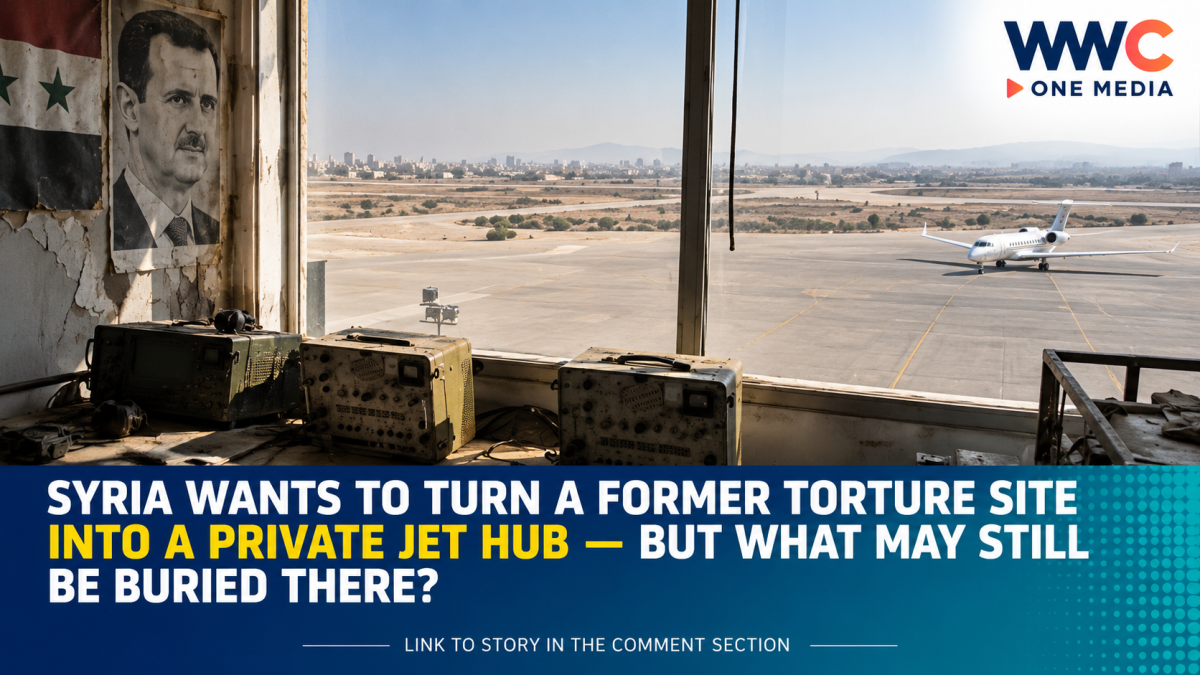
A plan to transform a former military airport in Damascus into a private-jet and business-aviation hub is triggering a fierce backlash from human-rights advocates and local residents, who warn that redevelopment could disturb suspected mass graves and potentially destroy evidence linked to Assad-era abuses.
The site at the center of the controversy is Mezzeh military airport, a facility that was deeply associated with Syria’s former security apparatus under Bashar al-Assad and his father, Hafez al-Assad.
Syria’s civil aviation authority says it wants to convert the airport for limited civilian operations, primarily serving private and executive aviation, while allowing it to operate alongside Damascus International Airport. Preliminary work, including rubble removal and upgrades to air-navigation infrastructure, has already begun.
But newly surfaced documents and investigations have transformed what might otherwise look like an ordinary airport redevelopment project into a highly sensitive test of how Syria deals with the legacy of decades of repression.
The airport’s dark history
During the Assad era, Mezzeh was more than a military airfield.
It housed important elements of the Air Force Intelligence Directorate, as well as detention facilities where government opponents were reportedly subjected to torture, executions and enforced disappearance. Human Rights Watch documented detention and torture facilities at the Mezzeh airport complex more than a decade ago.
The United Nations’ Syria investigation has also documented deaths and severe mistreatment of detainees associated with the Air Force Intelligence branch at Mezzeh.
Now, documents obtained by the Syria Justice and Accountability Centre (SJAC) and reviewed by Reuters provide an even more disturbing picture.
According to Reuters, Syrian military documents show that senior officials approved Mezzeh in 2012 as a location for executions of detainees sentenced to death by military field courts.
One document reportedly proposed moving executions from Sednaya prison to Mezzeh because the airport was a secure compound close to Damascus. Later communications discussed using a firing range and eventually a hangar near the runway as execution locations.
Suspected graves raise the biggest concern
The most urgent issue is what may remain underground.
A 2025 SJAC investigation identified two suspected grave sites connected to people who died in detention at Mezzeh. The organization said more than 1,150 detainees died at the site, including people who died through execution, torture or maltreatment.
In July 2025, SJAC provided Syria’s National Commission for Missing Persons with coordinates for the suspected graves and urged authorities to prevent construction or excavation until the sites could be investigated.
After redevelopment plans became public this month, SJAC sent another letter warning that excavation, rubble removal and other construction could potentially damage human remains and evidence that may be critical to identifying victims.
Importantly, the graves should be described as suspected, rather than presenting their contents as conclusively established. The concern is that construction could interfere with sites that investigators believe may contain remains.
Syria says the airport project is about development
The Syrian government has presented the project in very different terms.
The General Authority of Civil Aviation and Air Transport says the airport would serve private and executive aviation and complement Damascus International Airport rather than replace it.
Authorities say the project is being developed in stages and will undergo technical, operational, environmental and regulatory assessments. Those assessments are supposed to consider the surrounding urban area, noise, air-traffic levels and legal and community considerations.
The broader vision has also been described as an aviation-focused development that could include business facilities, hotels, training institutions and maintenance services.
That could make Mezzeh an important piece of Syria’s effort to rebuild its aviation and investment infrastructure after years of war.
But critics argue that economic redevelopment cannot come before investigating potential graves and preserving evidence.
Residents are raising another major issue: land ownership
The controversy does not stop at human-rights concerns.
Reuters found that the airport occupies land that belonged to hundreds of private citizens. Land records from the Moadamiya municipality indicate that the airport was built across approximately 2.76 square kilometers of privately held land.
Residents have alleged that property was expropriated during the Assad era without adequate compensation.
Protests reportedly took place in Moadamiya after the redevelopment plans were announced, with residents demanding that their property claims be addressed before investors move forward.
The dispute comes at a particularly sensitive time.
On September 2, UN human-rights experts called on Syria to address laws associated with property dispossession under the former regime and urged mechanisms for returning property to legitimate owners or providing appropriate compensation.
A painful choice for Syria’s new authorities
The Mezzeh project puts Syria’s new authorities in a difficult position.
On one side is the enormous need to rebuild infrastructure, attract investment and restore economic activity after years of conflict.
On the other is the unresolved fate of tens of thousands of Syrians who disappeared during the Assad era, along with the families still searching for answers about what happened to their relatives.
For families of missing detainees, a construction project at a site potentially containing human remains is not simply an infrastructure project.
It could represent the loss of evidence they have waited years to recover.
Amer Matar, founder of the Syria Prisons Museum, told Reuters that proceeding with a business airport without first investigating potential graves, protecting the site and preserving evidence would show disregard for families still searching for missing relatives.
The bigger question: Can development and accountability coexist?
The dispute over Mezzeh highlights one of Syria’s biggest post-Assad challenges.
The country needs airports, businesses, investment and jobs. But it also needs to investigate alleged atrocities, locate missing people, preserve forensic evidence and resolve property disputes inherited from the previous government.
Those goals do not necessarily have to conflict.
But rights advocates argue that the order matters.
Before bulldozers reshape a site potentially connected to executions and disappearances, investigators may need an opportunity to determine what happened there—and whether the ground still holds answers for families who have spent years waiting.
For now, Syria’s plan remains focused on transforming Mezzeh into a specialized civilian aviation facility.
But the controversy has ensured that the airport’s next chapter will be about far more than private jets.
It will also test whether Syria’s drive toward reconstruction can move forward without burying the evidence of its past.


Leave a Reply