
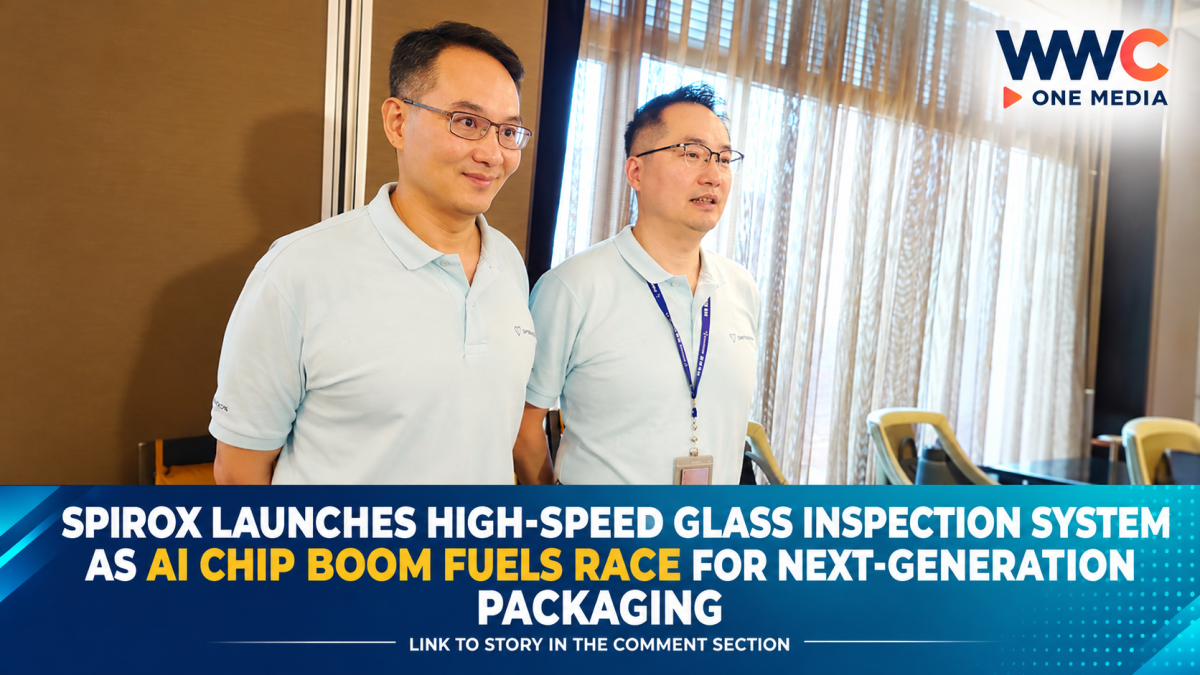
HSINCHU, Taiwan — Taiwan semiconductor equipment supplier Spirox Corp is making a bold push into next-generation chip packaging after launching its first high-speed inspection system designed to detect tiny cracks and defects inside advanced glass substrates.
The move comes as the artificial intelligence boom accelerates demand for more powerful chips, advanced packaging and high-bandwidth memory — creating a major opportunity for companies developing technologies that could help solve one of the semiconductor industry’s biggest manufacturing challenges.
Spirox said its new optical inspection system can detect microcracks and debris accumulation inside glass substrates, helping manufacturers improve yields and accelerate the move toward volume production of glass core and through-glass via, or TGV, technologies.
The Tiny Cracks That Could Hold Back the Next Chip Revolution
Glass is emerging as one of the semiconductor industry’s most closely watched materials for next-generation advanced packaging.
But there is a major problem.
Traditional optical inspection systems can struggle to detect extremely small internal cracks located deep inside transparent glass, particularly when manufacturers need to inspect materials at high speed.
That is where Spirox is placing its bet.
Chairman Peter Chin said the company’s new system was designed to identify microscopic cracks and debris that could affect manufacturing yields — a critical issue as chipmakers work to bring glass-based technologies from research and testing into large-scale production.
“We have attracted strong interest from Taiwan, Japan, the US and South Korean customers,” Chin said, adding that companies working on glass-based technologies have been approaching Spirox.)
AI Boom Is Changing the Future of Chip Packaging
The launch comes as AI, high-performance computing and high-bandwidth memory are pushing semiconductor companies to rethink how increasingly powerful chips are packaged and connected.
Advanced packaging has become one of the industry’s biggest battlegrounds because simply making transistors smaller is no longer enough to deliver the performance required for AI data centers and next-generation computing.
Glass core substrates and TGV technologies are increasingly being explored because they could offer improvements in areas such as:
- Thermal performance
- Power integrity
- Warpage control
- Signal performance
- Defect reduction
Major semiconductor companies are targeting the commercialisation of glass core and TGV technologies around 2028, according to Spirox, while engineering trials and process verification are expected to begin driving equipment demand as early as next year.
Spirox Targets Dozens of System Sales
Spirox said it aims to sell dozens of its new high-speed optical inspection systems next year, targeting applications involving TGV and through-silicon via technologies.
The system can also detect optical waveguides created inside glass substrates using lasers, according to chief executive officer Paul Yang.
These structures can be paired with emerging technologies such as glass couplers and glass bridges, potentially expanding the role of Spirox equipment beyond conventional defect inspection.
For the company, however, the technology represents something even bigger.
It is part of a fundamental transformation of Spirox itself.
From Equipment Distributor to Technology Developer
For years, Spirox primarily operated as a distributor of semiconductor equipment developed by other companies.
Now it wants to become a technology developer in its own right.
Yang said the new inspection system is critical to Spirox’s strategy of transforming from an equipment distributor into a developer of its own branded semiconductor manufacturing equipment.
The shift is already beginning to show up in the company’s financial results.
Spirox swung to a net profit of NT$13.64 million (US$432,535) last quarter, reversing a NT$103.95 million loss recorded a year earlier.
The company has streamlined its equipment distribution operations while focusing more heavily on developing its own products.
Its long-term goal is even more ambitious: Spirox wants own-brand equipment to account for 80% to 90% of its revenue.
TSMC Connection Raises Spirox’s Profile
Spirox gained significant attention within the semiconductor industry after its name appeared in validation results presented by Taiwan Semiconductor Manufacturing Co (TSMC) at the JPCA Show in June.
During a presentation titled “Glass Substrate Development for CoWoS,” TSMC discussed its work with Japanese substrate supplier Ibiden and Taiwan’s Innolux to develop glass core substrate technology.
Spirox helped Innolux validate the glass core substrate.
According to the reported validation results, the technology showed significant improvements in warpage, thermal performance, power integrity and defect rates.
The industry is exploring panel-based processing as one potential way to overcome physical limitations associated with traditional organic and silicon interposers.
Why Glass Could Become the Semiconductor Industry’s Next Big Bet
The AI revolution is forcing chipmakers to solve a growing list of engineering problems.
More computing power generates more heat.
More memory requires faster and more efficient connections.
And increasingly complex AI chips need new ways to integrate processors, memory and other components into advanced packages.
That is why technologies such as glass substrates, TGV and advanced optical interconnects are attracting so much industry attention.
For equipment companies like Spirox, the opportunity is enormous — but so is the risk.
Glass-based semiconductor packaging is still emerging, and the companies that can solve its manufacturing and inspection challenges could secure valuable positions in the next generation of the global chip supply chain.
The Bottom Line
Spirox is betting that one of the semiconductor industry’s smallest problems — microscopic cracks hidden deep inside glass — could become one of its biggest business opportunities.
The Taiwanese company has launched a high-speed inspection system as global chipmakers race to develop glass core and TGV technologies for next-generation AI and high-performance computing.
With major semiconductor companies targeting commercialisation around 2028, Spirox is preparing for a potentially explosive rise in demand — while transforming itself from a distributor into a homegrown semiconductor equipment developer.
And with TSMC, AI and glass-based packaging now reshaping the chip industry’s future, the biggest question is whether Spirox has arrived early enough to become one of the key technology winners in the next semiconductor revolution.
WWC ONE MEDIA J.M.D




Leave a Reply