
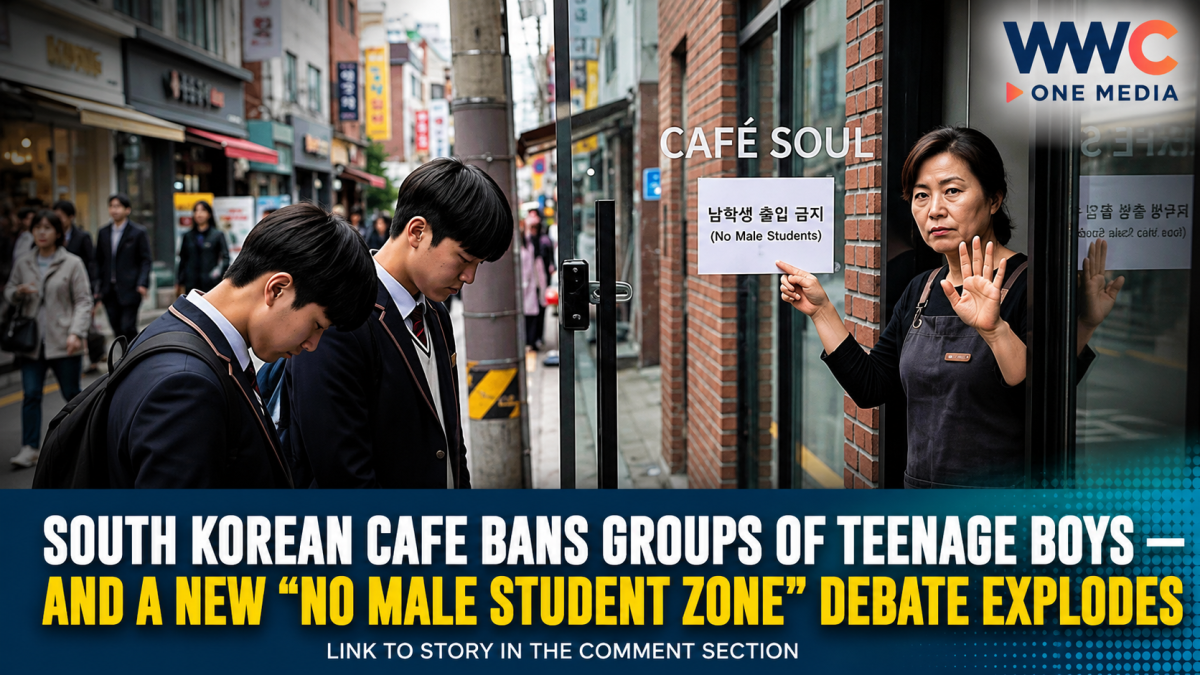
A Korean café has sparked a heated debate over discrimination, business owners’ rights and teenage behavior after putting up a notice banning groups of middle and high school boys from using the establishment.
The controversy erupted after a photo of the notice circulated on social media and online communities. The sign reportedly states that groups of male middle and high school students are prohibited from using the store, citing discomfort caused to other customers. The café attributed the decision to behavior including profanity and making a mess inside the establishment. The café’s exact location has not been publicly disclosed.
The notice quickly divided public opinion.
WHY DID THE CAFE BAN THEM?
According to reports, the café says the restriction was not introduced simply because the customers were teenagers.
Its explanation centers on what it describes as repeated disruptive behavior — particularly swearing during conversations and leaving the store messy.
Some online commenters said they understood the owner’s decision, arguing that café operators have to protect the experience of other customers and cannot be expected to tolerate repeated disruptive conduct. Similar accounts appeared in Korean media reports, with commenters describing situations in which groups of teenage boys allegedly became louder or more disruptive than individual customers.
But critics say that is precisely where the controversy begins.
Instead of dealing with customers based on specific behavior, the café’s notice applies the restriction to an entire demographic: male students in middle and high school.
That has led critics to accuse the policy of collective punishment and excessive generalization.
“OWNER’S RIGHT” VS. “DISCRIMINATION”
The argument has quickly become bigger than one café.
Supporters say private businesses need some freedom to establish rules that protect their customers and employees. If particular groups repeatedly cause disruptions, they argue, owners should have the ability to respond.
Opponents counter that bad behavior should be addressed individually, rather than assuming every teenage boy will behave badly.
One recurring criticism online has been essentially: if a customer swears, makes excessive noise or damages the premises, deal with that customer — don’t automatically exclude everyone who fits the same age and gender category.
The disagreement reflects a much older Korean debate over so-called “no-X zones.
FROM “NO-KIDS ZONES” TO “NO-MALE-STUDENT ZONES”
South Korea has debated restrictions on specific customer groups for years.
“No-kids zones” — businesses that prohibit children — became increasingly visible more than a decade ago. Similar concepts have since appeared around older customers and other demographic groups.
The latest controversy has now added teenage boys to that conversation.
The Korea Times, citing its sister publication Hankook Ilbo, described the latest case as part of a broader trend in which businesses use “no-X zone” policies to exclude particular demographic groups.
The concern is that once businesses begin defining customers by category rather than conduct, almost any group could potentially become the next target.
WHAT DOES KOREA’S HUMAN RIGHTS COMMISSION SAY?
South Korea’s National Human Rights Commission has previously taken a critical position toward blanket exclusion based on demographic characteristics.
In a 2017 decision concerning a restaurant that prohibited children aged 13 and under, the commission concluded that excluding an entire age group without a reasonable justification constituted discrimination. It acknowledged that businesses have freedom to operate, but said that freedom is not unlimited when an entire group is excluded from services.
The commission also emphasized an important principle: the misconduct of some customers should not automatically be generalized to an entire demographic. It suggested that businesses could instead establish clear behavioral rules, warn customers and restrict or remove individuals who actually violate those rules.
That earlier decision does not automatically determine the legality of this particular café’s policy, but it provides important context for why the new controversy is being framed as a discrimination issue.
THE DEBATE IS GETTING EVEN BIGGER
South Korean broadcaster Channel A reported that the issue is not limited to one viral notice.
Its report featured a Seoul franchise café where staff said they had been restricting groups of three or four teenage boys since March based on their behavior. The business alleged that some groups used profanity, were excessively loud and even lay on chairs, disturbing other customers.
The same report also highlighted the other side: teenage boys interviewed said they felt unfairly targeted and argued that they should have the same opportunity to use cafés as other customers.
That is the heart of the dispute:
Where does a business owner’s right to control their premises end — and where does unfair exclusion begin?
THE BIGGER SOCIAL QUESTION
The controversy exposes a growing tension in modern Korean society.
Customers increasingly expect cafés and restaurants to provide quiet, comfortable environments. Business owners, meanwhile, face pressure when particular customers disrupt that environment.
But blanket bans can create a different problem.
If a café bans specific behavior, the rule can theoretically apply to anyone.
If it bans an entire demographic, critics argue that innocent customers are punished for something they did not do.
And that is why this seemingly small café notice has become a much larger conversation about age, gender, stereotypes, business freedom and discrimination in South Korea.
For now, the café’s location and the full circumstances that led to the notice remain undisclosed. That makes it difficult to independently assess how extensive the reported behavioral problems actually were.
But one thing is already clear:
The “no-X zone” debate in South Korea isn’t disappearing. It’s evolving — and teenage boys may now be at the center of its next major battle.
WWC ONE MEDIA G.A




Leave a Reply