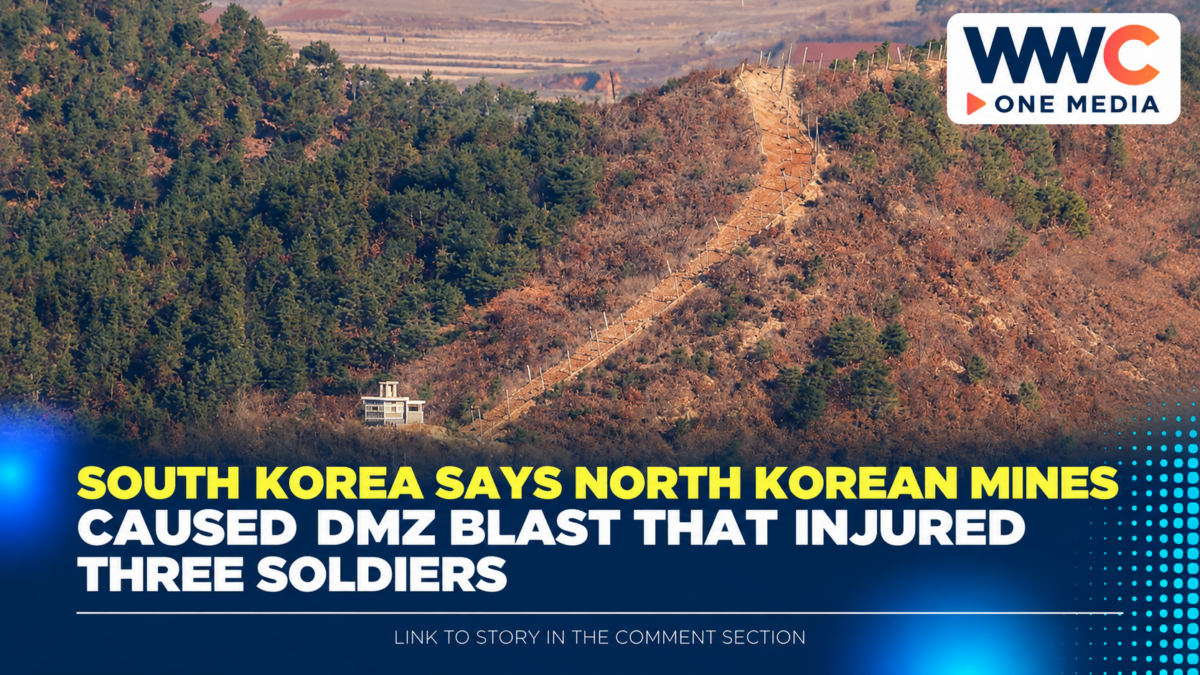
South Korea’s military has concluded that landmines planted by North Korea caused an explosion inside the Demilitarized Zone (DMZ) last month that seriously injured three South Korean soldiers, escalating tensions along the heavily fortified border.
The South Korean Joint Chiefs of Staff (JCS) announced its final findings on Monday (Oct. 5), saying a joint investigation with the United Nations Command found that North Korean anti-personnel mines had been deliberately buried south of the Military Demarcation Line (MDL).
The conclusion followed an explosion on Sept. 21 that injured three South Korean troops conducting routine operations inside the DMZ. Two suffered severe injuries to their ankles, while a third sustained minor injuries.
Investigation Links Mines to North Korea
South Korean military officials said fragments recovered from the injured soldiers matched the design of North Korean plastic anti-personnel mines previously found in the area.
The mines contained TNT and thermosetting resin components consistent with North Korean ordnance. Investigators also identified distinctive features, including a brown casing and lattice-patterned cover, that matched previously recovered North Korean mines.
The JCS said the mines were buried between about three and 10 centimetres underground rather than being mines that had simply been washed into the area by flooding.
GPS measurements showed that the blast sites were approximately 10 metres south of the MDL, according to the South Korean military.
The United Nations Command concluded that the mines had been intentionally placed and estimated that they were installed around 12 months before the September explosion.
South Korea said the findings provided the basis for its conclusion that North Korea was responsible.
Three Soldiers Injured in September Blast
The Sept. 21 explosion occurred as South Korean troops were carrying out routine operations near the inter-Korean border.
Two of the soldiers suffered serious injuries, while another sustained less severe injuries.
South Korea’s military had initially described North Korean mines as the likely cause of the explosion. A preliminary investigation found that two mines detonated and that a third unexploded mine was discovered as soldiers withdrew from the area.
The discovery of the additional mine prompted further investigation and heightened concern that North Korean forces may have placed multiple mines south of the MDL as part of their broader border fortification activities.
Seoul Demands Apology and Mine Removal
Following the final findings, South Korea demanded that North Korea apologise to the injured soldiers and remove mines that Seoul says were planted in violation of the Korean War Armistice Agreement.
Lt. Gen. Kwon Dae-won, vice chairman of South Korea’s Joint Chiefs of Staff, said the military would continue mine-removal operations if North Korea did not voluntarily remove the mines.
South Korean forces carried out a mine-clearing operation on Monday at a site identified during the investigation. The military said the operation targeted the minefield south of the MDL that had been verified by the United Nations Command.
North Korea Rejects Seoul’s Findings
North Korea has denied responsibility for the explosions.
Kim Yo Jong, the sister of North Korean leader Kim Jong Un, previously rejected South Korea’s accusations as groundless and dismissed Seoul’s demand for an apology.
Pyongyang has also warned that it would take retaliatory action if South Korean forces attack North Korean personnel involved in border fortification work.
The competing claims mean that while South Korea and the United Nations Command say the evidence points to deliberately planted North Korean mines, North Korea disputes that conclusion.
North Korea Has Been Strengthening Its Border
The mine dispute comes as North Korea has significantly increased construction and military activity along its border with South Korea.
According to the South Korean military, North Korea began intensifying its border fortification efforts in April 2024, reinforcing fences, installing mines and building anti-tank barriers.
The JCS estimated that as many as 7,000 North Korean personnel could have been involved in the work each day, particularly along the eastern section of the border.
South Korea also reported more than 50 instances of North Korean personnel crossing south of the MDL this year, compared with nine such incidents in 2024 and 17 in 2025.
The South Korean military has said some of those incidents occurred as North Korean personnel worked on the fortifications.
DMZ Remains One of the World’s Most Heavily Fortified Borders
The DMZ stretches roughly 250km across the Korean Peninsula and separates North and South Korea along a buffer zone established under the 1953 armistice.
Although the DMZ is officially intended to separate the two militaries, both sides maintain extensive military infrastructure around it.
The two Koreas technically remain at war because the 1950-53 Korean War ended with an armistice rather than a formal peace treaty.
The Armistice Agreement prohibits hostile acts within, from or against the DMZ and restricts unauthorised crossings of the military demarcation line. The United Nations Command has said the placement of a North Korean anti-personnel mine south of the MDL would constitute a violation of the agreement.
Tensions Rise as Dialogue Remains Stalled
The latest dispute comes as relations between Seoul and Pyongyang remain strained despite efforts by South Korea’s government to reopen channels of communication.
President Lee Jae Myung’s administration has previously proposed talks aimed at reducing tensions and preventing accidental military clashes along the border.
North Korea has not responded to those proposals and has increasingly described South Korea as a hostile state.
The mine blast adds another complication to those efforts, particularly as both sides maintain heavily fortified positions along the border.
For South Korea, the final investigation has strengthened its case that the Sept. 21 explosion resulted from North Korean military activity. For Pyongyang, the accusation remains unacceptable and has been rejected outright.
With South Korea now conducting mine-clearance operations and North Korea continuing to deny responsibility, the incident risks becoming another flashpoint along one of the world’s most closely watched military borders.