
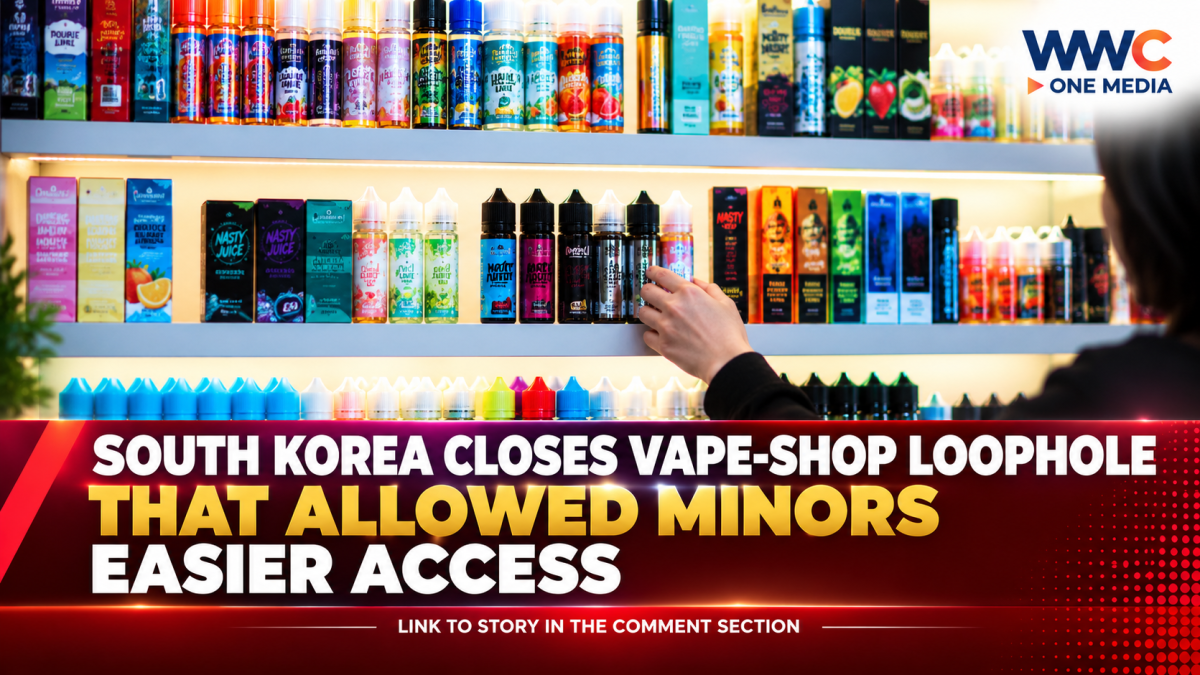
SEOUL, South Korea — South Korea has tightened its regulation of electronic cigarettes, closing a long-standing legal loophole that had made it easier for minors to access some nicotine products at unmanned vape shops.
The major change came after the government expanded the legal definition of tobacco to include nicotine-based products, including synthetic nicotine, bringing liquid electronic cigarettes under regulations that already applied to conventional tobacco products.
The revised rules took effect on April 24, 2026, marking the first major expansion of the legal definition of tobacco since the law was introduced in 1988.
Why Unmanned Vape Shops Became a Problem
South Korea’s previous tobacco rules focused on products containing tobacco leaf. That created a regulatory gap for liquid products made with synthetic nicotine.
Because these products fell outside the traditional legal definition of tobacco, some unmanned vape stores were able to operate without the same licensing and age-verification requirements imposed on conventional tobacco retailers.
The loophole became increasingly controversial as unmanned stores and vending machines expanded, raising concerns about whether young people could purchase nicotine products without adequate age checks.
A government inspection highlighted the problem: among 241 e-cigarette vending machines inspected, 17 lacked age-verification devices and another 10 had devices that were not functioning.
New Rules Put Synthetic Nicotine Under Tobacco Controls
The revised Tobacco Business Act changes that framework.
Synthetic-nicotine and other nicotine-based products are now treated as tobacco products for regulatory purposes. That means sellers must comply with requirements involving adult verification, health warnings, advertising restrictions and retail controls.
Unmanned retailers and vending machines are also subject to stricter requirements, including systems designed to verify that purchasers are adults.
The government has also moved to restrict where tobacco vending machines can be installed, with requirements designed to prevent unrestricted access in public areas.
Stronger Restrictions on Marketing
The regulatory overhaul goes beyond simply checking a customer’s age.
Products covered by the expanded definition must comply with tobacco-related health-warning requirements, while advertising and promotional practices face tighter restrictions.
The government has specifically moved against marketing approaches that could increase the appeal of nicotine products to young people, including certain flavored-product labeling and promotional practices.
Violations can carry significant penalties, including fines and possible imprisonment for certain offenses.
The Bigger Youth-Protection Concern
The debate surrounding unmanned vape stores reflects a broader challenge for South Korea: technology has made retail more convenient, but automated sales can also make enforcement more difficult when products are legally restricted by age.
Earlier inspections showed that age-verification systems were not consistently installed or operational, exposing weaknesses in the previous regulatory framework.
South Korean authorities have therefore shifted toward regulating the product itself, rather than relying on whether a particular nicotine product contains tobacco leaf.
That distinction is important because synthetic nicotine had previously occupied a regulatory gray area.
A Major Shift in Korea’s Tobacco Policy
The reform represents a significant change in how South Korea regulates electronic cigarettes.
For decades, the country’s tobacco definition largely centered on tobacco-leaf products. By extending the definition to nicotine-based products, authorities can apply the same broader tobacco-control framework to newer forms of vaping.
Korea JoongAng Daily reported that unmanned stores are now required to install age-verification systems, while liquid e-cigarettes are also subject to tobacco-related taxation and other regulatory requirements.
The government has described the changes as necessary to keep regulation aligned with rapidly evolving nicotine products.
Why It Matters
The crackdown is not simply about unmanned stores. It represents South Korea’s attempt to eliminate a regulatory gap created by the rapid emergence of synthetic-nicotine products.
For consumers and retailers, the message is increasingly clear: synthetic nicotine is no longer sitting outside the country’s core tobacco-control framework.
For authorities, the next challenge is enforcement — particularly ensuring that automated retail systems actually prevent underage purchases rather than merely requiring age-verification technology on paper.
South Korea’s move could also become a closely watched example of how governments adapt tobacco regulations as nicotine products evolve beyond traditional cigarettes.




Leave a Reply