
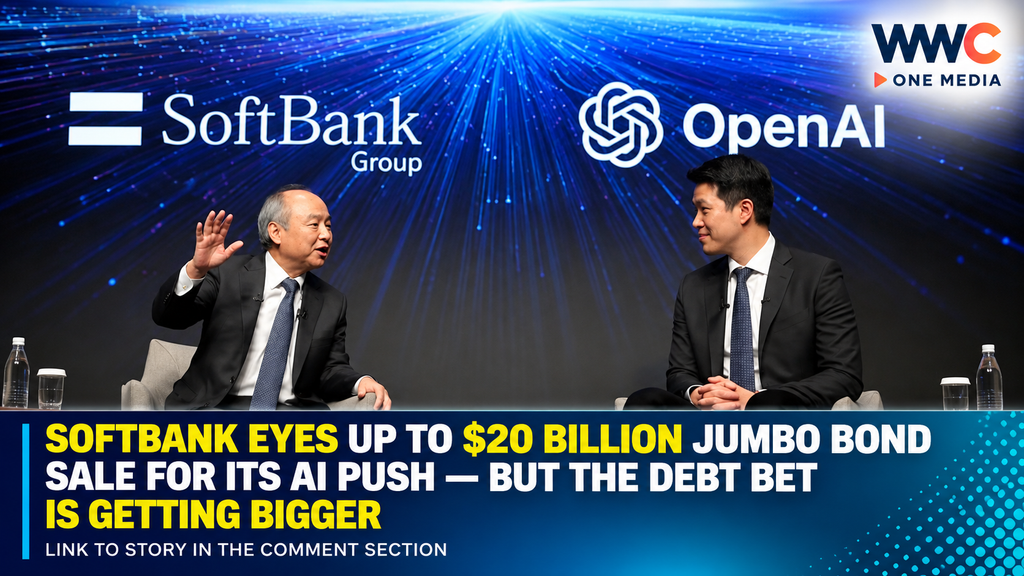
SoftBank Group is preparing to test investor appetite for what could become one of the biggest corporate bond offerings by an Asian company this year, as the Japanese conglomerate searches for longer-term funding to support its aggressive artificial intelligence strategy and refinance debt tied to its investment in OpenAI.
SoftBank executives, including Chief Financial Officer Yoshimitsu Goto, are scheduled to meet investors in New York from September 14 to 17 to gauge demand for a potential U.S.-dollar-denominated junk-bond offering, according to reporting by Bloomberg cited by The Japan Times and other financial outlets.
The potential transaction could raise $10 billion to $20 billion, although no final amount has been decided and the discussions do not necessarily mean a bond sale will proceed. The company could also include euro-denominated debt, according to people familiar with the matter.
If SoftBank proceeds at the upper end of the range, the deal would represent a major expansion of the company’s borrowing program and could rank among the largest Asian corporate bond offerings of 2026.
Why SoftBank needs so much money
At the center of the fundraising push is SoftBank’s increasingly aggressive bet on artificial intelligence.
The company has committed tens of billions of dollars to AI-related investments, including a planned investment of roughly $65 billion in OpenAI by October, with part of that commitment financed through borrowing.
SoftBank also secured a $40 billion bridge loan earlier this year connected to its OpenAI investment. The potential bond offering could provide longer-term financing to help refinance that short-term borrowing.
That means the proposed bond sale isn’t simply about raising fresh cash for another investment. It is also part of SoftBank’s effort to restructure and extend the financing behind its enormous AI ambitions.
SoftBank is already tapping Japan’s bond market
The potential U.S. bond deal comes just days after SoftBank completed pricing for a record ¥1 trillion ($6.3 billion) retail corporate bond in Japan.
The seven-year notes carry a 4.75% annual coupon and mature in September 2033. SoftBank said the proceeds will be used partly to repay domestic bonds and partly to fund its acquisition of the ABB Robotics business.
The Japan Times reported that the ¥1 trillion transaction was the largest retail corporate bond offering in Japan and helped demonstrate growing demand from individual investors seeking returns above traditional bank deposits.
The offering is also significant for Japan’s broader debt market. Yen-denominated retail corporate bond issuance had already reached ¥2.88 trillion by September 4, surpassing the full-year total of every previous year, according to Bloomberg data cited by The Japan Times.
Why investors are watching closely
SoftBank’s borrowing spree comes as investors are becoming increasingly focused on the amount of debt being used to finance the global AI boom.
The proposed U.S. notes would reportedly target institutional investors through the Rule 144A market, potentially giving SoftBank access to a much larger pool of U.S. investors than its traditional offshore bond offerings.
But the financing comes with an important consideration: SoftBank carries significantly different credit assessments across rating agencies. Its Japanese retail bonds have received investment-grade ratings from Japanese agencies, while major international rating agencies classify the group as speculative grade.
That credit-risk premium helps explain why SoftBank has historically had to offer relatively high yields to attract investors.
In April, for example, the company sold dollar- and euro-denominated bonds totaling about $3.6 billion, including a 10-year dollar tranche carrying an 8.5% coupon.
The bigger AI financing race
SoftBank’s fundraising plans also highlight how expensive the global AI race has become.
Technology companies are borrowing enormous sums to finance data centers, computing infrastructure, chips and AI models. Bloomberg data cited in August indicated that companies had already borrowed more than $410 billion in bond markets during 2026 for data centers and related AI investments.
For SoftBank, the stakes are particularly high because its investment strategy increasingly revolves around AI infrastructure and companies that could benefit from the technology’s expansion.
The group is therefore attempting to balance two objectives: securing enough capital to pursue Masayoshi Son’s ambitious AI vision while preventing its financing burden from becoming a bigger concern for investors.
The next test is coming
SoftBank’s New York meetings could provide an early indication of whether global investors are willing to absorb another enormous tranche of debt from the Japanese conglomerate.
The company has not committed to a specific U.S. bond size, and the investor meetings are being used to assess potential demand rather than announce a finalized transaction.
But if SoftBank ultimately chooses to raise $20 billion, the move would send a powerful signal about the scale of financing now required to sustain its AI strategy.
And that leaves investors with the biggest question: How much debt can SoftBank take on before its massive AI opportunity starts looking like an equally massive financial risk?
Leave a Reply