
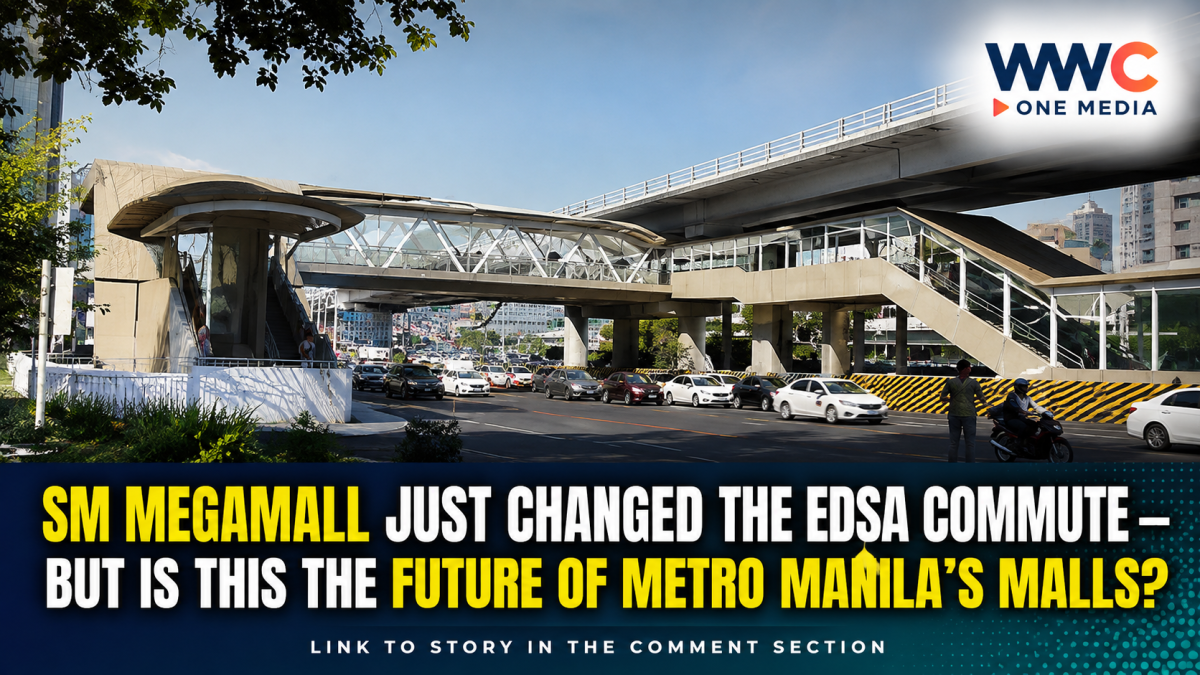
For millions of Filipinos who rely on EDSA every day, a few hundred meters of walking can mean battling heat, rain, crowds and congested footbridges.
That is precisely the problem SM Megamall’s new EDSA Busway Concourse is designed to address.
Opened to the public in April 2026, the elevated, covered connection links SM Megamall Building A directly with the Ortigas station of the EDSA Bus Carousel. Instead of forcing commuters to navigate a lengthy and congested route across EDSA, the new walkway provides a more direct connection between the mall and the busway.
And while the project may look like a simple pedestrian bridge, its significance is much bigger.
EDSA’S MASSIVE BUSWAY DEMAND IS DRIVING THE CHANGE
The EDSA Busway has become one of Metro Manila’s most heavily used public transportation corridors.
The Department of Transportation reported that the busway carried 66.67 million passengers in 2025, a 5.89% increase from the previous year. That translates to an average of roughly 182,000 passenger trips per day when spread across the year. SM Supermalls, meanwhile, has cited a January 2025 daily average of more than 170,000 passengers.
That scale of demand puts enormous pressure on the stations and pedestrian infrastructure surrounding EDSA.
At Ortigas, where the busway intersects with one of Metro Manila’s major business and commercial districts, simply getting from the bus station to a destination can become part of the commuting ordeal.
The new SM Megamall connection attempts to remove one of those bottlenecks.
MORE THAN A WALKWAY
The concourse is elevated, enclosed and weather-protected. It includes escalators, elevators and accessible pathways intended to make the connection easier for persons with disabilities, senior citizens and pregnant commuters.
The connection also gives passengers direct access to the EDSA Bus Carousel platform, which serves northbound trips toward Monumento and southbound trips toward the Parañaque Integrated Terminal Exchange.
For commuters, the benefit is straightforward: less exposure to traffic, fewer difficult crossings and a shorter path between transportation and destination.
Top Gear Philippines reported that the facility officially opened on April 1, 2026, describing it as an elevated connection between SM Megamall and the Ortigas EDSA Bus Carousel station.
THE BIGGER STORY: WHEN MALLS BECOME PART OF THE TRANSPORT SYSTEM
This is where the development becomes more interesting.
Malls have traditionally been destinations people travel to. Increasingly, major commercial developments along EDSA are also becoming places people travel through.
The concept is not entirely new.
In 2021, the Philippine Daily Inquirer reported plans for EDSA Busway concourses at SM North EDSA, SM Megamall and SM Mall of Asia, with the facilities envisioned as complements to the government’s Busway program.
The Department of Transportation later partnered with SM Prime Holdings and other agencies for EDSA Busway bridge-and-concourse projects designed to provide safer, more accessible connections between bus stations and major commercial areas. PNA reported that the planned facilities included ramps, elevators, ticketing areas and automated fare-collection interfaces.
That means the SM Megamall link is not an isolated convenience project. It is part of a broader evolution in how Metro Manila’s transport infrastructure connects with privately developed spaces.
SM NORTH EDSA SHOWS WHERE THIS COULD GO
SM Megamall is also not the first SM property to embrace direct transit connectivity.
A similar approach has been implemented at SM North EDSA, while the SM North EDSA–MRT-7 connection is being developed to improve access between the mall and the emerging Common Station transport network. GMA News reported that the project is intended to connect commuters more seamlessly with MRT-3, LRT-1 and MRT-7 while providing a covered pedestrian route.
The potential implications are significant.
If more commercial centers directly integrate with major transport stations, Metro Manila could gradually develop a network in which malls, offices, rail stations and bus corridors function as interconnected pedestrian environments rather than isolated destinations.
BUT THERE IS A QUESTION BEYOND CONVENIENCE
The success of projects like the SM Megamall Busway Concourse raises a bigger question:
Should private developments increasingly become part of the city’s public mobility infrastructure?
There are obvious advantages.
Privately developed connections can provide additional space, weather protection, elevators and other amenities that government transport projects may struggle to deliver quickly.
But the bigger challenge is making sure these connections remain part of a coherent citywide transportation strategy.
A convenient walkway to one mall does not solve EDSA’s larger problems if commuters still encounter unsafe crossings, overcrowded stations, missing pedestrian links or difficult transfers elsewhere.
That is why the broader push to improve EDSA Busway infrastructure matters.
In January 2026, PNA reported that the government had completed rehabilitation work on the dedicated busway lanes, restoring normal operations along the rehabilitated sections.
Meanwhile, the government has also been pursuing additional concourses and pedestrian upgrades at other Busway stations. President Ferdinand Marcos Jr. inspected the upgraded Kamuning Station footbridge and concourse in March, with the project featuring elevators, wheelchair lifts and a covered walkway.
THE COMMUTE IS BECOMING PART OF THE DESTINATION
SM Megamall’s new connection represents something larger than a shorter walk.
It reflects a changing Metro Manila, where transportation, retail, offices and pedestrian infrastructure increasingly overlap.
For commuters, that could mean a future in which transferring from a bus to a mall, office tower or another transport line does not require stepping into chaotic traffic or navigating exposed and overcrowded sidewalks.
For developers, it could mean that accessibility to public transportation becomes a more important part of how major commercial properties are designed.
And for the government, it presents another opportunity—and responsibility—to make sure private-sector infrastructure complements rather than substitutes for a coordinated public transportation system.
The SM Megamall Busway link may therefore be just one small piece of Metro Manila’s transportation puzzle.
But with tens of millions of passenger trips moving through the EDSA Busway every year, small improvements at major interchange points could have an outsized impact on the daily lives of commuters.
The bigger question now is whether this model will remain concentrated around a handful of major malls—or become a blueprint for how Metro Manila connects its entire transport network.
WWC ONE MEDIA MJE

Leave a Reply