
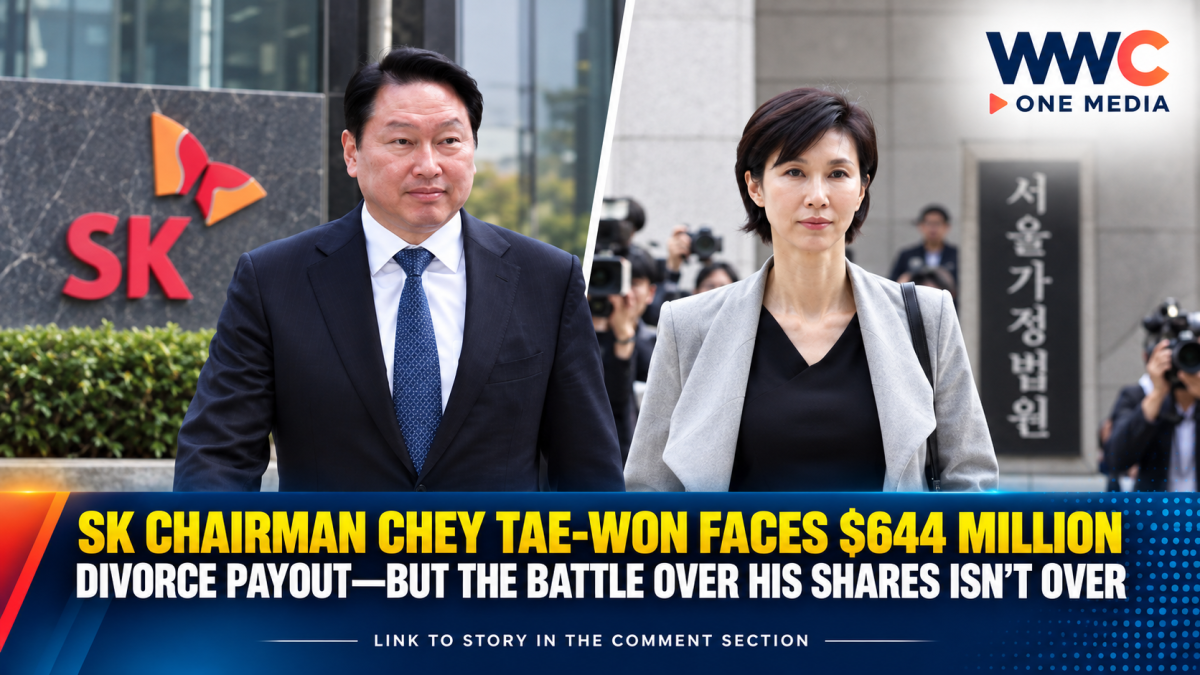
SEOUL — SK Group Chairman Chey Tae-won has been ordered to pay his former wife, Roh Soh-yeong, 944 billion won — about $644 million — in their long-running divorce and property division case, in a ruling that continues to rank among South Korea’s most closely watched corporate-family disputes.
The Seoul High Court issued the latest ruling on July 24, reducing the amount from the 1.38 trillion won awarded by the appeals court in 2024 but maintaining a key finding that could have major implications for Chey’s wealth: his holdings in SK Inc. are subject to marital property division.
The ruling came after South Korea’s Supreme Court sent the case back to the Seoul High Court for reconsideration, citing issues surrounding how the lower court had calculated the property division.
From $986 million to $644 million
The latest award represents a substantial reduction from the previous 1.38 trillion-won settlement, which was worth roughly $986 million at the time.
However, the revised amount remains dramatically higher than the original ruling.
In the first trial in 2022, Chey was ordered to pay Roh 66.5 billion won in property division and 100 million won in alimony.
The 2024 appellate ruling then increased the property division award to 1.3808 trillion won, making it one of the largest divorce settlements ever ordered in South Korea.
The latest decision therefore represents a middle ground: significantly below the previous appellate award, but still more than 14 times the original property-division amount.
The SK shares remain at the center of the dispute
The biggest issue is not simply the size of the cash payment.
The Seoul High Court again recognized Chey’s SK shares as part of the couple’s marital property, meaning they remain relevant to the calculation of Roh’s entitlement.
That finding is particularly significant because Chey is the chairman of SK Group, one of South Korea’s largest conglomerates.
The court’s decision follows years of arguments over how Chey’s wealth and his contribution to the growth of SK should be treated in the division of marital assets.
Why the case became known as South Korea’s “divorce of the century”
The dispute has attracted enormous attention because it combines one of the country’s most powerful business families with an unusually large financial settlement.
Roh is the daughter of former South Korean President Roh Tae-woo, while Chey leads SK Group.
The couple married in 1988 and have three children. Their divorce proceedings have stretched across several years, turning what began as a private family dispute into a major legal and corporate story.
The enormous size of the settlement also raised broader questions about how South Korean courts determine the contribution of a spouse to the accumulation and growth of business assets.
Supreme Court intervention changed the trajectory
The case took another major turn when South Korea’s Supreme Court sent the dispute back to the appeals court.
The Supreme Court’s intervention followed controversy surrounding the earlier calculation of Roh’s contribution to the growth of SK Group and questions about evidence used in determining the couple’s property division.
The Seoul High Court subsequently reopened the case and recalculated the amount.
The result was the 944 billion-won award announced in July 2026.
A huge payout—but not the end of the story
Although the new figure is lower than the previous 1.38 trillion-won award, the ruling does not necessarily bring the dispute to an immediate end.
The court ordered Chey to pay 944 billion won in cash, with annual interest of 5 percent, according to Korea JoongAng Daily.
The continued recognition of his SK shares as marital property also keeps the corporate dimension of the case firmly in focus.
For investors and observers of South Korea’s chaebol system, the case illustrates how disputes involving the personal wealth of a conglomerate leader can intersect with the ownership structure of one of the country’s biggest business groups.
What happens next?
The latest ruling substantially changes the size of the financial award, but the fundamental battle over the couple’s assets remains historically significant.
Chey now faces a settlement of 944 billion won, rather than the previous 1.38 trillion won.
Yet the court’s continued treatment of his SK holdings as marital property means the consequences extend beyond a headline-grabbing cash payment.
The case has become a test of how South Korea’s courts balance marital contributions, corporate wealth and ownership accumulated during a decades-long marriage.
And while the amount has fallen by hundreds of billions of won, the legal fight surrounding one of South Korea’s most valuable corporate fortunes may not be finished yet.
WWC ONE MEDIA G.A




Leave a Reply