
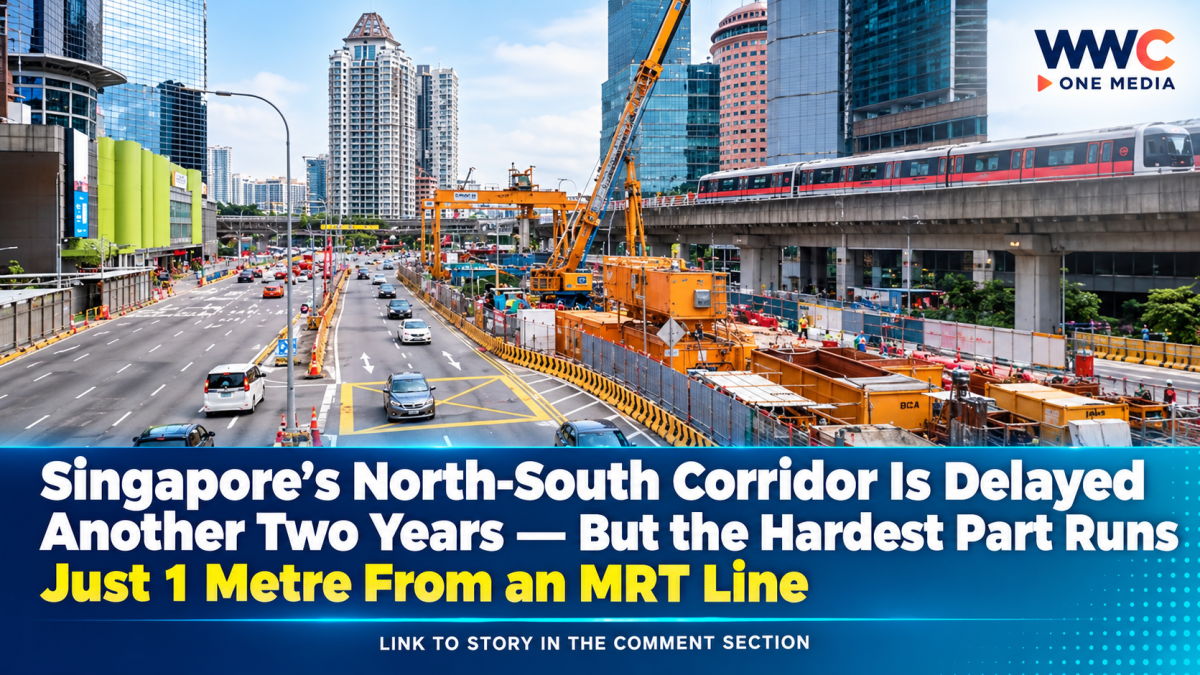
SINGAPORE — One of Singapore’s biggest transport projects has hit another major delay, pushing some of the North-South Corridor’s most important sections into the next decade.
The Land Transport Authority said on Thursday, September 17, that unexpectedly difficult underground conditions have forced it to revise the opening schedule by about two years. The northern viaduct from Admiralty Road West to Lentor Avenue will now open progressively from 2029, while the underground section extending from Lentor Avenue to the East Coast Parkway will begin opening in phases from 2031.
The previous schedule was 2027 for the viaduct and 2029 for the tunnel.
That means motorists waiting for a direct alternative to the Central Expressway will have to wait longer.
But below Novena, engineers are confronting something more consequential than a missed deadline.
They are excavating one North-South Corridor tunnel above an operational North-South MRT Line tunnel and another below it, with live rail infrastructure squeezed between them. In one critical section, construction comes within roughly 1 metre of the MRT line.
Engineers found fractured rock and water where they did not expect it
At Novena, the North-South Corridor’s southbound tunnel has already been completed.
The northbound tunnel is the problem.
Engineers encountered fractured rock and groundwater inflows that made the originally planned tunnelling method too risky. LTA therefore switched to a slower technique in which the ground is excavated in smaller sections, followed by grouting and the installation of structural supports as work progresses.
That extra caution is not optional.
LTA said the method is necessary to prevent soil movement or settlement that could affect both MRT operations and surface traffic in Novena.
The upper half of the northbound tunnel is being excavated through softer ground where water is seeping in.
The lower half runs through rock.
So engineers cannot simply dig the entire tunnel using one technique.
The tunnel now has to be built in two separate phases
LTA says tunnelling through the softer upper section began in August and should be completed by the end of 2026.
The lower section is even more challenging.
Excavation will start in 2027 and continue through 2028 using controlled blasting.
That means workers are effectively constructing a major road tunnel beneath one of Singapore’s busiest urban areas while protecting an operating railway line sandwiched inside the excavation zone.
The engineering constraint helps explain why simply adding more workers or machinery cannot automatically recover the lost time.
There are limits to how aggressively excavation can proceed when trains continue operating nearby.
Thomson brought another surprise: much more rock
Novena is not the only trouble spot.
Around Thomson, engineers also encountered rock formations that were harder and higher than expected.
LTA said the volume of rock that had to be removed was equivalent to about seven Olympic-sized swimming pools.
The effect on productivity was dramatic.
A tunnel structure that could have taken roughly one week to construct without the unexpected rock instead required about one month.
That is the kind of delay that compounds across a project stretching more than 20km.
One difficult geological section can slow the next construction stage, which delays the stage after that.
Even the elevated viaduct ran into underground problems
The northern portion is elevated, but that does not mean it escaped geological risk.
At Gambas Avenue and Woodlands Avenue 8, crews encountered fractured rock and other unexpected ground conditions beneath the planned viaduct foundations.
Some piles therefore had to be driven deeper than originally expected before engineers could establish sufficiently secure foundations.
LTA had said several days before announcing the new delay that more than 90% of viaduct foundation works were completed, with construction moving increasingly toward installing columns and precast viaduct sections.
But delays in foundations have consequences farther up the construction sequence.
A viaduct segment cannot be installed until the structures supporting it are ready.
And Singapore is building its longest viaduct
The northern viaduct itself is enormous.
It stretches 8.8km, is about 40m wide in some sections and rises to roughly 19m, or more than six storeys. It will be Singapore’s longest road viaduct.
More than 6,000 precast elements have to be manufactured, transported and installed.
Many of the largest installation jobs can only be performed during four- to five-hour overnight windows because engineers have to minimise disruption to active roads and bus routes below.
Some individual precast pieces weigh between roughly 100 and 160 tonnes, according to earlier LTA reporting.
This is another reason the schedule cannot simply be accelerated indefinitely.
Singapore cannot shut major roads for days every time a segment needs to be lifted into position.
Why didn’t engineers discover all this rock earlier?
That may be the question many Singaporeans ask after hearing about another delay.
LTA says extensive ground investigations and engineering studies were conducted during planning, design and construction.
But underground geology can change significantly over very short distances.
The challenge becomes greater in places such as Thomson and Novena because engineers cannot freely drill exploratory holes everywhere they want.
The areas are already packed with operational MRT tunnels, utility lines, buildings and heavily used roads.
LTA said completely closing corridors so engineers could carry out much more extensive investigations would itself have caused major disruption and was not feasible. Some investigations therefore had to take place progressively as access became available during construction.
So the problem is not that no surveys were done.
It is that a 21.5km underground-and-elevated project running through a dense city cannot be completely mapped metre by metre before excavation begins.
This is actually the corridor’s second major schedule blow
The North-South Corridor’s timeline has already changed substantially.
The project was originally conceived as the North South Expressway before being redesigned in 2016 as a broader integrated transport corridor prioritising not only cars but buses, cyclists and pedestrians.
Major construction began in 2018.
At one point, the project was expected to be substantially completed around 2026.
COVID-19 disruptions and manpower constraints then pushed the schedule back.
By 2023, the government was targeting the viaduct for 2027 and the road tunnels for 2029.
Now both milestones have moved another two years.
The new schedule is:
Viaduct: progressively from 2029. Tunnel: progressively from 2031.
The S$7.47 billion figure is an old contract value — not necessarily today’s final project cost
Cost is another detail that requires careful wording.
When LTA awarded the final major civil contracts in 2019, the 14 civil contracts had a combined value of about S$7.47 billion.
That number is frequently described as the cost of the North-South Corridor.
But it should not automatically be treated as the project’s final all-in 2026 cost.
The latest announcement did not provide a new total cost or quantify how much the additional engineering work and revised timeline will add.
So headlines saying the project is now costing a particular higher figure would be speculation unless LTA releases updated financial details.
Residents were already calling it a decade of disruption before the latest delay
For people living along the route, the schedule revision is more than a project-management issue.
CNA TODAY spoke with more than 50 residents and businesses along the corridor in June, many of whom described years of noise, dust, changing roads and pedestrian diversions.
A Woodlands resident told CNA that construction noise had made sleeping difficult and that dust regularly reached her home.
In Novena, residents described repeatedly changing crossings, roads and bus stops as construction progressed.
Businesses have also felt the impact.
CNA reported that some shops around Thomson Road and Novena saw customers struggle to reach them because hoardings obscured storefronts and road diversions made access confusing. One gelato shop said sales had fallen about 25% after barricades went up.
Those complaints were recorded when people were still working on the assumption that the corridor would begin opening in 2027.
The first opening is now 2029.
But LTA says residents should see some relief before the road opens
The revised schedule does contain one important piece of better news.
LTA says construction disruption should begin easing before motorists can use the North-South Corridor itself.
From 2027, more work will move underground, which should gradually reduce surface noise.
From 2028, roads, footpaths and other construction-occupied spaces will start being reinstated in stretches, and some noise barriers can be removed.
From 2029, pedestrian links and cycling paths will begin to improve progressively.
The most complicated stretches around Thomson Road and the PIE interchange are expected to start seeing reinstatement from around 2030.
So the public does not necessarily have to wait until 2031 for every construction barrier to disappear.
Why Singapore is still building it despite the disruption
The project is designed to solve a long-term transport problem.
The North-South Corridor runs 21.5km from Admiralty Road West to the East Coast Parkway, serving areas including Sembawang, Yishun, Ang Mo Kio, Toa Payoh, Novena and Rochor.
Its purpose is partly to take traffic away from the heavily used Central Expressway and nearby arterial roads such as Thomson Road and Marymount Road.
But calling it simply Singapore’s next expressway misses much of the design.
When vehicle traffic moves onto the underground and elevated corridor, the roads above can be redesigned for buses, cycling, walking and community use.
That was the major shift when the old North South Expressway concept became the North-South Corridor.
The project could free surface space equivalent to around 30 football fields
The Ministry of Transport has said the diversion of traffic underground and onto the viaduct will allow substantial amounts of ground-level road space to be reallocated.
The government has previously described the amount as equivalent to roughly 30 football fields.
That reclaimed space can support wider footpaths, cycling routes, public-transport priority measures, greenery and community areas.
So even residents who never drive through the tunnel could eventually experience the project through redesigned neighbourhood streets.
Bus passengers were supposed to be some of the biggest winners
The corridor was designed with dedicated or priority bus infrastructure as a core feature.
LTA previously estimated that commuters travelling from northern Singapore toward the city could save up to around 15 minutes once the surface bus-priority system is fully implemented.
Earlier versions of the project forecast even larger savings for certain express bus journeys, including trips that today can take around an hour or more.
The exact real-world savings will ultimately depend on route design and traffic conditions after the corridor opens.
But the basic purpose remains unchanged:
move through-traffic away from local streets so buses and active-mobility users receive more space above ground.
Cyclists are getting an entirely new north-to-city route
The project also includes a major cycling trunk route connecting northern towns toward central Singapore and linking with existing park connectors and local cycling networks.
That makes the North-South Corridor unusual compared with Singapore’s older expressways.
Its value is supposed to come partly from taking cars away from surface roads, rather than simply adding lanes for more cars.
This is why the 2016 redesign became a significant part of Singapore’s “Walk-Cycle-Ride” transport planning.
There are also limits to how much construction can disrupt live Singapore
The NSC runs directly through a city that cannot simply stop operating.
MRT trains must continue running.
Buses must continue moving.
Residents still need access to homes.
Businesses still need customers.
Utilities cannot casually be disconnected.
Major roads must remain functional.
That means construction is often performed in narrow windows and in carefully sequenced stages.
The same constraints that help keep Singapore functioning while the corridor is being built can also slow the project when unexpected geology appears.
LTA says adding resources can help — but only where it is effective
The authority says it will deploy extra manpower and equipment where useful, optimise construction sequencing and prioritise critical activities in an effort to recover time.
But the wording is significant.
LTA did not promise to recover the entire two-year delay.
The new dates are now the official planning assumption reported by CNA.
And when work is taking place around active railway tunnels and unstable fractured rock, engineering safety takes precedence over trying to hit an old opening date.
One important public-information issue: some older official pages may still show the previous schedule
Until this week, LTA’s published project information stated that the viaduct would begin opening in 2027 and the tunnel in 2029.
The September 17 announcement supersedes that timetable.
The current reported schedule from LTA is now 2029 for the viaduct and 2031 for the tunnel, both opening progressively.
That distinction matters because anyone searching older government or project documents may still encounter the previous dates.
The delay is two years — but some residents will have lived with the project much longer than that
Construction started in 2018.
If the underground portion is still opening progressively from 2031, the project will have been part of Singapore’s urban landscape for more than a decade before all major sections are operating.
Residents along Woodlands, Ang Mo Kio, Thomson, Novena and other parts of the route have already absorbed years of diversions and construction.
LTA acknowledged that reality directly in announcing the new timeline, saying it recognises the revision will prolong the impact on residents, businesses, motorists and commuters.
Yet the hardest part may explain why rushing would be worse
One image captures the entire engineering dilemma.
In Novena, an operating MRT line runs between two future road tunnels.
One NSC tunnel passes above it.
Another passes below.
Workers found fractured rock and groundwater where conditions were more complicated than anticipated.
The lower tunnel now requires phased excavation, grouting, structural support and controlled blasting.
And all of it has to happen while Singaporeans continue riding trains through the middle of the construction zone.
That is why the revised schedule matters beyond the headline.
Singapore has effectively chosen a later opening over taking greater risks around operating transport infrastructure.
The 2027 opening has become 2029.
The 2029 tunnel date has become 2031.
But if the engineering works as intended, much of the disruption above ground will start disappearing before the entire corridor is open.
The North-South Corridor therefore now faces a different test:
after more than a decade of construction, can the eventual reduction in congestion, faster bus journeys and reclaimed streets justify another two years of waiting?




Leave a Reply