
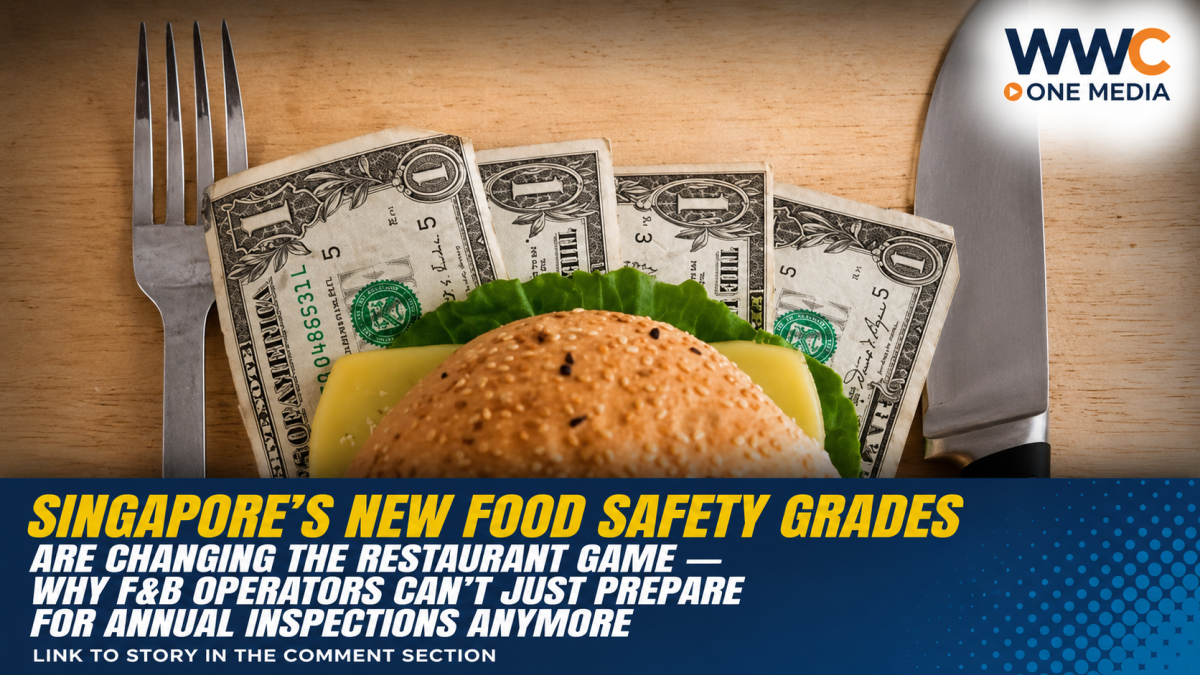
Singapore’s food and beverage industry is facing a major shift in how food safety performance is judged, with operators now expected to maintain hygiene standards consistently rather than simply prepare for an annual inspection.
The change comes under the Singapore Food Agency’s (SFA) Safety Assurance for Food Establishments (SAFE) framework, which took effect on January 19, 2026 and replaced the decades-old A-to-D grading system based largely on annual “snapshot” assessments.
From one inspection to a long-term safety record
Under the previous system, food establishments were graded based on conditions observed during an annual assessment. The SAFE framework takes a different approach: grades increasingly reflect an establishment’s food safety track record over time, alongside the systems and capabilities it has in place to manage food safety.
Prof. William Chen, director of NTU’s Future Ready Food Safety Hub, said the objective is to encourage businesses to make food safety part of their everyday operations rather than something addressed around inspection dates.
That means practices such as preventing cross-contamination, maintaining proper hygiene and controlling food-handling risks have to become part of the routine — every day.
What do the new SAFE grades mean?
The framework covers about 45,000 SFA-licensed food establishments, ranging from restaurants and caterers to bakeries, hawker stalls, takeaway outlets and food carts.
Businesses are divided into two categories based on the level of food processing and preparation they conduct.
Category 1 includes higher-risk operations such as food caterers, food-processing establishments, restaurants with larger kitchens and certain in-house kitchens.
Category 2 covers establishments involving lower or moderate levels of food preparation, including many hawker stalls, smaller restaurants, bakeries, takeaway outlets and food carts.
Under Phase 1:
- Grade A: More than three years of good food-safety track record with no major lapse.
- Grade B: One to three years of good track record.
- Grade C: A major food-safety lapse, such as a licence suspension or court conviction.
- NEW: Establishments operating for less than one year.
A major violation can result in an establishment being downgraded to C, regardless of its previous grade, with more frequent inspections.
Good operators can face less frequent inspections
The system is not simply about giving restaurants a new letter grade.
SFA says establishments with consistently good food-safety records will receive higher grades, while those with poorer records will face more frequent inspections.
This creates a different incentive for operators: maintaining a strong record over several years can matter more than simply passing one inspection.
The Straits Times reported that F&B operators welcomed the system because it rewards consistent performance rather than judging a business based on conditions observed on a particular inspection day.
Bigger kitchens face tougher requirements
The transition will become more significant under Phase 2.
Category 1 establishments seeking to maintain or attain Grade A will eventually need to appoint an Advanced Food Hygiene Officer (AFHO) and implement a Food Safety Management System (FSMS). More details on Phase 2 are expected to be announced by 2027.
There is also a fast-track route for eligible Category 1 establishments to obtain an A grade if they have at least one year of good food-safety records, appoint an AFHO and implement a certified FSMS.
For smaller Category 2 businesses, SFA has designed a less demanding framework, reflecting their lower or moderate level of food processing.
Consumers can check a restaurant’s record
The changes also give diners a new way to assess food establishments.
Consumers can check an establishment’s SAFE grade through the SFA’s online Track Records for Licensed Food Establishments system or scan the QR code on the SFA licence displayed at the premises.
Unlike the previous system, restaurants are not required to prominently display their grade on-site, meaning diners may need to actively check the information.
And the system is already being maintained online: SFA’s track-record database was updated on September 2, 2026.
Why the change matters now
The tougher focus on consistency comes as Singapore continues to deal with food-safety incidents involving restaurants, caterers and central kitchens.
The Straits Times reported in June that Singapore’s authorities investigated 113 gastroenteritis outbreaks in 2024 and 2025, with 55 central kitchens, caterers and restaurants identified in connection with outbreaks during that period. Large-scale food preparation can increase the number of people potentially affected when something goes wrong.
That makes the SAFE framework particularly significant for central kitchens and large-scale food operators: a lapse is no longer simply an issue that could affect one inspection score — it can become part of the establishment’s longer-term safety record.
The broader message from Singapore’s regulators is clear: food safety is becoming a continuous responsibility rather than an annual compliance exercise.
For restaurants and hawker businesses, the question is no longer simply, “Will we pass our next inspection?”
WWC ONE MEDIA J.M.D


Leave a Reply