
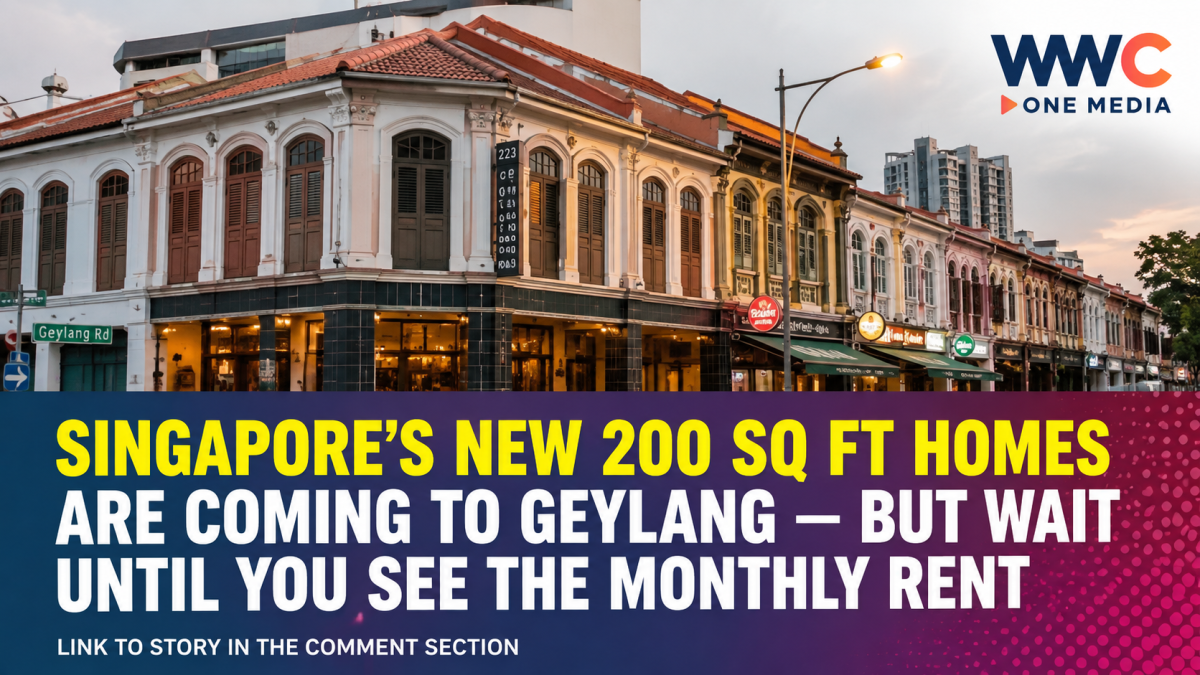
SINGAPORE — Three adjoining conservation shophouses along Geylang Road are set for a major transformation into compact, fully self-contained micro-residences, offering a new option for professionals seeking a home somewhere between a traditional rental and a serviced apartment.
The project, called House 223, will convert properties at 223, 225 and 227 Geylang Road into 15 move-in-ready micro-residences, each measuring approximately 200 sq ft. Monthly rents are expected to range from $2,300 to $2,700, according to developer and operator ABIEL Property Investment Fund. The development is expected to open in September 2026.
What Do You Get in a 200 Sq Ft Home?
Despite their compact footprint, the units are designed to be entirely self-contained rather than conventional rental rooms. Each residence is expected to include a private kitchenette, bathroom, laundry facilities, workspace and sleeping area, while being fully furnished and ready for immediate move-in.
That distinction is central to ABIEL’s pitch: residents will not have to share a kitchen or laundry room with housemates — a common feature of many co-living arrangements.
The three shophouses span five levels and approximately 12,957 sq ft in total. Commercial tenants, including businesses in the restaurant, entertainment and nightlife sectors, will continue to occupy the lower floors, while the residential component will sit above them.
A $2,700 Question: Is Tiny Living Worth the Price?
The asking rent may raise eyebrows. At roughly 200 sq ft, the top-end monthly rate works out to a premium on a per-square-foot basis.
But House 223 is not targeting tenants looking for the cheapest room in Singapore. ABIEL says it is aiming at professionals and expatriates on medium-term stays of between three and 24 months — including consultants, executives on overseas postings and professionals on temporary assignments who may not want to commit to a conventional long-term lease.
The concept sits between lower-cost co-living accommodation and traditional serviced apartments. Stacked Homes noted that some established co-living providers offer furnished rooms at lower monthly prices but typically involve shared facilities, while premium flexible-living and serviced-apartment options can cost considerably more.
The Rooftop Is Where the Community Comes Together
While privacy is a major selling point inside each unit, House 223 will feature a communal rooftop designed for residents to socialise voluntarily.
Plans include an edible kitchen garden, barbecue area, communal dining table, reading corners and hammocks — creating a shared space without requiring residents to share their everyday living facilities.
The interiors are expected to combine influences from industrial loft, mid-century modern and Japanese minimalist design, with warm wood finishes, darker tones, stone surfaces and exposed steel elements.
Why Geylang — and Why Now?
The project also reflects Geylang’s continuing evolution. Long known for its colourful identity and red-light district, parts of the neighbourhood have increasingly attracted investors, creative businesses and alternative accommodation operators.
Geylang’s location, extensive food scene and proximity to the city have long made it attractive to tenants seeking relatively accessible rents. At the same time, the neighbourhood is seeing renewed investment and new lifestyle concepts, including other co-living developments.
ABIEL purchased the three adjoining shophouses for $18.68 million, according to property records cited by multiple reports. The company is now betting that there is demand for a different kind of Singapore rental product: small but private, fully equipped and flexible enough for people who are staying for months rather than years.
Singapore’s Rental Market Is Getting Smaller — Literally
House 223 arrives amid a broader conversation about compact living and Singapore’s high rental costs. A recent CNA report highlighted how some tenants have turned to extremely small rooms and converted spaces in search of more affordable accommodation, underscoring the pressure that price and location can place on living standards.
House 223 takes a very different approach: rather than competing purely on affordability, it is attempting to sell privacy, convenience and flexibility in a dramatically smaller footprint.
Whether Singapore’s professionals and expatriates will pay up to $2,700 a month for just 200 sq ft remains the big question. But if the concept succeeds, these three Geylang shophouses could offer a glimpse into how the city’s rental market may continue to evolve — where a home is no longer judged simply by how big it is, but by how much of life can fit inside it.
And that could be the real test for Singapore’s next generation of micro-living: how small can a home become before convenience is no longer enough?




Leave a Reply