
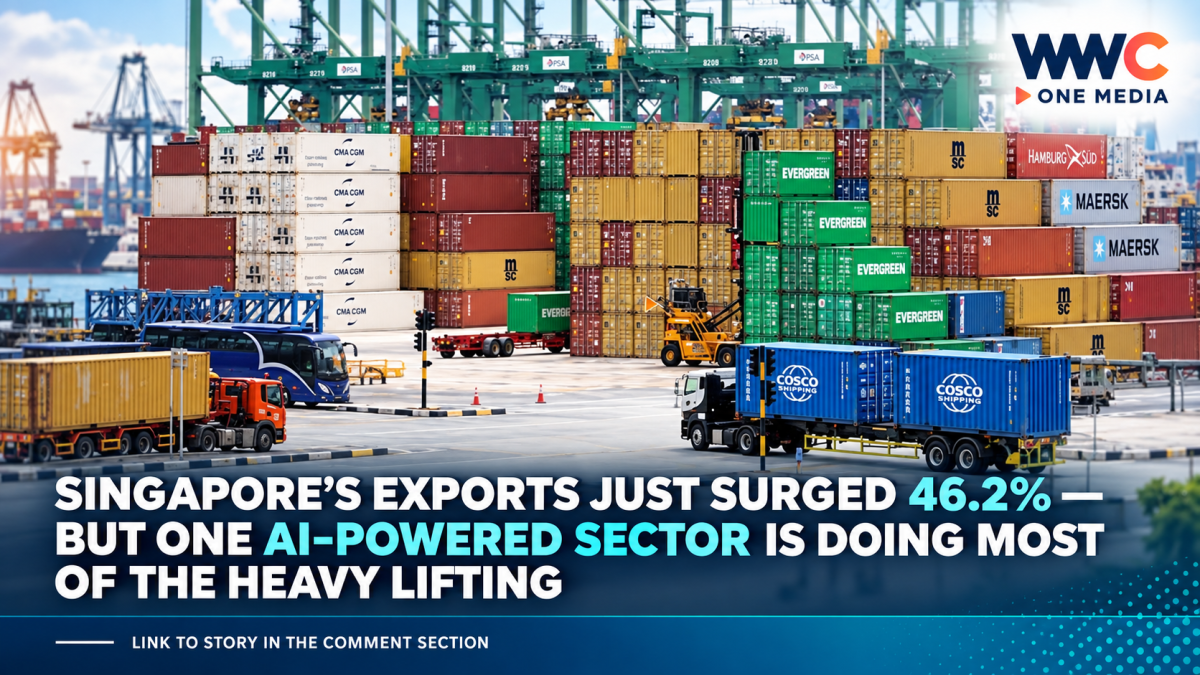
SINGAPORE — Singapore’s key exports exploded 46.2% in August from a year earlier, smashing economists’ forecasts as the global artificial-intelligence investment boom drove another extraordinary surge in semiconductors, computers and data-storage products.
The jump in non-oil domestic exports, or NODX, accelerated sharply from July’s revised 24.1% increase and was far stronger than the roughly 35% growth economists had expected.
Reuters said the increase was the largest recorded in an LSEG series stretching back to November 2005.
That gives Singapore an eye-catching headline.
But underneath it sits an even more dramatic number.
Electronics exports surged 131.8%.
And that means Singapore’s extraordinary trade performance is becoming increasingly tied to one of the hottest—and most cyclical—investment stories in the world: artificial intelligence.
Electronics exports more than doubled
Enterprise Singapore said electronic NODX jumped 131.8% year on year in August, accelerating from a 112% rise in July.
Three product categories did most of the work:
Disk media products jumped 290.2%.
Personal-computer exports surged 237.9%.
Integrated-circuit shipments climbed 90.9%.
These are precisely the kinds of products benefiting from the enormous global buildout of AI computing infrastructure.
Cloud companies, semiconductor manufacturers and data-center operators are investing heavily in processors, memory, servers, storage and chip-production equipment as they race to meet demand for artificial-intelligence workloads.
Singapore sits inside that supply chain.
Its electronics sector includes major semiconductor manufacturing, assembly, testing, storage and equipment operations serving global markets.
And the AI boom is translating directly into export orders.
Singapore’s semiconductor industry matters far beyond manufacturing
The scale of electronics inside Singapore’s economy helps explain why AI demand is showing up so clearly in the national trade numbers.
The Ministry of Trade and Industry said electronics accounted for 43.2% of Singapore manufacturing’s nominal value added in 2025 and about 8% of the entire economy’s nominal value added.
Within electronics, semiconductors dominate.
They represented 80.2% of electronics-cluster value added in 2025, up dramatically from 45.6% in 2000.
That gives Singapore an unusually strong position when semiconductor demand accelerates.
But it also means swings in the chip cycle can have an outsized effect on headline manufacturing and export growth.
Non-electronics finally returned to growth too
August was not entirely an electronics story.
Non-electronic NODX rose 12%, reversing a 2.4% decline in July.
The biggest contributors included:
specialised machinery, up 57.7%;
non-monetary gold, up 67%;
and medical apparatus, up 22.1%.
That broadening matters because Singapore’s June and July trade results had shown a much clearer split between booming AI-linked electronics and softer non-electronics shipments.
A recovery outside electronics makes August’s export performance less one-dimensional.
Still, the difference in scale is striking.
Non-electronics grew 12%.
Electronics grew nearly 11 times faster.
America nearly doubled its purchases from Singapore
The geographic breakdown was also unusually strong.
Exports rose to nine of Singapore’s top 10 markets in August.
NODX to the United States surged 91% from a year earlier.
Exports to South Korea rose 87.1%.
Shipments to China increased 70.3%.
Those three markets sit at the heart of the global technology supply chain.
The U.S. is home to the largest AI infrastructure investors and chip designers.
South Korea is a global memory-chip powerhouse.
China remains one of the world’s largest electronics-manufacturing and technology markets.
Strong demand across all three helps explain why Singapore’s AI-linked exports are rising so rapidly.
Europe was the only major market still shrinking
There was one notable exception.
Singapore’s NODX to the European Union fell 1.7% in August.
Even that represented a substantial improvement from July, when exports to the EU had plunged 36% year on year.
The divergence highlights how uneven global demand remains.
Singapore may be seeing extraordinary orders from technology-heavy markets, but not every major destination is expanding at the same pace.
That is another reason the 46.2% headline should not automatically be interpreted as evidence that every part of the global economy is booming.
There is also a low-base effect
August’s spectacular percentage increase deserves another qualification.
Enterprise Singapore said the result was partly amplified by the unusually weak level of exports a year earlier.
In August 2025, monthly NODX fell to about S$13.3 billion—the lowest monthly level recorded that year.
Exports in August 2025 had fallen 11.3% year on year, weighed down by specialised machinery, food preparations, petrochemicals and weaker electronics.
Comparing today’s strong exports against that depressed base makes the current growth percentage look even larger.
That does not make the 2026 recovery artificial.
Actual exports have clearly strengthened.
But it means the 46.2% growth rate combines genuine AI-led demand with unusually weak year-earlier numbers.
Five straight months above 20%
Even after accounting for the base effect, Singapore’s export momentum has been unusually persistent.
Reuters noted that August marked the fifth consecutive month in which NODX growth exceeded 20%.
The recent sequence has included:
April: 24.4%.
May: 38.4%.
June: about 20.7%.
July: about 24.2%.
August: 46.2%.
Over the first eight months of the year, NODX was up 22.4% compared with the same period in 2025.
That suggests the AI-linked export boom is not simply a one-month anomaly.
It has become one of the dominant features of Singapore’s 2026 economy.
Singapore already upgraded its full-year export forecast
The government saw enough strength by August to make a major forecast revision.
Enterprise Singapore raised its 2026 NODX growth forecast to 14% to 16%, dramatically higher than the previous projection of 3% to 5%.
That upgrade followed a 27.4% year-on-year increase in NODX during the second quarter, after 9.6% growth in the first quarter.
Enterprise Singapore said the exceptionally strong first half was led by surging electronics exports and expected AI demand to continue supporting the second half, although growth could moderate because future comparisons will become tougher.
That last point matters.
Once exports begin being compared against today’s extremely strong figures, sustaining triple-digit electronics growth becomes mathematically much more difficult.
The AI boom is lifting Singapore’s wider economy too
The trade numbers are already showing up in GDP.
Singapore’s economy expanded 5.9% year on year in the second quarter, bringing first-half 2026 growth to 6.1%.
Manufacturing grew 12.5% in the second quarter, driven heavily by electronics and precision engineering linked to artificial-intelligence investment.
The strength prompted the Ministry of Trade and Industry to lift its full-year 2026 GDP growth forecast to 4.5% to 5.5%, from an earlier range of 2% to 4%.
MTI specifically cited the acceleration in global AI-related capital expenditure as one reason for its greater optimism.
That means artificial intelligence is no longer merely a technology-sector story for Singapore.
It is becoming a trade story.
A factory-output story.
And increasingly, a national economic-growth story.
Total merchandise trade hit S$156.9 billion in August
The AI-driven increase was also visible outside NODX.
Singapore’s total merchandise trade rose 44.5% year on year in August, following a 38.3% increase in July.
Total trade for the month reached S$156.9 billion.
Exports amounted to S$84.7 billion.
Imports were S$72.2 billion.
Non-oil re-exports—products imported into Singapore and subsequently exported elsewhere—jumped 53.3%, with electronics re-exports rising 68%.
That points to another role Singapore plays in the AI economy.
It does not only manufacture technology products.
It also functions as a major logistics, distribution and trading hub moving electronics through global supply chains.
Singapore factories are still expanding
Other indicators reinforce the same picture.
Singapore’s Purchasing Managers’ Index rose to 51.5 in August, marking the 13th consecutive month of expansion in factory activity and reaching its strongest level in nearly eight years.
A PMI reading above 50 signals expansion.
Manufacturers were benefiting from healthy AI-related demand even as Middle East disruptions increased shipping times and input costs.
Industrial production was also still expanding in July, with overall factory output up 6.8% year on year and electronics output rising 11.2%.
So the export surge is supported by broader manufacturing activity rather than appearing in isolation.
But Singapore itself is already watching the concentration risk
The government has also acknowledged the obvious vulnerability.
Earlier this month, Singapore’s Ministry of Trade and Industry was asked in parliament whether the extraordinary performance of electronics was creating a concentration risk as some domestic-facing sectors grew much more slowly.
MTI said Singapore’s economy remains diversified—services still account for about 70% of GDP and manufacturing 18.5%—but added that authorities are “mindful of the risks of becoming reliant on any particular sector, firm, or end-market.”
That caution is significant.
Singapore does not need the AI boom to end for growth to slow.
It only needs AI infrastructure investment to stop accelerating at today’s pace.
What happens if AI spending cools?
Technology cycles rarely rise indefinitely.
The current boom is being powered by enormous spending from companies building data centers, buying high-end semiconductors and expanding AI computing capacity.
That spending could remain strong for years.
But it could also slow if:
companies conclude that AI projects are generating weaker-than-expected returns;
financing costs rise;
a semiconductor downturn emerges;
governments tighten technology restrictions;
or global economic weakness reduces corporate investment.
MTI has already identified potential financial-market volatility and changes in AI-related capital spending among the risks to Singapore’s outlook.
That does not mean an AI downturn is imminent.
It means Singapore’s exceptionally strong 2026 export performance is partly connected to an investment cycle over which the city-state has limited control.
Trade barriers remain another risk
Singapore’s trade dependence also makes global tariff policy unusually important.
The country is one of the world’s most open economies, with trade flows that are large relative to its domestic economy.
Restrictions affecting semiconductor equipment, electronics supply chains or access to major markets could therefore influence exports rapidly.
For now, key electronics products have remained comparatively resilient to recent tariff disruption.
But global trade policy remains highly fluid, particularly between major technology powers.
A change in semiconductor export controls or tariff treatment could alter supply chains even if final AI demand remains strong.
Middle East disruptions add another complication
The same economy benefiting from AI exports is simultaneously dealing with an energy and logistics shock.
The Middle East conflict has disrupted feedstock supplies for Singapore’s chemical industry and increased transportation costs.
MTI said the chemicals cluster contracted in the second quarter partly because of feedstock disruption linked to the regional conflict.
August factory surveys also showed longer supplier delivery times and higher input costs.
This illustrates why Singapore’s headline economic numbers can tell two different stories at once.
Electronics may be booming.
Chemicals can struggle.
Exporters selling AI hardware may see record demand.
Domestic businesses exposed to transport, energy or imported input costs can face a very different operating environment.
The 46.2% jump is real—but the 131.8% figure is the one to watch
Singapore’s August trade performance is extraordinary by almost any measure.
NODX rose 46.2%.
Exports to the U.S. jumped 91%.
Shipments to China increased 70.3%.
Total merchandise trade climbed 44.5%.
And the government has upgraded both its export and GDP forecasts.
But the figure that best explains all the others may be this:
electronics exports: +131.8%.
That is the engine.
Singapore has positioned itself extremely well for a world spending heavily on AI infrastructure, semiconductors and data centers.
The opportunity is enormous.
So is the exposure.
Because the same concentration that makes Singapore one of the biggest beneficiaries of the AI investment boom could also make future export numbers much harder to sustain if that boom eventually cools.
For now, though, the chips are still moving.
And Singapore is selling them faster than it has in years.


Leave a Reply