
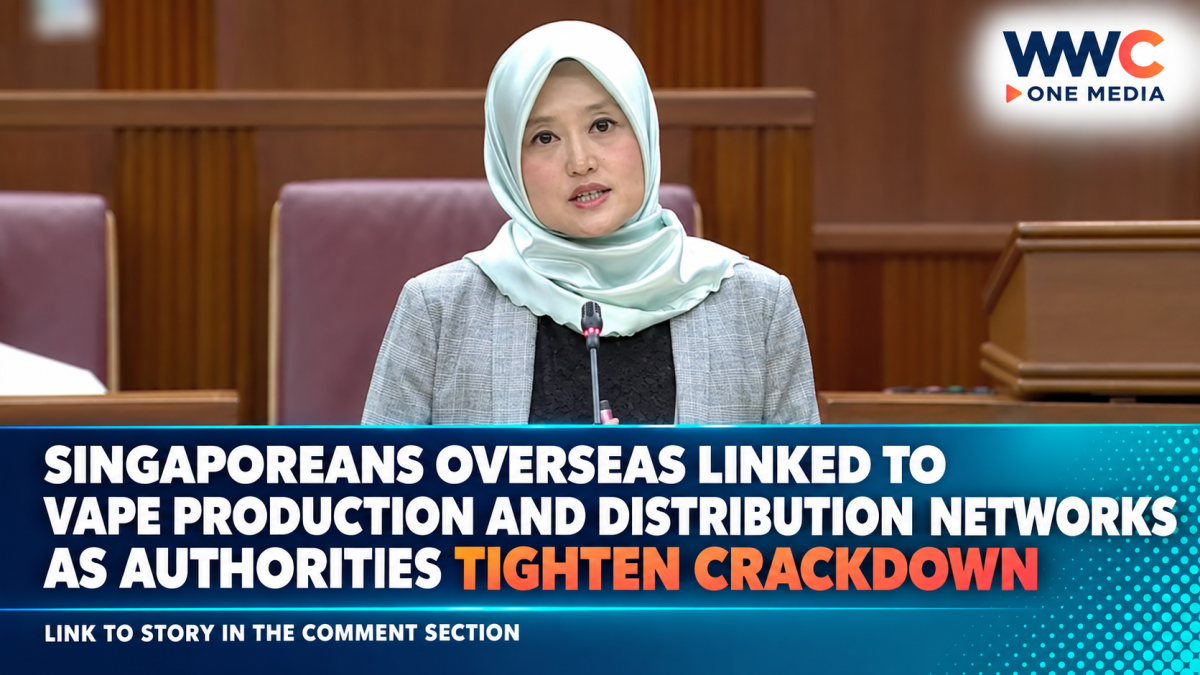
SINGAPORE — Singapore authorities are stepping up their fight against cross-border vape syndicates as enforcement agencies uncover cases involving Singaporeans allegedly linked to overseas production and distribution networks.
The crackdown reflects a growing concern that illegal vape supply chains are no longer confined to smugglers bringing products across Singapore’s borders. Instead, authorities are increasingly targeting complex transnational networks involving overseas suppliers, distributors, online sellers and local delivery operations.
Singapore maintains a zero-tolerance stance on vaping, with the government strengthening penalties and enforcement under the Tobacco and Vaporisers Control Act.
Crackdown Goes Beyond Singapore’s Borders
Singapore’s enforcement agencies have been working with foreign counterparts to disrupt vape supply chains before prohibited products even reach the country.
The Ministry of Health has said the Immigration & Checkpoints Authority, Central Narcotics Bureau and Singapore Police Force engage in intelligence sharing with overseas authorities to target cross-border networks.
In 2025, joint operations involving the Health Sciences Authority and ICA detected 59 large-scale vape smuggling cases, with about 230,000 vaporisers and related products seized.
Authorities have also intensified efforts against online advertising and digital sales channels, with more than 10,000 vape-related advertisements removed across 2024 and 2025.
Singaporeans Allegedly Linked to Transnational Networks
The crackdown has already uncovered alleged links between Singaporeans and international vape syndicates.
In June, four Singaporean men were arrested over their suspected involvement in a transnational network supplying etomidate-laced vape pods, commonly known as Kpods. The case marked the first investigation of a syndicate of its nature under Singapore’s newer vape enforcement framework, according to HSA.
Authorities said transnational networks pose a greater challenge because their operations can stretch across several jurisdictions, involving different players in production, importation, storage, distribution and sales.
That means Singapore’s enforcement efforts increasingly depend on international intelligence sharing and coordinated action.
Etomidate-Laced Vapes Raise the Stakes
Singapore’s fight against illegal vaping has become even more urgent because of the emergence of vaporisers containing etomidate and other psychoactive substances.
Under the current framework, Singapore treats offences involving specified psychoactive substances particularly seriously.
HSA says suppliers of such products can face between two and 10 years’ imprisonment and caning, while importers can face even heavier penalties.
Between April and June 2026 alone, authorities charged nine people over the alleged import or supply of etomidate vaporisers. Six of them were allegedly connected to a transnational syndicate, with more than S$880,000 worth of etomidate vape pods seized.
Authorities Target Every Part of the Supply Chain
Singapore’s strategy is increasingly focused on disrupting the entire illegal vape ecosystem.
That includes targeting:
- Overseas production and suppliers
- Cross-border smuggling operations
- Importers and distributors
- Local storage facilities
- Online sellers and advertisements
- Delivery networks
- Individual users
HSA also monitors local online retail platforms, social media and messaging applications for suspected vape sales and works with platforms to remove prohibited listings.
The Numbers Show the Scale of the Problem
Singapore’s enforcement agencies have continued to uncover thousands of vaping offences.
From April to June 2026, authorities caught and penalised 2,428 people for possessing or using vaporisers, including 457 involving etomidate vaporisers.
Authorities also seized more than 3,900 vaporisers and related components at checkpoints during the same three-month period.
The government says enforcement is being combined with rehabilitation and education as part of a broader strategy to reduce both the supply and demand for illegal vaporisers.
The Bottom Line
Singapore’s war on illegal vaping is increasingly becoming an international operation.
As authorities uncover alleged links between Singaporeans and overseas production and distribution networks, the government is expanding its focus beyond users and street-level sellers.
The message from Singapore’s enforcement agencies is becoming increasingly clear:
Illegal vape networks may operate across borders, but Singapore is working to follow the supply chain wherever it leads — from overseas production to local distribution and the final sale.
WWC ONE MEDIA J.M.D




Leave a Reply