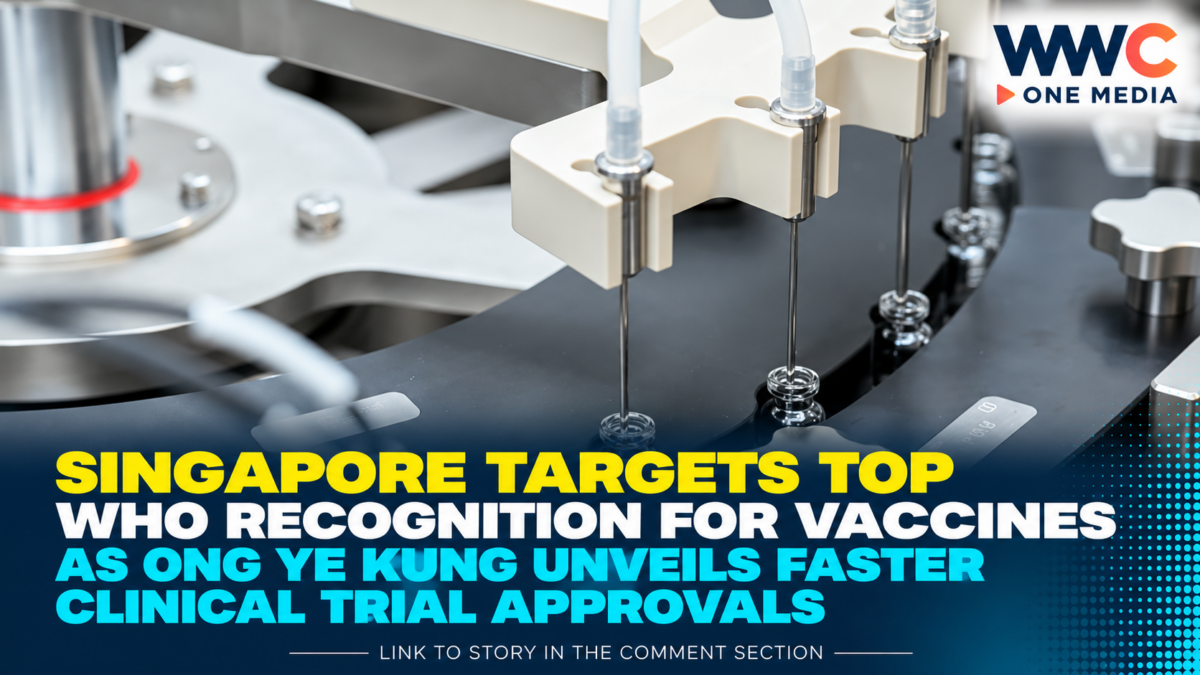
Singapore is stepping up efforts to strengthen its vaccine regulatory system and accelerate medical research, with Health Minister Ong Ye Kung announcing new initiatives aimed at making the country a more attractive destination for clinical trials.
Speaking at the inaugural Health Regulatory Conference on Monday (Oct 12), Ong said Singapore was working towards attaining the World Health Organization’s (WHO) highest-level recognition for its vaccine regulatory system, building on its achievement in medicines regulation in 2023.
“This is critical for our pandemic prevention, preparedness and response efforts,” he said.
The push comes as Singapore seeks to strengthen its position as a trusted regional hub for healthcare innovation, while ensuring that faster approvals do not compromise patient safety.
Why WHO recognition matters
Singapore was among the first three national regulatory authorities to attain WHO-listed authority status for medicines regulatory systems in 2023.
The country is now working towards securing the same status for vaccines. Such recognition would reflect the maturity of its regulatory framework and could help strengthen international confidence in the vaccines it evaluates.
For Singapore, stronger vaccine regulation is also part of its broader strategy to prepare for future pandemics and improve access to medical innovations.
Clinical trial approvals could be cut in half
One of the key announcements involves plans to streamline clinical research applications through a common entry point for trial sponsors.
The initiative, developed through collaboration involving the Singapore Economic Development Board, the Health Sciences Authority (HSA) and the Singapore Clinical Research Institute, is expected to launch in early 2027.
It aims to give companies earlier regulatory advice, clearer guidance on clinical development and support in identifying investigators and coordinating trial sites.
Under the initiative, approval timelines for selected lower-risk Phase 3 clinical trials are expected to be reduced from 30 days to 15 days.
A common template will also be introduced to simplify consultations and approvals for trials conducted across multiple healthcare institutions.
The goal is to reduce unnecessary delays and administrative burdens without weakening the safeguards designed to protect research participants.
Singapore strengthens its push for AI-driven drug development
Artificial intelligence is increasingly being used throughout the drug development process, including research, clinical trial design and the evaluation of potential treatments.
Ong said HSA was building its capabilities and developing regulatory guidance to address the technology’s growing role.
The authority is also working with the United Kingdom’s Medicines and Healthcare products Regulatory Agency on a regulatory innovation corridor designed to support breakthrough therapies, including treatments developed using AI.
The collaboration aims to give innovators a clearer and more coordinated way to engage with both regulators, helping them plan studies, reduce duplication and avoid unnecessary delays.
However, regulatory decisions will continue to require rigorous assessment of safety and effectiveness.
New priority track to speed up access to innovative treatments
From November 2026, HSA and the Agency for Care Effectiveness will establish a priority track for selected innovative health products.
The initiative will allow regulatory evaluation and health technology assessment to proceed concurrently rather than sequentially.
For products submitted through the agency’s company-led submission process, Singapore aims to shorten the time to the first health technology assessment decision from about one year to between six and nine months after regulatory approval.
The change is intended to help promising treatments reach patients sooner while preserving the independence of regulatory and assessment decisions.
Can Singapore become a regional clinical research hub?
Singapore faces competition from other markets seeking to attract pharmaceutical investment, clinical trials and biotechnology companies.
By simplifying regulatory processes and improving coordination between researchers, companies and healthcare institutions, the country hopes to become a more efficient location for developing and evaluating new treatments.
Ong said Singapore could serve as a trusted gateway to markets encompassing hundreds of millions of people across other countries and regions.
The broader objective is to connect clinical development, regulation, health technology assessment and patient access more closely.
If the initiatives deliver their intended results, Singapore could strengthen its role in regional medical research while improving the pathway from scientific discovery to treatments that patients can access.