
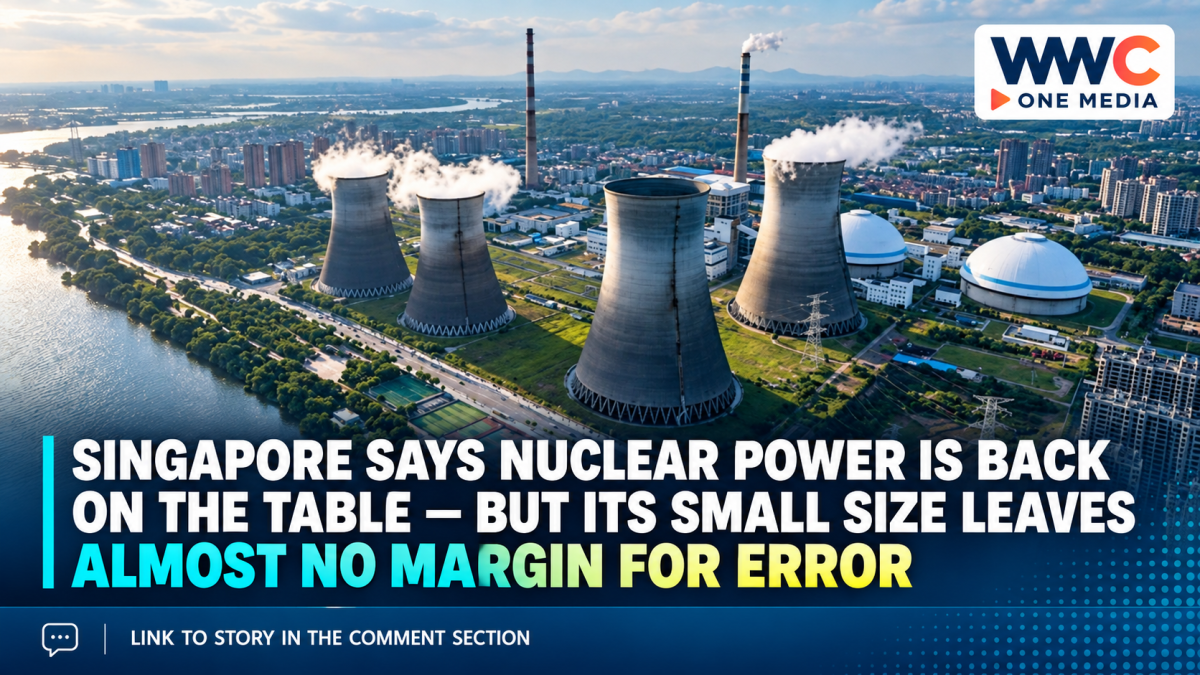
SINGAPORE — For years, the idea of putting a nuclear power plant in one of the world’s smallest and most densely populated countries sounded closer to an engineering thought experiment than an actual energy option.
Singapore is no longer dismissing it.
Speaking at the International Atomic Energy Agency’s General Conference in Vienna on Monday, September 14, Sustainability and the Environment Minister Grace Fu said Singapore is approaching nuclear energy with an “open mind” while recognizing the severe constraints that come with being a compact, densely populated city-state with few domestic energy resources.
The government is studying whether advanced nuclear technologies — particularly small modular reactors, or SMRs — could eventually become viable enough to help Singapore meet its long-term climate, electricity-security and affordability goals.
But Fu’s message was equally clear about what has not happened.
Singapore has not selected a reactor.
It has not chosen a site.
It has not committed to nuclear electricity.
And it has not set a date for building a nuclear plant.
Instead, the country is preparing itself to answer a far more fundamental question:
Could nuclear power ever be safe enough for Singapore?
The first major test comes in 2027
The answer will not come from politicians alone.
Starting in 2027, Singapore will undergo an Integrated Nuclear Infrastructure Review, or INIR, Phase 1 mission conducted with the IAEA.
International experts will examine Singapore’s readiness across 19 areas, including nuclear safety, radioactive-waste management, emergency planning, legislation, safeguards, financing and the broader institutional framework required for a civilian nuclear programme.
Fu stressed that taking part in the review does not mean Singapore has chosen nuclear power.
The Phase 1 assessment is essentially a readiness check: does the country possess the expertise, institutions and governance structures needed even to make a credible decision?
Prime Minister Lawrence Wong made the same distinction when announcing the review in May. The government has said Singapore could ultimately complete all of this preparatory work and still conclude that nuclear energy is unsuitable.
That makes 2027 important — but not because a reactor will suddenly receive a green light.
It could just as easily identify weaknesses that convince Singapore to slow down or walk away.
Why nuclear is suddenly harder to ignore
Singapore’s problem begins with a number that has shaped its energy policy for years:
about 95% of its electricity is generated using natural gas.
And almost all of that fuel has to be imported.
Natural gas helped Singapore move away from more carbon-intensive fuels and has supported an exceptionally reliable electricity system.
But heavy dependence on any single imported fuel creates vulnerability.
Wars can disrupt shipping.
Geopolitical disputes can reshape supply.
Global gas prices can surge.
And Singapore has almost no domestic fossil-fuel buffer if international energy markets suddenly tighten.
Recent turmoil in global gas markets has made that vulnerability especially visible.
Singapore therefore faces what policymakers often describe as an energy trilemma: electricity has to remain secure, affordable and increasingly low-carbon at the same time.
Nuclear power potentially addresses all three — at least in theory.
It produces large quantities of electricity continuously.
Operational carbon emissions are low.
Fuel volumes are small relative to the enormous amount of energy generated.
And unlike solar, nuclear reactors can produce electricity regardless of whether the sun is shining.
But Singapore also has disadvantages that make nuclear exceptionally complicated.
Solar alone cannot solve Singapore’s problem
Singapore is already covering rooftops, reservoirs and other available spaces with photovoltaic panels.
It reached 1.5 gigawatt-peak of installed solar capacity and is working toward at least 2 GWp by 2030.
Yet land remains the limiting factor.
The government estimates that even with aggressive deployment, domestic solar can supply only around 10% of Singapore’s projected electricity demand in 2050.
That is why Singapore is simultaneously pursuing electricity imports.
The country aims to import around 6 gigawatts of low-carbon electricity by 2035, potentially supplying about one-third of its energy demand by then through regional grids.
Natural gas remains one pillar.
Solar is another.
Regional electricity imports form another.
Emerging fuels and technologies may add more.
Nuclear is therefore not being studied as a single replacement for everything else.
It is being considered as one possible piece of an increasingly diversified system.
Prime Minister Wong has described Singapore’s future energy strategy as requiring multiple pathways rather than dependence on one technology or supplier.
There is a reason Singapore rejected nuclear before
This is not the country’s first nuclear study.
A government pre-feasibility assessment completed in 2012 concluded that the nuclear technologies available at the time were not suitable for deployment in Singapore.
The problem was not that nuclear fission was scientifically unworkable.
It was Singapore itself.
Traditional nuclear reactors are enormous facilities.
They require substantial land.
They normally come with emergency-planning considerations extending beyond the reactor boundary.
They need strong cooling arrangements, radioactive-waste systems, physical security and sophisticated regulatory oversight.
For a large country, those requirements can be separated geographically from major population centers.
Singapore does not have that luxury.
A serious accident in a remote part of a continent presents one kind of emergency.
A serious accident in a country roughly the size of a major metropolitan area presents another.
That is why officials repeatedly emphasize population density when discussing nuclear power.
Wong said in May that Singapore effectively has no margin for error when evaluating the technology.
Then small modular reactors changed the conversation
What makes the debate different today is the development of small modular reactors.
SMRs are designed to generate less power per unit than traditional large reactors and, depending on the design, potentially incorporate more passive or simplified safety systems.
Their smaller physical footprint could also make them more compatible with countries where land is scarce.
EMA says the reduced amount of radioactive material in some SMR designs and enhanced safety features could potentially reduce the consequences of an accident and allow smaller emergency-planning areas.
That is obviously attractive to Singapore.
But there is a catch.
Most advanced SMR concepts remain relatively immature commercially.
Many have not accumulated the decades of operating experience available for established reactor designs.
EMA explicitly acknowledges that most advanced reactor projects remain at early stages and that more time is needed for operating experience, safety standards and regulatory frameworks to mature.
Singapore therefore faces an unusual strategic decision.
Waiting allows the technology to improve.
Waiting too long could leave the country scrambling for expertise if nuclear suddenly becomes commercially attractive.
The government’s solution is to build capability now — without promising to buy anything.
Singapore has already hired outside experts to study the reactors
That work has moved beyond broad policy discussion.
In September 2025, EMA appointed engineering consultancy Mott MacDonald to evaluate the safety performance and technical feasibility of advanced nuclear-energy technologies, including SMRs.
The study examines safety features, technological maturity and commercial readiness.
Singapore has also formed dedicated nuclear teams within key agencies.
EMA operates a Nuclear Energy Office, while the National Environment Agency has strengthened capabilities dealing with nuclear safety and radiation protection.
Those steps indicate how policy has evolved.
Singapore is still saying “we have not decided”.
But it is increasingly building the machinery a country would need before it could responsibly decide.
It has also spent S$66 million building nuclear expertise
Another significant move came at the National University of Singapore.
In July 2025, the Singapore Nuclear Research and Safety Initiative was expanded into the full-fledged Singapore Nuclear Research and Safety Institute.
It was backed by a S$66 million grant for its next phase of research and capability building.
The institute develops expertise in nuclear science, engineering and safety — skills Singapore will need regardless of whether it eventually builds a reactor.
That last point is important.
Nuclear power is becoming more relevant across Southeast Asia.
Even if Singapore never constructs a plant, neighboring countries may.
Singapore would still need experts capable of understanding reactor risks, monitoring radiation, participating in regional emergency responses and evaluating possible cross-border incidents.
The government therefore argues that nuclear knowledge itself has value independent of deployment.
Singapore is learning from countries that already know nuclear
Singapore has also been steadily constructing an international network around the issue.
Its civil nuclear “123 Agreement” with the United States entered into force in December 2024, enabling deeper peaceful nuclear cooperation and exchanges of technical expertise.
A separate strategic civil nuclear cooperation memorandum followed in January 2025.
EMA later signed cooperation arrangements involving Battelle Memorial Institute and Idaho National Laboratory, giving Singapore access to institutions with decades of nuclear technology and safety experience.
The government has also highlighted cooperation with countries including France and organizations elsewhere with experience in reactor regulation and nuclear technology.
None of those agreements amounts to a reactor purchase.
What they do is make it possible for Singapore to develop the expertise required to evaluate vendor claims instead of simply accepting them.
That distinction could be critical.
Because an SMR vendor’s safety claim is not enough
Advanced reactor companies often advertise designs with lower accident probabilities, passive cooling and smaller emergency-planning zones.
But Singapore cannot base a national energy strategy solely on manufacturer projections.
Officials need to independently evaluate whether those assumptions hold in Singapore’s climate, geography, electricity system and population density.
What happens in a prolonged blackout?
How would emergency cooling work?
How large would an exclusion or planning zone need to be?
Where would radioactive material be transported?
Where would spent fuel go?
Could a facility withstand extreme weather, sabotage or cyberattack?
What happens if several safety systems fail simultaneously?
Those are the kinds of questions hidden behind the deceptively simple phrase “nuclear feasibility”.
EMA has repeatedly stressed that safety is its overriding priority and that nuclear readiness requires much more than selecting the right reactor technology.
Waste may prove as difficult as the reactor
One issue that inevitably follows nuclear power is radioactive waste.
Even advanced fission reactors generate material that requires secure handling, storage and long-term management.
Large nuclear countries can sometimes develop dedicated repositories or substantial interim storage facilities.
Singapore’s size again makes those choices harder.
The IAEA review will therefore look not only at reactor operations but also at areas including radioactive-waste management.
Singapore has not announced a waste-storage solution because it has not decided to deploy nuclear energy in the first place.
Any suggestion that a final waste plan already exists would therefore be premature.
But if Singapore eventually advances beyond feasibility studies, waste will almost certainly become one of the politically and technically difficult questions policymakers have to answer.
Public confidence may be just as important as engineering
Fu specifically included public confidence among the issues Singapore must consider.
That may prove decisive.
Nuclear power differs from many other infrastructure decisions because public perception is shaped not only by everyday performance but by low-probability, high-consequence disasters.
Chernobyl.
Fukushima.
Nuclear weapons.
Radioactive waste.
These associations remain powerful even though civilian reactor technologies, operating practices and regulatory systems have evolved considerably.
IAEA Director General Rafael Grossi has warned that public understanding of nuclear energy remains limited in parts of Southeast Asia and that confusion between nuclear power and nuclear weapons can complicate public acceptance.
Singapore officials say the government intends to keep the public informed through the 2027 review and publish the IAEA’s key findings.
That transparency matters because no technically viable reactor is politically viable if the public fundamentally does not trust the institutions operating it.
Regional nuclear plans raise the stakes even if Singapore says no
Singapore’s debate is also taking place while nuclear interest rises across Southeast Asia.
Countries including Vietnam, Indonesia, the Philippines, Malaysia and Thailand have been studying or pursuing various nuclear options.
That is one reason Fu used her Vienna speech to emphasize regional cooperation.
Singapore wants ASEAN countries to strengthen nuclear emergency-response systems, radiation-monitoring networks, information sharing and readiness exercises.
A radioactive release does not stop at a national border.
Neither does the economic fallout from a serious regional nuclear incident.
Singapore therefore has an interest in strong ASEAN nuclear governance whether its future electricity mix includes a domestic reactor or not.
This is a decades-long decision, not a 2027 launch plan
Another important correction to more dramatic interpretations of Singapore’s announcement is the timeline.
EMA describes nuclear capability building as a long-term endeavor that could span decades.
Even countries that already decide they want nuclear plants commonly face years of regulation, site studies, financing, construction and commissioning.
Singapore is not even at that stage.
The IAEA’s milestones framework contains three broad phases.
Phase 1 asks whether a country is ready to make a knowledgeable policy decision.
Only later phases address preparation for contracting a plant and eventually implementing a first nuclear project.
Singapore is preparing for Phase 1.
That fact alone shows how early the process remains.
And the IAEA will not decide for Singapore
There is another subtle but crucial distinction.
The IAEA review will not tell Singapore: “Build this reactor here.”
Nor does it function like a licensing authority granting permission to start construction.
Its role is to evaluate whether Singapore has developed the institutional infrastructure necessary to make its own informed decision and to identify gaps requiring more work.
Technical feasibility studies of individual reactor designs are separate.
Political acceptance is separate.
Economic calculations are separate.
Ultimately, deployment would remain a Singapore government decision subject to whatever regulatory and legislative arrangements are established.
So why prepare so seriously if the answer could still be no?
Because energy systems take years — sometimes decades — to change.
Singapore cannot wait until the day it urgently needs another low-carbon electricity source and then begin training nuclear engineers, creating regulations and learning how reactors work.
The government’s strategy is essentially to buy itself optionality.
If SMRs become demonstrably safe, commercially mature and affordable, Singapore wants to possess enough expertise to evaluate them quickly and credibly.
If the technology fails to mature or proves unsuitable for a dense city-state, the country can reject it from a position of knowledge rather than uncertainty.
And if regional countries begin deploying nuclear plants first, Singapore will still have the expertise needed to understand the implications.
That is why the phrase “open mind” matters.
It is neither an endorsement nor a rejection.
It is a decision to prepare before deciding.
The hardest part may not be splitting the atom
Nuclear physics is well understood.
Humans have generated commercial nuclear electricity for decades.
Singapore’s problem is not whether uranium can produce power.
It is whether nuclear power can fit inside Singapore.
A reactor has to satisfy one of the world’s most demanding combinations of constraints:
Little land.
A dense population.
Virtually no domestic energy resources.
High expectations for electricity reliability.
Limited tolerance for disruption.
A commitment to net-zero emissions by 2050.
And an economy where a major safety incident could have consequences far beyond the energy sector.
That is why the government is moving slowly even as it becomes visibly more serious.
In 2012, the available technology did not make sense.
In 2026, newer reactors look promising enough to investigate.
In 2027, international experts will examine whether Singapore has built the capabilities needed even to decide what comes next.
Singapore has not chosen nuclear power. But after years of keeping the option at arm’s length, it is now doing something more consequential: preparing itself for the possibility that one day, the answer might be yes.


Leave a Reply