SINGAPORE — Singapore’s latest haze episode is raising fresh health concerns after a new study found that even relatively small increases in fine-particle pollution were associated with more emergency department visits for asthma and chronic respiratory disease.
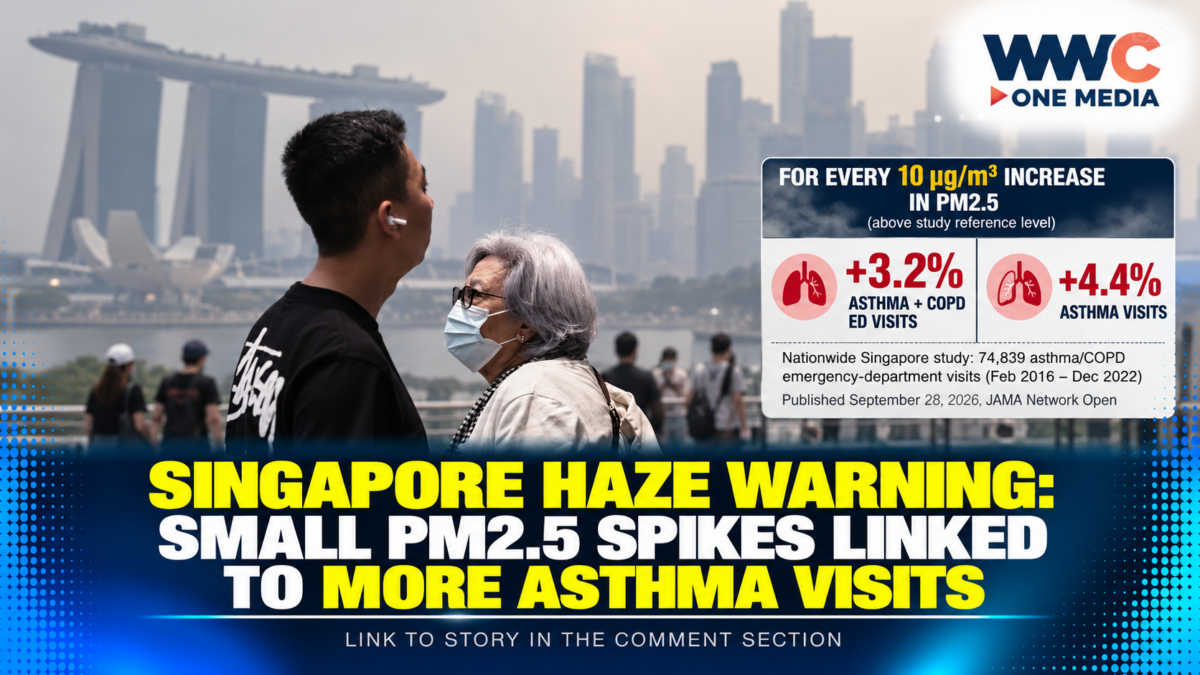
The study, published Sept. 28 in JAMA Network Open, examined 74,839 emergency department visits involving asthma and chronic obstructive pulmonary disease (COPD) among Singapore residents from 2016 through 2022.
Researchers found that for every 10 micrograms per cubic metre increase in PM2.5 above the World Health Organization’s 15 micrograms per cubic metre reference level, emergency visits for asthma and COPD rose by 3.2% over the following two days.
Asthma-related emergency visits alone increased by 4.4% during that two-day period. The association was less clear for COPD at lower pollution levels, although stronger evidence emerged at higher PM2.5 concentrations.
PM2.5 refers to extremely small airborne particles that can penetrate deep into the lungs. Singapore’s researchers said the findings are significant because the country generally has lower background pollution than many locations previously studied, while still experiencing periodic spikes associated with transboundary haze.
Haze Returns as Pollution Levels Rise
The findings arrive as Singapore experiences another period of unhealthy air quality.
On the morning of Sept. 29, 24-hour PSI readings were above 120 in four of the island’s five regions, while hourly PM2.5 readings were elevated across Singapore. The central region recorded a PSI of 151 at 6am, while the west recorded an hourly PM2.5 reading of 123 and the central region 133.
The National Environment Agency said dry conditions were expected to continue over southern Sumatra and parts of Kalimantan, with prevailing winds potentially carrying smoke haze toward Singapore.
What the Researchers Found
Of the 74,839 emergency visits analysed, 49,318 were associated with asthma and 25,327 with COPD. About 58% resulted in hospital admission, while 1,369 patients died within 30 days.
However, the researchers found no statistically significant association between the short-term PM2.5 increases and 30-day mortality.
The researchers also cautioned that the study has limitations. It focused on public emergency departments and did not capture visits to clinics, polyclinics or urgent-care centres. Because the analysis focused on PM2.5, the possible effects of other pollutants could not be completely separated.
Why the Timing Matters
One important finding was the delay between pollution exposure and emergency visits.
The respiratory-health association was concentrated in the two days following increased PM2.5 exposure, meaning the health impact may not necessarily appear immediately when haze levels rise.
Researchers said the results support using real-time air-quality information in health alerts and emergency-department planning, particularly when pollution levels rise.
With Singapore again experiencing elevated haze levels, the study adds another layer to the ongoing public-health debate surrounding transboundary air pollution.
The immediate concern is not simply how bad the air looks today — but what the latest pollution spike could mean for respiratory emergencies in the days ahead.
WWC ONE MEDIA G,A