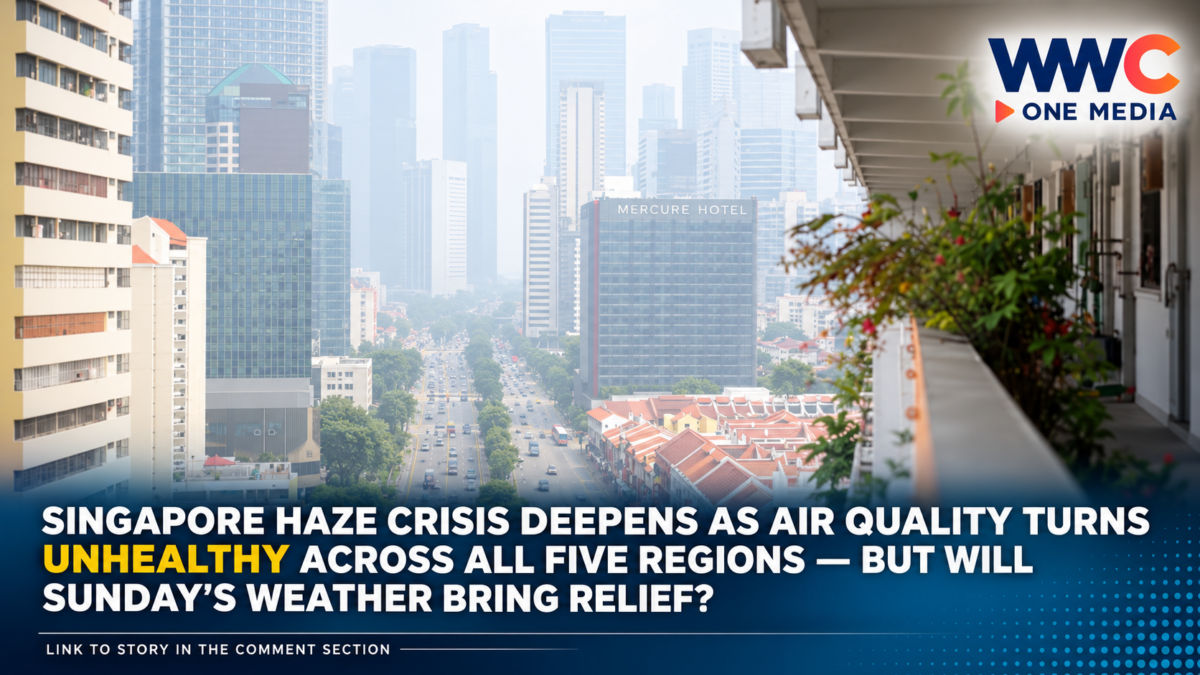
Singapore, October 24, 2026 — Singapore’s worsening haze has pushed air quality into the unhealthy category across all five regions, raising fresh concerns over public health, outdoor activities and the continuing impact of smoke from vegetation fires in neighboring Indonesia.
The deterioration intensified overnight, with the 24-hour Pollutant Standards Index (PSI) climbing to between 117 and 146 as of 9 a.m. Saturday, according to Channel NewsAsia (CNA). Western Singapore recorded the highest pollution reading, approaching the upper limit of the unhealthy range.
Hourly PM2.5 concentrations were also elevated across the island, ranging from 66 micrograms per cubic meter in the south to 97 in the central region at 9 a.m.
The latest readings highlight how quickly the haze can return, even after temporary improvements in air quality.
Singapore’s National Environment Agency (NEA) had forecast PSI readings of 90 to 140 for Saturday, spanning the moderate and unhealthy categories.
With smoke continuing to drift toward the island, residents are being urged to monitor air-quality advisories and reconsider prolonged or strenuous outdoor activities.
Haze Spreads Across Singapore as Indonesia Fires Continue
The latest deterioration follows another difficult day on Friday, October 23, when the western and central regions became the first areas to experience unhealthy air quality.
By 6 p.m. Friday, the PSI had climbed to 108 in western Singapore and 102 in the central region, while hourly PM2.5 concentrations were elevated in all five regions.
The situation worsened overnight, eventually pushing the entire island into the unhealthy range.
According to NEA, smoke haze originating from Sumatra was observed moving toward Singapore, while additional smoke was detected over Kalimantan.
Dry weather and shifting wind patterns have contributed to the deteriorating conditions.
The regional haze situation remains concerning, with vegetation-fire hotspots identified in southern Sumatra and Kalimantan.
Smoke from these fires can cross national borders depending on wind direction, making transboundary haze a continuing environmental and public-health challenge for Southeast Asia.
Singapore’s Air Quality Deteriorates After Brief Improvement
The Straits Times reported that Singapore’s pollution levels began rising again on October 23 after a period of relatively clearer conditions earlier that morning.
By 7 a.m. Saturday, the 24-hour PSI had reached 142 in the west and 133 in central Singapore, while the northern and southern regions registered 115.
The newspaper also reported that hourly PM2.5 concentrations had climbed sharply during the previous day, highlighting the potential for rapid changes in exposure levels.
AsiaOne separately reported on Friday that PM2.5 readings had entered the elevated category across all five regions by early afternoon, as prevailing winds carried smoke toward Singapore.
The developments show how temporary improvements may be quickly reversed when regional fires remain active and atmospheric conditions favor the movement of smoke toward the island.
Could Rain and Changing Winds Finally Clear Singapore’s Haze?
Despite the worsening conditions, weather forecasts offer some possibility of improvement.
NEA expects showers over Singapore and surrounding areas on Saturday, October 24. However, smoke from Sumatra may continue reaching the country under south-southeasterly or south-southwesterly winds.
Conditions could become more favorable beginning Sunday, October 25, when winds are forecast to shift toward the southwest or west.
This change could reduce the amount of haze transported toward Singapore.
Rainfall could also help lower airborne particle concentrations.
Nevertheless, any improvement remains dependent on actual weather conditions, ongoing fire activity and the direction of smoke movement.
A change in wind direction does not necessarily mean the regional haze problem has ended.
Health Warning: Children, Seniors and People With Medical Conditions Face Greater Risks
As haze blankets Singapore, authorities are emphasizing the importance of reducing unnecessary exposure to polluted outdoor air.
Fine particulate matter, commonly known as PM2.5, consists of particles small enough to penetrate deep into the respiratory system.
Exposure can aggravate asthma and other respiratory conditions, while people with existing heart or lung diseases may face greater health risks.
Under NEA’s guidance for unhealthy air conditions:
- Healthy individuals should reduce prolonged or strenuous outdoor physical exertion.
- Children, pregnant women and elderly residents should minimize prolonged or strenuous outdoor activities.
- People with chronic heart or lung conditions should avoid prolonged or strenuous outdoor physical exertion.
- When hourly PM2.5 levels are elevated, vulnerable individuals should avoid strenuous outdoor activities for the next hour.
Residents should consult the 24-hour PSI forecast when planning activities ahead and the latest one-hour PM2.5 concentrations when making immediate decisions about outdoor exposure.
Those who need additional protection from haze particles when going outdoors may consider a properly fitted N95 mask or equivalent, following government health guidance.
Singapore Intensifies Investigation Into Companies Potentially Linked to Haze
Beyond immediate health concerns, Singapore is also stepping up efforts to investigate businesses that may be connected to the fires contributing to transboundary haze.
On Friday, October 23, NEA issued notices to 10 Singapore-based companies under the country’s Transboundary Haze Pollution Act.
The notices seek information about corporate relationships, Indonesian land concessions and measures taken to prevent or control fires.
Authorities have also requested additional information from 10 Indonesian companies previously served notices.
Meanwhile, Singapore’s Ministry of Law announced plans for a specialist panel involving legal, audit and investigative professionals to examine businesses potentially associated with the haze.
These steps could increase scrutiny of corporate structures, land management practices and supply chains linked to the regional agricultural and forestry industries.
The notices are investigative measures and do not, by themselves, establish that the companies violated the law.
Regional Haze Remains a Challenge for Southeast Asia
Singapore’s latest pollution episode underscores the continuing risks posed by cross-border smoke pollution.
When fires occur across parts of Indonesia during dry conditions, shifting winds can carry fine particles toward neighboring countries, affecting air quality, public health and outdoor activity.
The ASEAN region has faced recurring difficulties in controlling vegetation fires and limiting their cross-border consequences.
Singapore’s latest response combines public-health advisories, atmospheric monitoring and investigations into possible corporate responsibility.
However, the immediate outlook remains closely tied to weather conditions and fire activity.
What Happens Next?
The biggest question now is whether Sunday’s anticipated wind shift and rainfall will deliver sustained relief.
NEA’s outlook suggests conditions may improve from October 25, but further smoke transport remains possible while regional hotspots continue producing haze.
For residents planning weekend activities, the priority is to follow official air-quality readings and adjust their exposure accordingly.
Singapore’s skies may begin clearing as weather conditions change — but with fires and smoke still affecting parts of the region, the threat of another haze episode remains.