
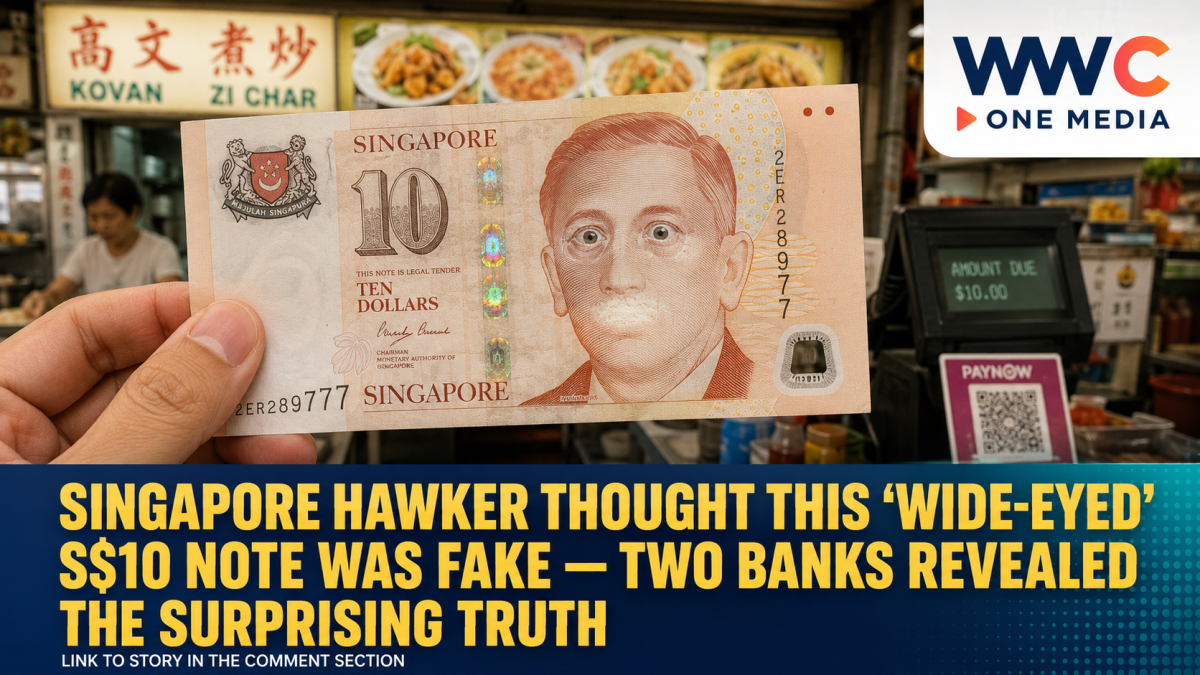
SINGAPORE — A strange-looking S$10 note that left hawker stall workers wondering whether they had been handed counterfeit money has turned out to be genuine — but someone appears to have deliberately altered the portrait printed on it.
The unusual banknote surfaced at 21 Seafood, a zi char stall reported as being in the Kovan/Hougang area, after it was received during the busy lunchtime period on August 2, 2026.
At first glance, nothing seemed particularly unusual.
But when 42-year-old cook Zhang Xiao Hai later examined the note while preparing change for another customer, he noticed something was very wrong with the portrait of Singapore’s first president, Yusof Ishak.
His familiar moustache appeared to have been scraped away.
Marks had also been scratched around his eyelids, making his eyes appear significantly larger — and giving the normally dignified portrait an unusually startled, almost wide-eyed expression.
Zhang initially wondered whether the stall had been fooled with a counterfeit S$10 note.
‘It Looked Like It Was Staring at You’
Zhang told Lianhe Zaobao that the note had felt like ordinary Singapore currency when it was received.
Because counterfeit notes are not something he commonly encounters, he had checked the denomination but had not carefully inspected every security feature while handling the lunchtime rush.
Only later did the strange portrait catch his attention.
Photographs of the note show fine scratch marks around Yusof Ishak’s moustache and eyelids. Despite the altered appearance, its colour, texture and visible security characteristics reportedly resembled those of an ordinary S$10 note.
That led Zhang to another theory: rather than being counterfeit, someone may simply have played an elaborate prank on whoever eventually received the note.
Stall Owner Takes the Mystery Note to Police
The strange S$10 note remained with the stall until August 27, when its owner, identified in reports as Mr Guo, decided to investigate further.
Guo first brought the note to a neighbourhood police post.
According to Lianhe Zaobao, he was advised to have the currency authenticated by a bank.
So he went to not one, but two banks — OCBC and DBS.
Staff reportedly took the S$10 note away for examination before delivering their verdict.
It was genuine.
The unusual appearance had apparently been caused by damage to the surface of the note, believed to have been made using a sharp object. Both banks concluded that the currency itself was authentic.
OCBC reportedly offered to exchange the damaged note for the stall owner.
Guo declined.
Instead, he decided to keep what had started as a suspected fake banknote as an unusual souvenir.
Internet Users Suddenly Wanted the ‘Damaged’ S$10 Note
After the stall shared the curious discovery on Chinese social-media platform Xiaohongshu, the scratched banknote quickly became a conversation piece.
Some users joked about Yusof Ishak’s unexpectedly intense expression.
Others apparently saw something more valuable than S$10.
According to AsiaOne and other reports, several people expressed interest in buying the altered note, with at least one online user reportedly offering several times its face value.
The irony was difficult to miss: a banknote whose damage could technically reduce its redeemable value was attracting offers worth more than the amount printed on it.
But deliberately doing the same thing to another Singapore banknote would be a very bad idea.
Defacing Singapore Currency Can Be an Offence
Singapore’s Currency Act 1967 contains provisions covering the mutilation, destruction and defacement of currency.
Under Section 23, prohibited acts can include mutilating or destroying currency and certain forms of marking or altering notes and coins. A person convicted of an offence under the provision can face a fine of up to S$2,000.
The law also makes an important distinction concerning damaged money.
A holder is not automatically entitled to recover the face value of a mutilated or illegally altered note from the Monetary Authority of Singapore. MAS has discretion over whether value will be refunded as an act of grace and under what conditions.
Damaged notes can generally be submitted through commercial banks for assessment.
The Timing Comes as Counterfeit Currency Is Also Back in the News
The bizarre S$10 incident should not be confused with or linked to a separate counterfeit-currency investigation announced by Singapore police in August.
In an unrelated case, police said a counterfeit S$100 Portrait Series note bearing the word “COPY” was detected at Marina Bay Sands Casino on August 24.
Investigations subsequently led officers to a hotel room, where police said 121 suspected counterfeit S$100 notes, along with items including a printer, ink, paper and a paper cutter, were discovered.
A 33-year-old man and a 25-year-old woman, both Chinese nationals, were to be charged over their suspected involvement in counterfeiting Singapore currency.
Singapore police have advised anyone who suspects they have received counterfeit currency to avoid excessive handling of the note, record details about the person who presented it when possible, protect the note from further contamination or damage and contact police.
For 21 Seafood, however, what looked like a counterfeit mystery ultimately proved far less sinister.
The S$10 was real.
Its unusual “wide-eyed” Yusof Ishak portrait appears to have been the result of somebody physically altering a genuine banknote — turning an everyday piece of Singapore currency into an unlikely online curiosity.
And instead of spending it, its owner now plans to keep it.




Leave a Reply