
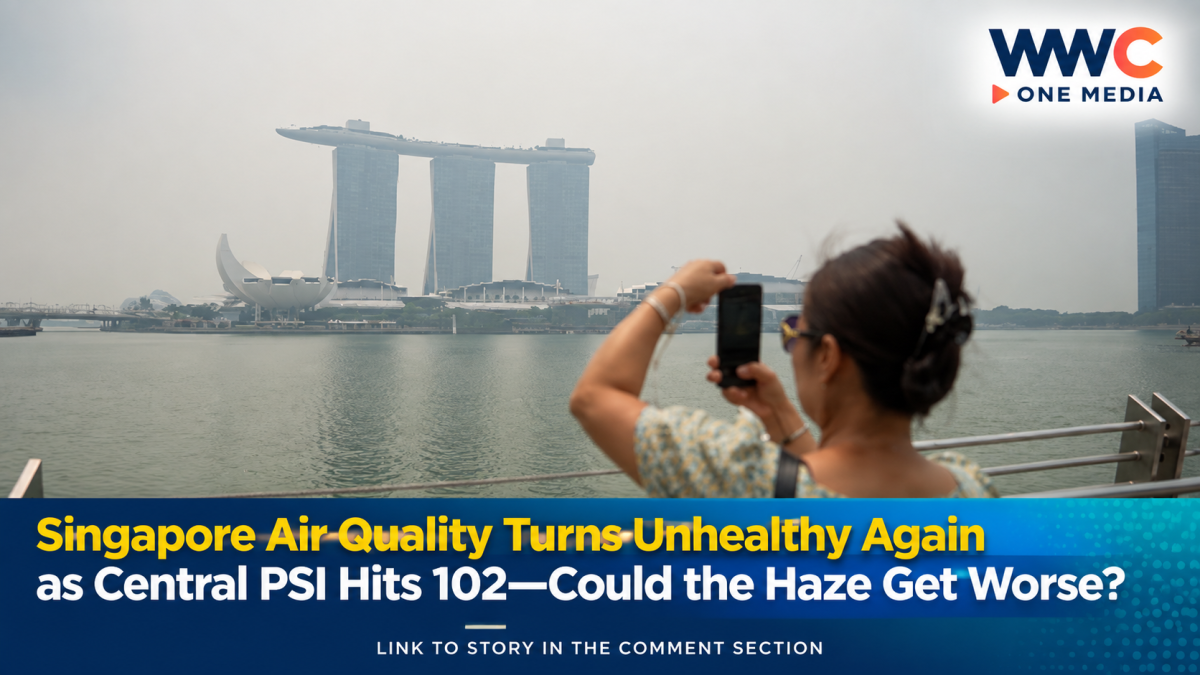
SINGAPORE — Air quality in Singapore has returned to the unhealthy range, with the central region recording a 24-hour Pollutant Standards Index (PSI) reading of 102 at noon on Monday, Sept 14.
The latest deterioration comes as haze continues to affect the city-state, raising fresh concerns for residents and prompting authorities to closely monitor pollution levels across the island.
While central Singapore crossed into the unhealthy category, the rest of the country remained in the moderate range, with 24-hour PSI readings between 79 and 91. The eastern and western regions recorded the next-highest reading of 91.
Central Singapore Crosses the Unhealthy Threshold
Under Singapore’s PSI classification, a reading between 101 and 200 is considered unhealthy.
The central region’s reading of 102 means air quality has officially crossed that threshold again, although only slightly.
Earlier on Monday morning, the situation had not yet reached the unhealthy category. At 9am, readings across Singapore ranged between 73 and 92, with central Singapore recording the highest level at 92.
The rapid change highlights how quickly haze conditions can fluctuate depending on wind patterns and the movement of smoke particles.
PM2.5 Levels Also Remain Elevated
Fine particulate matter, known as PM2.5, has also remained elevated across Singapore.
Earlier in the day, the one-hour PM2.5 reading in central Singapore reached 107 micrograms per cubic metre, according to AsiaOne.
PM2.5 is closely watched during haze episodes because the tiny particles can remain suspended in the air and are small enough to be inhaled deeply into the respiratory system.
The elevated PM2.5 readings are another sign that the haze situation remains unstable even when the 24-hour PSI moves between moderate and unhealthy levels.
Haze Linked to Fires in Indonesia
The current haze episode has been linked to smoke from forest and land fires in Indonesia.
Channel NewsAsia reported that Indonesia’s fires have spread haze across Southeast Asia, with conditions of particular concern as the region’s dry season and El Nino-related weather patterns contribute to hotter and drier conditions.
Fires in areas including Sumatra and Kalimantan have historically posed a haze risk to Singapore when prevailing winds carry smoke across the region.
The situation could continue changing rapidly depending on weather conditions and the persistence of hotspots.
Singapore Has Already Seen Several Unhealthy Readings This Month
The latest deterioration is not an isolated incident.
Singapore’s air quality first entered the unhealthy range in early September, with the central region crossing the threshold of 101.
The haze episode prompted increased public attention and daily haze advisories as readings fluctuated between high-moderate and unhealthy levels.
On Sept 14, the return to a PSI reading above 100 showed that the haze has not fully disappeared despite periods of improvement.
What Does a PSI of 102 Mean?
A PSI reading of 102 is just inside the unhealthy category, but authorities advise the public to remain aware that conditions can change.
The 24-hour PSI is designed to reflect pollution levels over a longer period, while one-hour PM2.5 readings provide a more immediate picture of current particulate conditions.
During haze episodes, Singapore residents are encouraged to monitor official air quality updates and adjust prolonged or strenuous outdoor activities when conditions deteriorate.
Could Singapore’s Air Quality Get Worse?
That is now the biggest question.
The central region has already crossed back into the unhealthy range, while PM2.5 readings remain elevated and regional fires continue to create a haze risk.
The National Environment Agency’s forecasts in recent days have indicated that Singapore’s 24-hour PSI could fluctuate between the higher end of moderate and the lower end of unhealthy depending on weather and haze conditions.
For now, Singapore’s haze situation remains unpredictable.
Central Singapore’s PSI has climbed back to 102. PM2.5 levels remain elevated. And haze is still hanging over parts of the city-state.
The question now is: Will changing winds finally bring Singapore relief—or could the air quality cross even deeper into the unhealthy range?



Leave a Reply