
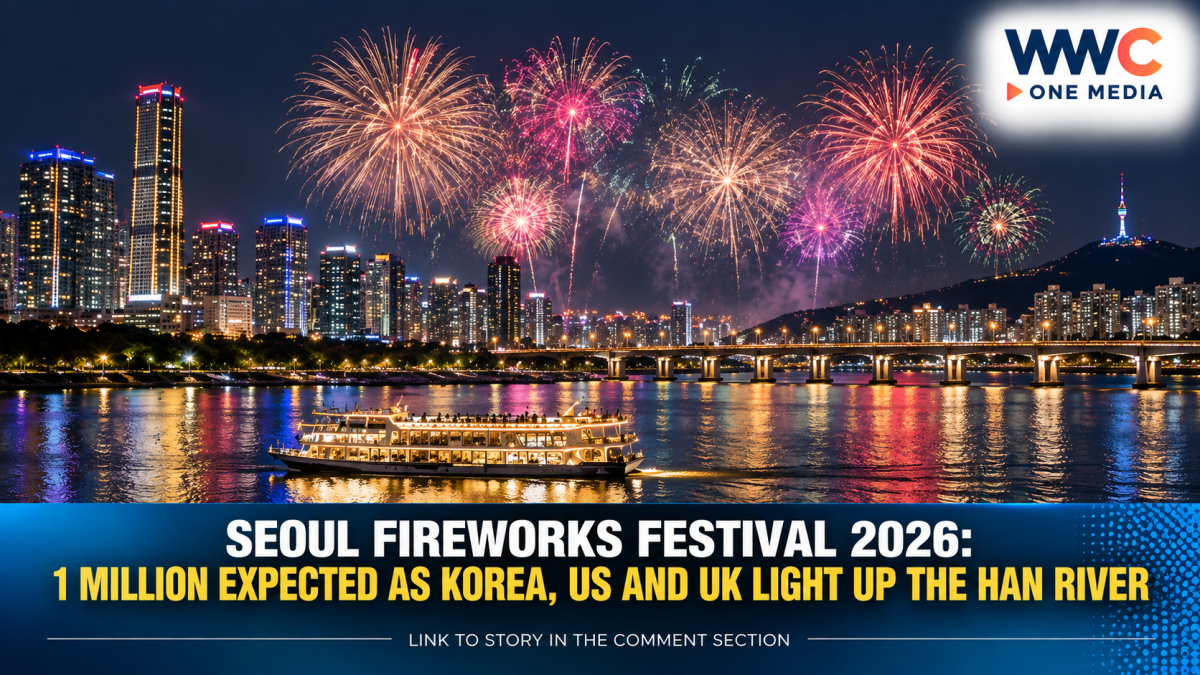
SEOUL,South Korea — Seoul’s night sky is set for one of its biggest spectacles of the year as South Korea, the United States and Britain prepare to unleash a massive fireworks display over the Han River on Saturday, September 5.
The 2026 Seoul International Fireworks Festival, hosted by Hanwha Group, begins its main fireworks program at 8 p.m. around Yeouido and Ichon Hangang parks, with the fireworks scheduled to continue until approximately 9:10 p.m.
But behind the colorful spectacle is an enormous logistical operation.
Seoul authorities are preparing for a crowd of around 1 million people, with thousands of personnel deployed for crowd management, transportation, emergency response and public safety.
Three countries, one massive Seoul skyline
This year’s festival features fireworks teams from South Korea, the United States and the United Kingdom, with the participating teams taking turns transforming the night sky above the Han River.
The festival is now in its 22nd year, making it one of Seoul’s most recognizable annual large-scale public events.
The 2026 event is being held roughly three weeks earlier than last year’s festival, largely because of the timing of the Chuseok holiday later this month and the expected increase in international tourism demand.
That earlier date also means spectators could face warmer conditions than those accustomed to the festival’s traditional late-September schedule.
The fireworks aren’t the only thing making headlines
For many visitors, the challenge will not be finding the fireworks—it will be finding a place to watch them.
Yeouido Hangang Park remains the closest and most popular viewing area, while Ichon Hangang Park offers another major vantage point across the river.
Korea JoongAng Daily reported that spectators had already begun claiming prime viewing areas at Yeouido a day before the main event, with picnic mats covering large portions of the prime riverside lawn.
The city is discouraging prolonged unattended occupation of viewing spaces, and officials have warned visitors about overcrowding and congestion.
Seoul is preparing for the million-person rush
The expected crowd has prompted an unusually extensive public-safety operation.
The Seoul Metropolitan Government said 6,800 personnel would be deployed for the festival, covering traffic management, safety, emergency response and visitor assistance.
Police are also increasing their presence around major crowd-gathering points, subway stations and bridges. Additional patrol resources are being deployed around the Han River as authorities prepare for the enormous concentration of spectators.
The precautions are not simply about the fireworks themselves.
The biggest challenge may come before and after the show, when hundreds of thousands of people attempt to enter or leave the riverside viewing areas at roughly the same time.
Major roads will be closed
Visitors planning to drive into Yeouido should expect significant restrictions.
According to Seoul’s official event information, Yeouidong-ro will be fully closed from 3 p.m. to midnight on September 5 between the southern end of Mapo Bridge and the area near the 63 Building.
Wonhyo Bridge will also be fully closed to vehicles and pedestrians from 9 a.m. Saturday until 3 a.m. Sunday. Additional restrictions may be imposed depending on conditions at the event.
Bus services will also be affected, with 24 routes temporarily detoured around the restricted areas.
The city is strongly encouraging visitors to use public transportation rather than private vehicles.
One subway station could become a no-go zone
One of the most important warnings for spectators concerns Yeouinaru Station on Seoul Subway Line 5, the closest station to the main Yeouido viewing area.
Authorities say the station may operate without train stops between approximately 7 p.m. and 10 p.m. if platforms become dangerously crowded. Entrances may also be closed when necessary.
Visitors are being encouraged to consider alternative stations, including Yeouido, Mapo and Saetgang, and continue their journey on foot.
Additional subway services have also been scheduled, including 18 extra Line 5 trips and 65 extra Line 9 trips, for a total of 83 additional services during the main event period.
The event is free—but some viewing areas are different
General viewing at the Han River parks is free.
However, Nodeulseom operates a ticketed viewing area, according to Seoul’s official event information.
That distinction is important for visitors who may assume every riverside viewing area operates under identical access rules.
The official festival schedule runs from 1 p.m. to 10 p.m., while the main fireworks program itself is scheduled for 8 p.m. to 9:10 p.m.
The city has prepared extra facilities
With hundreds of thousands of people expected to gather around the Han River, Seoul is expanding basic facilities.
The city says 94 temporary toilets and additional waste-collection facilities will be installed in Yeouido and Ichon Hangang parks.
Official food-truck areas will also operate, while authorities plan to crack down on unauthorized street vendors and disorderly commercial activity.
The city is also asking visitors to take their rubbish with them or use designated collection points because of the enormous volume of waste expected after the event.
The heat could become another challenge
Although September marks the beginning of autumn, temperatures remain relatively high.
Reports from the scene indicated temperatures around 29°C (84°F) in the days leading up to the festival.
That makes hydration especially important for spectators who plan to secure viewing spots hours before the fireworks begin.
Visitors spending the entire afternoon outdoors should also plan for limited shade, crowded pathways and long periods of standing.
Even the river will be restricted
The safety operation extends beyond roads and public parks.
Seoul says portions of the Han River will be subject to sequential waterway restrictions, while patrol vessels will monitor the area.
A total of 45 patrol boats are scheduled to assist with water safety around the event.
The restrictions are designed to prevent vessels and recreational users from entering areas where fireworks operations and massive spectator concentrations could create additional hazards.
A major tourism event as well as a fireworks show
The festival has increasingly become part of Seoul’s international tourism calendar.
The city’s decision to move the event forward by several weeks this year was partly connected to Chuseok scheduling and growing foreign-tourist demand.
The scale of the event also creates a significant commercial impact.
Retailers around Yeouido have been stocking additional supplies of bottled water, ice, drinks and ready-to-eat food as businesses prepare for the enormous crowd.
For Seoul, therefore, the fireworks are more than a spectacular evening.
They are also a major tourism and consumer event capable of transforming the surrounding districts for an entire weekend.
Where to watch if Yeouido is too crowded
Yeouido may provide the closest experience, but it is far from the only possible viewing area.
Korea JoongAng Daily has highlighted alternatives including Ichon Hangang Park, Noryangjin-area viewpoints and other elevated or riverside locations for people who want to see the fireworks without fighting for space directly in front of the main launch area.
The trade-off is simple: the farther away spectators move from Yeouido, the less immersive the experience may become—but they may gain more space and easier access.
For visitors who prioritize comfort over proximity, choosing a secondary viewing point could be the smarter strategy.
The real spectacle may begin after 9:10 p.m.
The fireworks themselves last just over an hour.
Getting hundreds of thousands of people home afterward is another story.
Seoul’s transportation measures are designed around that problem, with additional subway services and concentrated bus operations during the expected departure period.
Authorities are also preparing crowd-dispersal measures to prevent dangerous concentrations around stations, roads and bridges.
That means visitors should resist the temptation to rush immediately toward the nearest subway station once the final fireworks disappear.
Seoul’s biggest night is finally here
For spectators, the formula is simple: arrive early, carry water, use public transportation, choose a viewing location carefully and be prepared for crowds.
For Seoul officials, however, September 5 represents a far more complicated challenge.
The city must safely manage potentially one million spectators, keep transportation moving, protect the Han River, maintain emergency access and prevent dangerous overcrowding—all while delivering one of South Korea’s most anticipated annual visual spectacles.
Tonight, the sky above the Han River will belong to fireworks from Korea, the United States and Britain.
But once the final burst fades, the real test for Seoul will be getting a million people safely home.

Leave a Reply