
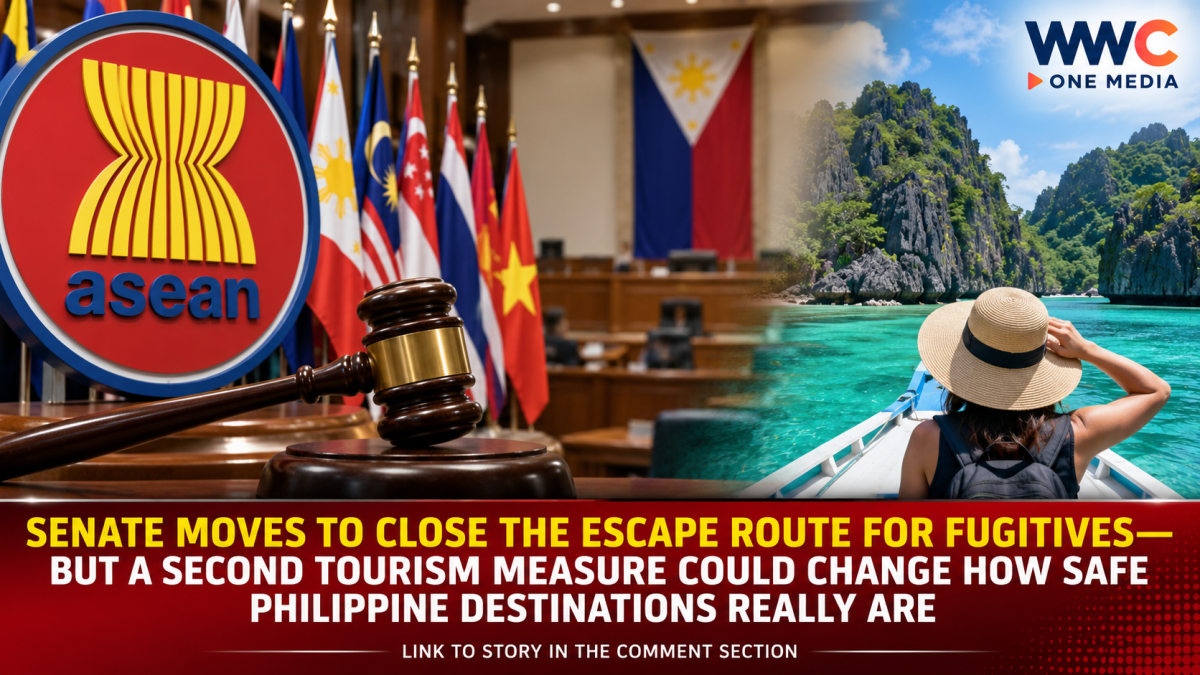
MANILA, Philippines — The Philippine Senate is moving to strengthen cooperation with Southeast Asian neighbors against cross-border crime while lawmakers are also pushing tougher safeguards for tourists—two developments that could significantly reshape the country’s approach to regional justice and tourism safety.
At the center of the regional security push is the ASEAN Treaty on Extradition, signed in Manila on November 14, 2025. The agreement is designed to prevent suspected or convicted criminals from escaping prosecution or punishment simply by crossing an international border.
The treaty would allow ASEAN member states to request the extradition of individuals located in another member state for prosecution, sentencing, or enforcement of an already imposed sentence, subject to the treaty’s provisions and each country’s domestic legal framework.
The Philippine Department of Justice serves as the country’s central authority for extradition matters. Under existing Philippine law, extradition can be granted only pursuant to a treaty or convention, with Presidential Decree No. 1069 providing the country’s legal framework for extradition proceedings.
A wider net against cross-border criminals
The proposed regional framework is particularly significant as criminal activity increasingly crosses national borders.
During a Senate hearing, Justice Department officials explained that the ASEAN treaty would expand the Philippines’ extradition arrangements beyond its existing bilateral agreements with individual countries.
The Philippines currently has extradition treaties with several countries and jurisdictions, including Australia, Canada, China, India, Indonesia, South Korea, Russia, Spain, Switzerland, Thailand, the United Kingdom and the United States, among others.
Under the ASEAN arrangement, regional cooperation could eventually cover additional ASEAN jurisdictions, reducing opportunities for fugitives to exploit gaps between national legal systems.
Senator Erwin Tulfo has also backed the agreement, emphasizing the need to deny criminals a safe haven while ensuring that extradition remains subject to due process and human-rights protections.
But the treaty is not yet in force
There is an important distinction between Senate concurrence and the treaty actually taking effect.
ASEAN’s official treaty database currently lists the ASEAN Treaty on Extradition as “Not In Force.” The agreement provides that it will enter into force after at least six signatory states deposit their instruments of ratification, acceptance or approval, followed by the required 30-day period.
Singapore’s Ministry of Law likewise reported in April 2026 that no ASEAN member state had yet ratified the treaty at that point and that there was no agreed timetable for its entry into force.
That means Senate action in the Philippines is an important step—but it does not by itself activate the regional extradition system.
Tourist safety becomes another major legislative focus
Alongside the extradition initiative, lawmakers are pursuing legislation designed to make Philippine tourism destinations safer, particularly for children and families.
One key measure is Senate Bill No. 1926, the Child Tourist Safety Act, also known as “Sandy’s Act.” The measure seeks to prevent, mitigate and respond to risks affecting children and other tourists participating in tourism-related activities.
The legislation was inspired by the death of Sandy Garovillas, a young girl who died after being stung by a box jellyfish while vacationing in Palawan in 2023. Her family’s experience highlighted gaps in emergency preparedness, first aid and access to immediate medical assistance at tourism facilities.
The proposed legislation would establish stronger safety requirements, including a Tourist Safety Risk Map, emergency and risk-mitigation plans, lifeguard deployment, access to medical facilities and emergency-response protocols.
It also calls for safety and lifesaving training for tourism workers, with TESDA involved in providing subsidized training.
Philstar previously reported that the proposed law would require tourism-related establishments such as hotels and resorts to have access to medical services and first-aid facilities, as well as an adequate number of trained lifeguards.
Why the issue matters
The push comes as the Philippines seeks to attract more international visitors while confronting concerns over safety and emergency response in some tourist destinations.
During recent Senate discussions on maritime search-and-rescue capabilities, Senate Majority Leader Juan Miguel Zubiri pointed to the difficulty tourists can face when hospitals and emergency services are far from remote destinations. He also linked stronger search-and-rescue capabilities with the country’s ability to expand tourism.
The concern is not limited to crime.
Tourists can face risks from drowning, marine animals, accidents, natural hazards and medical emergencies—particularly in remote island destinations where emergency response can take valuable time.
A 2025 BusinessMirror report on the proposed Child Tourist Safety Act noted that Philippine Statistics Authority data cited during Senate discussions showed 1,056 children aged 1 to 14 were among 3,604 accidental drowning deaths recorded in 2021.
What could change for Filipinos and foreign visitors?
If the ASEAN extradition treaty eventually enters into force, criminals who attempt to escape prosecution by moving between participating Southeast Asian countries could face a significantly tighter regional legal net.
For tourists, meanwhile, the proposed safety legislation could push tourism establishments toward more formalized emergency preparedness, trained personnel, lifesaving equipment and clearer response procedures.
Together, the measures point to a broader challenge for the Philippines: making the country not only an attractive destination, but also a safer one—and ensuring that international borders cannot easily become an escape route for criminals.
But neither initiative is an instant solution.
The extradition treaty still requires the necessary ratification process among ASEAN states before it can enter into force, while the tourist-safety legislation must still complete the remaining stages of the Philippine legislative process.
The bigger question now is whether these initiatives can move from legislation and international agreements into actual protection on the ground—for both Filipinos and the millions of visitors who travel through the Philippines each year.




Leave a Reply