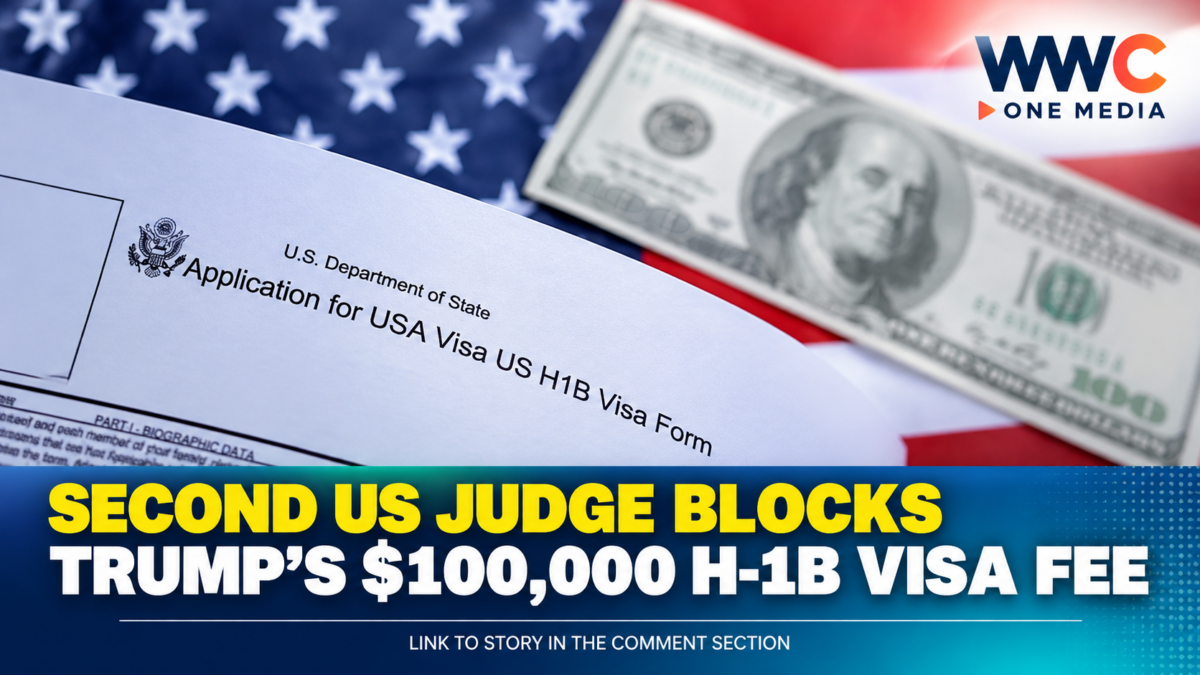
A second US federal judge has blocked the Trump administration from enforcing a $100,000 fee on certain new H-1B visas for highly skilled foreign workers, adding another legal setback to a policy that has been challenged by states, employers, unions and nonprofit groups.
US District Judge Haywood Gilliam in Oakland, California, ruled that US Citizenship and Immigration Services and the State Department failed to follow required rule-making procedures before implementing the fee. The decision prevents the agencies from enforcing the policy while the underlying lawsuit proceeds.
The ruling follows a separate decision in June by a federal judge in Boston, who also blocked the $100,000 payment requirement. An appeals court in July declined to pause that earlier ruling, meaning the fee had already been prevented from taking effect while the government pursued its legal options.
The H-1B programme allows US employers to hire foreign workers for specialty occupations that generally require specialized knowledge and at least a bachelor’s degree. Technology companies are among the major users of the programme, although H-1B workers are also employed in fields including engineering, education and other specialized professions.
Federal law provides for 65,000 H-1B visas each year, along with another 20,000 for foreign workers with advanced degrees from US universities. Many other H-1B cases fall outside those annual limits because of exemptions covering certain employers and circumstances.
Trump’s administration introduced the $100,000 payment requirement in September 2025 for certain new H-1B petitions involving workers outside the United States. The measure represented a dramatic increase from the fees that had typically been associated with H-1B applications, which Reuters reported had generally ranged from about $2,000 to $5,000 depending on the circumstances.
The administration argued that the H-1B system had been abused and that the higher cost would discourage employers from relying on lower-paid foreign labor. Trump invoked presidential authority under federal immigration law to restrict the entry of foreign nationals whose admission he determined would be detrimental to US interests.
The legal challenges have focused on whether the president and federal agencies had the authority to impose the charge and whether the government followed the procedures required under administrative law.
In the latest case, Judge Gilliam sided with a coalition of unions, employers and nonprofit organizations that challenged the implementation process. The ruling did not represent a final resolution of every legal issue surrounding the policy, leaving the broader dispute subject to further proceedings and possible appeals.
The administration has also been pursuing a separate approach to making the fee permanent. The Department of Homeland Security moved in August toward a proposed permanent charge of roughly $103,000. That proposal would face separate legal questions and could also be challenged once finalized.
The latest court ruling adds further uncertainty for employers planning to hire skilled workers from abroad. Companies that depend on the H-1B programme have faced an evolving set of requirements as the administration pursues changes to immigration policy and courts consider challenges to those measures.
The US Chamber of Commerce has filed another lawsuit challenging the $100,000 fee, while its separate legal challenge continues through the courts. The combination of multiple cases means the final legal status of the fee could depend on decisions from several courts and potentially further appeals.
For now, the second federal court ruling means the $100,000 H-1B fee remains blocked as the legal battles continue, leaving employers and prospective foreign workers awaiting further developments over the future of the policy.