
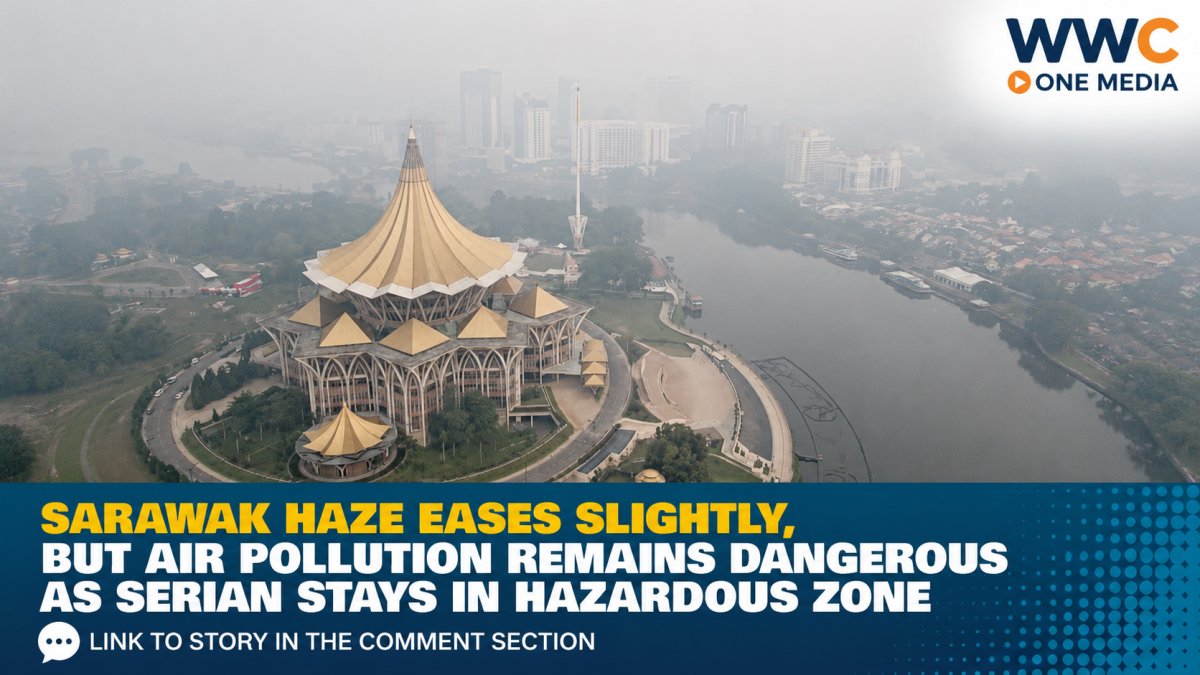
Air quality has improved in some parts of Sarawak, but several areas remain at very unhealthy levels as smoke from regional fires continues to affect the state.
KUCHING, MALAYSIA — Sarawak’s worsening haze situation showed signs of easing on Thursday, September 3, but authorities and residents remain on alert as several monitoring stations continue to record unhealthy to hazardous air quality.
The latest readings show that Serian remains the most affected area, with its Air Pollutant Index (API) reaching the hazardous category. At 9:30 a.m., the Department of Environment’s Air Pollutant Index Management System recorded an API of 345 at the Serian District Police Headquarters.
Four other Sarawak locations were in the very unhealthy range at the same time: Sri Aman at 294, Kuching at 273, Samarahan at 255 and Sarikei at 223.
The situation represents a slight improvement from the previous days, when several Sarawak stations crossed the hazardous threshold simultaneously.
Sarawak remains at the centre of Malaysia’s haze crisis
The latest readings underline how uneven the haze situation remains.
As of 9 a.m. Thursday, 20 locations across Malaysia were recording unhealthy to hazardous API readings, according to APIMS data reported by The Star.
Fourteen locations were in the unhealthy category, while Serian was the only location at hazardous levels at that particular time.
The API categories used by Malaysian authorities are:
- 0–50: Good
- 51–100: Moderate
- 101–200: Unhealthy
- 201–300: Very unhealthy
- Above 300: Hazardous
Because API readings are updated hourly, conditions can change considerably throughout the day.
Lubok Antu also raises concern
A separate Sarawak monitoring system reported an even more serious reading earlier Thursday.
The Natural Resources and Environment Board Sarawak reported Lubok Antu at API 456 at 8 a.m., placing it in the very hazardous category under Sarawak’s classification system.
The same report placed Serian at 343 and Sri Aman at 298.
The difference between individual readings reported during the morning highlights why haze figures need to be accompanied by their time and monitoring station rather than treated as a single statewide number.
What is causing the haze?
The current episode is linked largely to smoke from fires in Indonesia’s Kalimantan region, which is drifting across the border into Sarawak.
Sarawak shares the island of Borneo with Indonesian Kalimantan, making the state particularly vulnerable to smoke transported by prevailing winds during dry periods.
The ASEAN Specialised Meteorological Centre has been monitoring the regional smoke-haze situation, including hotspot activity and wind patterns across southern Southeast Asia.
Earlier this week, Sarawak officials said satellite monitoring had detected dramatically more hotspots in Kalimantan than inside Sarawak itself. AFP reported that authorities counted 1,180 hotspots in Indonesian Kalimantan compared with nine in Sarawak at the time of the assessment.
Kalimantan recorded more than 15,000 hotspots between January and late August, with more than 13,000 occurring in August alone, according to figures cited by Sarawak authorities.
Malaysia turns to cloud seeding
With haze intensifying and water levels also coming under pressure after a prolonged dry spell, Malaysian authorities have been preparing cloud-seeding operations.
Sarawak officials said operations could be conducted from September 3 to 5, provided suitable clouds and atmospheric conditions are available.
That qualification is important: cloud seeding cannot create rain when suitable clouds are absent.
The operation is being carried out through cooperation between the Malaysian Meteorological Department and the Royal Malaysian Air Force.
Besides potentially helping to clear haze, rainfall could also help replenish dams and reservoirs whose water levels have fallen during the dry spell.
The crisis is already affecting daily life
The haze has gone beyond poor visibility and smoky skies.
Sarawak recently cancelled some outdoor events because of deteriorating air quality, while Malaysia’s wider National Day celebrations were also affected by haze conditions.
The Straits Times reported that Sarawak’s current air quality deterioration was the state’s worst since 2019, when an API reading of 405 was recorded.
The situation has also raised health concerns.
Malaysia’s Health Ministry reported 1,811 asthma cases between August 23 and 29, an increase from the previous week, according to The Straits Times.
Residents in affected areas have been advised to reduce prolonged outdoor activity and take precautions when air quality deteriorates.
Not just Sarawak
Although Sarawak is bearing the brunt of the current haze, other parts of Malaysia and neighbouring countries have also experienced deteriorating air quality.
On Thursday morning, unhealthy readings were reported in several areas of Sabah, including Kota Kinabalu, Keningau and Kimanis, while Labuan and Nilai in Negeri Sembilan were also affected.
Regional monitoring organization IQAir has also reported poor air quality across parts of Southeast Asia, attributing much of the deterioration to smoke from forest and peat fires in Indonesia being carried by prevailing winds.
Could Sarawak declare a haze emergency?
Not yet.
Sarawak authorities have previously said that an API reading of 500 or above would trigger consideration of an emergency declaration under the National Haze Action Plan.
Officials have stressed that any such declaration would apply to the affected locality rather than automatically covering the entire state.
With some readings now improving while others remain dangerously high, officials are continuing to monitor conditions closely.
The bigger picture
Sarawak’s haze crisis is showing how quickly air quality can swing during prolonged dry weather.
Thursday’s figures provide some relief compared with the multiple hazardous readings recorded earlier in the week. But with Serian still above 300 and other areas approaching that threshold, the situation remains serious.
For now, rain is the biggest potential game-changer.
Until sustained rainfall arrives and fire activity falls, Sarawak residents can expect the haze situation to remain closely watched.
WWC ONE MEDIA J.M.D




Leave a Reply