
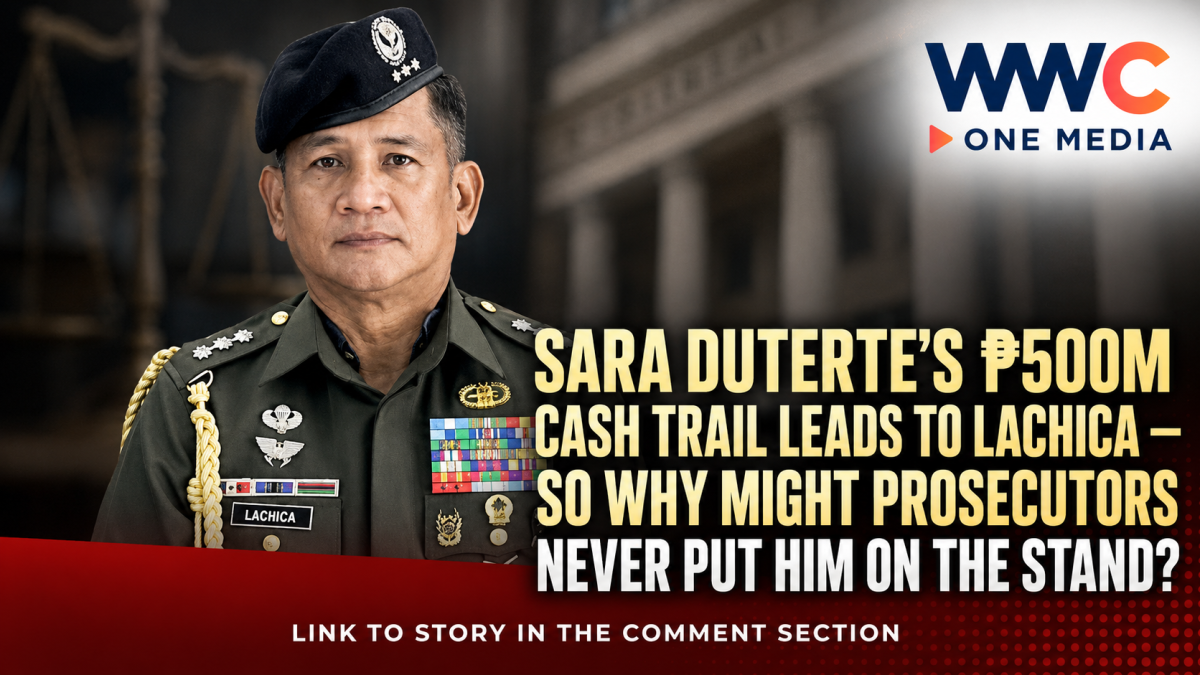
MANILA, Philippines — The man repeatedly identified in testimony as having received hundreds of millions of pesos in confidential funds from the Office of the Vice President may never be called by House prosecutors in Vice President Sara Duterte’s impeachment trial.
And that decision could become one of the most closely watched strategic gambles of the case.
House prosecutors say they are considering dropping plans to subpoena Col. Raymund Dante Lachica, Duterte’s former security chief, arguing that testimony already presented before the Senate impeachment court is enough to establish their allegation that confidential funds were improperly handled and that responsibility ultimately leads to the Vice President.
But there is an important distinction: that is the prosecution’s position, not yet a ruling of the impeachment court.
The Senate sitting as an impeachment court has not determined that Duterte misused public funds or committed an impeachable offense. Duterte has denied wrongdoing, and her defense continues to challenge the prosecution’s evidence and interpretation of the transactions.
Why Lachica is at the center of the ₱500-million question
Former OVP special disbursing officer Gina Acosta testified that she released a total of ₱500 million in confidential funds to Lachica in four ₱125-million tranches, following instructions from Duterte.
The releases covered transactions beginning in December 2022 and continuing into 2023.
Acosta also acknowledged during testimony that Lachica was not the OVP’s special disbursing officer and was not fidelity-bonded for the funds entrusted to him. She remained the accountable officer on paper even after the cash was turned over.
That arrangement has become central to the prosecution’s argument.
Lanao del Sur Rep. Zia Alonto Adiong, a prosecution spokesman, said prosecutors believe the evidence already shows who ordered the transfers and where accountability should lie.
For the prosecution, putting Lachica on the witness stand may therefore be unnecessary.
But the testimony heard so far has also exposed a potentially significant gap.
Witnesses could trace the money to Lachica—but not fully beyond him
Acosta testified that she did not personally know how Lachica ultimately spent the money after it was turned over to him.
OVP Assistant Secretary and Assistant Chief of Staff Lemuel Ortonio, another hostile witness called by prosecutors, likewise testified that he did not have personal knowledge of exactly where the confidential funds went.
During questioning, Ortonio identified Duterte, as head of the agency, and Lachica, as the officer involved in implementing confidential activities, as the people with knowledge closest to the transactions under examination.
Ortonio also testified that Duterte knew of and authorized activities involving the OVP confidential funds and approved documents connected to the process.
Again, those statements form part of the evidence being tested before the impeachment court; they are not themselves a final judgment that an offense occurred.
That creates the question now hanging over the trial:
If Lachica was the person who actually implemented the confidential activities, should senator-judges hear directly from him about what happened to the money?
Lachica says he is willing to testify
Adding another layer to the controversy, Lachica has said he has never refused to appear.
“If lawfully called,” he said in a statement released this week, he is prepared to testify and “tell the truth,” subject to applicable laws and security restrictions.
That means prosecutors are not necessarily dealing with a witness who is publicly refusing to cooperate.
They are making a strategic choice about whether his testimony would strengthen—or potentially complicate—their case.
Earlier, prosecutor Lorna Kapunan said there could be risks in calling Lachica and fellow military officer Col. Dennis Nolasco because prosecutors were unable to examine them during the House inquiry into confidential funds in 2024.
That means the prosecution cannot be certain in advance what the officers would say under oath in the Senate.
Lead prosecutor Batangas Rep. Gerville Luistro later said she was also leaning against presenting Lachica, maintaining that testimony already placed the alleged irregularity in the transfer of the funds before the court.
Some senator-judges still want answers from him
Not everyone appears convinced that Lachica’s testimony can simply be skipped.
Senator-judge Erwin Tulfo has expressed interest in hearing from the former security chief, saying his testimony could help clarify questions involving the confidential funds.
That matters because an impeachment trial is not controlled entirely by the prosecution and defense.
The senator-judges themselves have repeatedly questioned witnesses, and the impeachment court has powers to compel testimony and documents when it considers them necessary.
So even if House prosecutors ultimately decide not to call Lachica themselves, his absence from the prosecution witness list does not necessarily mean the Senate will never hear from him.
The AFP investigation adds another layer
Lachica and Nolasco were also previously subjects of an Armed Forces of the Philippines inquiry connected to their alleged involvement in confidential fund transactions.
Defense Secretary Gilberto Teodoro said this week that the AFP terminated its internal investigation in November 2025 after the Office of the Ombudsman acquired jurisdiction over the matter.
Teodoro explained that referring the issue to the Ombudsman was considered more appropriate because the watchdog has broader authority to investigate and, if warranted, pursue cases.
The termination of the military’s internal inquiry therefore came as jurisdiction shifted to the Ombudsman, rather than serving as a Senate impeachment court determination on the underlying allegations.
Attention is now shifting to DepEd’s ₱112.5 million
While the Lachica question remains unresolved, prosecutors are preparing to move deeper into another part of Duterte’s confidential-fund case: the ₱112.5 million allocated to the Department of Education while Duterte was education secretary.
As of Aug. 29, prosecutors say three Armed Forces officials and lawyer Michael Wesley Poa are expected to testify regarding the DepEd funds.
Poa served as DepEd chief of staff and spokesman during Duterte’s tenure and is now part of her impeachment defense team. Prosecutors plan to seek his presentation as a hostile witness.
The AFP testimony is expected to focus partly on military activities and certifications cited in DepEd’s responses to Commission on Audit questions.
One military witness, Col. Manaros Boransing II, is expected to address whether an annual military activity actually received financial assistance or reward money from DepEd—an issue prosecutors say could help senator-judges evaluate explanations previously given for confidential-fund expenditures.
Why the Lachica decision matters
For prosecutors, the strategy is understandable: if they believe documentary evidence and testimony already establish their case, calling an unpredictable witness could introduce new inconsistencies or give the defense material it can exploit.
For the defense, however, the decision could open another argument.
If prosecutors repeatedly identify Lachica as the person who received and implemented confidential funds but decline to ask him directly where the money went, the defense could question whether the prosecution has actually completed the chain of proof.
And for the senator-judges, the issue may be even simpler.
They must eventually decide whether the evidence proves the impeachment charge—not whether either side believes it has already proved it.
That is why Lachica’s potential absence could become almost as important as his testimony.
The prosecution says it already has enough.
Lachica says he is ready to talk.
And after ₱500 million in public money was traced in testimony from the OVP disbursing officer to Duterte’s former security chief, the biggest unanswered question may now be whether the impeachment court will allow the trial to end without hearing his version of what happened next.



Leave a Reply