
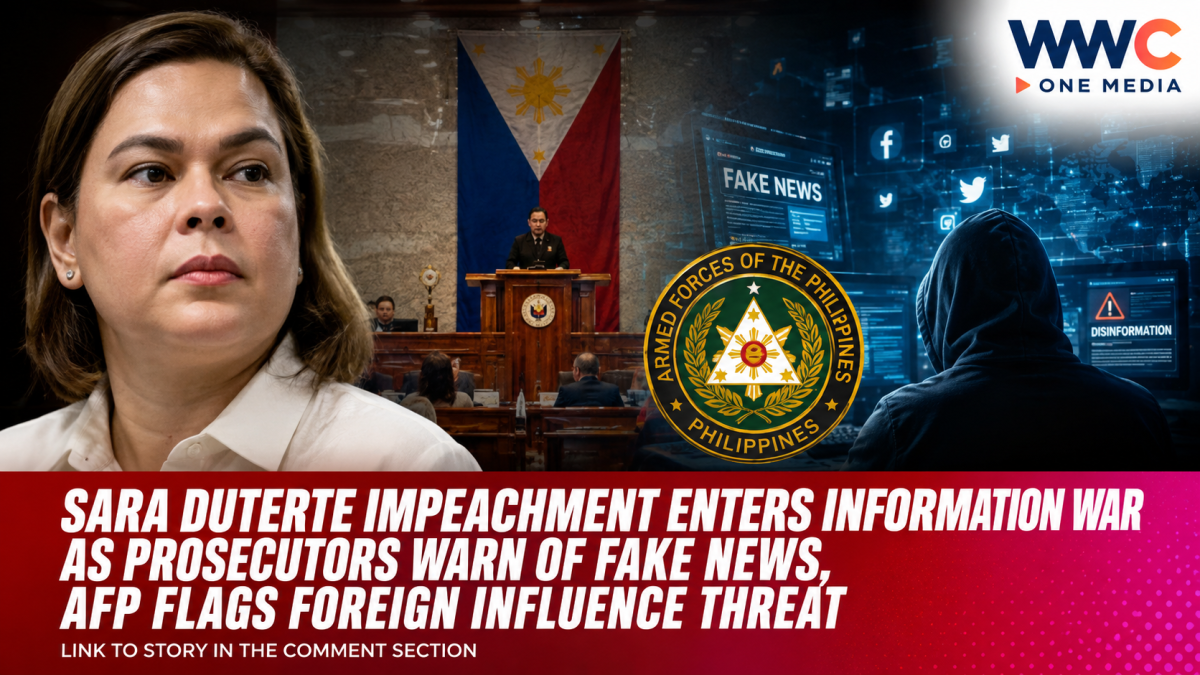
MANILA, Philippines — The impeachment trial of Vice President Sara Duterte is no longer unfolding only inside the Senate chamber. As prosecutors prepare to deepen their case over the alleged misuse of confidential funds, another battle is intensifying outside the courtroom: the fight over what Filipinos believe about the proceedings.
House impeachment team adviser and spokesperson Robert Ace Barbers on Saturday, August 29, warned the public against fake news and misleading narratives surrounding Duterte’s trial, urging Filipinos to rely on verified information and the evidence actually presented before the Senate sitting as an impeachment court.
The warning comes as the Armed Forces of the Philippines has separately raised concerns about what it calls foreign malign influence operations, particularly coordinated online campaigns designed to manipulate public opinion, deepen political divisions and weaken trust in Philippine institutions.
But an important distinction must be made: the AFP’s warning about foreign malign influence does not by itself establish that a foreign government is directing disinformation about Duterte’s impeachment trial. Military officials have described a broader information-security threat affecting Philippine political and national-security debates, while prosecutors are separately confronting what they describe as misinformation surrounding the impeachment proceedings.
‘Every day there is fake news’
Barbers said misleading information has become a recurring problem as Duterte’s impeachment trial continues, arguing that Filipinos should examine what is being presented in open court rather than rely solely on viral posts, partisan commentary or unverified social-media claims.
The prosecution has made similar warnings before. In June, House prosecutors cautioned that false narratives could intensify as the case moved toward trial, while in August the panel sought help from the Cybercrime Investigation and Coordinating Center after a statement falsely attributed to Duterte defense spokesperson Michael Poa circulated online.
The dispute has become particularly sensitive because the Senate impeachment court is now enforcing its sub judice rule, restricting parties and lawyers from publicly discussing disputed facts, witness credibility, the strength or sufficiency of evidence, legal arguments bearing on the merits, and the possible outcome of the case.
Presiding officer Senator Francis “Chiz” Escudero has said the restriction applies to the prosecution, defense and Duterte herself. GMA News reported that Escudero specifically reminded Duterte’s lawyers on August 26 that the Vice President was also covered by the rule after she issued a statement challenging prosecutors to prove their accusations with evidence rather than what she called insults, speculation and political theatrics.
Barbers said the prosecution would comply with the court’s ruling but has appealed for enough flexibility to allow designated spokespersons to explain factual developments without commenting on the merits of the case.
He argued that completely restricting explanations from trial participants could create an information vacuum that unreliable online sources could exploit.
AFP warns the information battlefield is expanding
The controversy comes amid an AFP warning that the Philippines is seeing an increase in foreign malign influence activity, particularly in the digital information environment.
Rear Admiral Roy Vincent Trinidad, the AFP spokesperson on West Philippine Sea concerns, has described these operations as potentially involving coordinated proxy accounts, deceptive media outlets and psychological manipulation intended to divide Filipinos, erode trust in national-security institutions and shape public perception.
The AFP has publicly supported stronger countermeasures against alleged foreign state-sponsored influence campaigns, saying that defending Philippine interests in the West Philippine Sea now extends beyond ships, aircraft and maritime territory into the country’s online information space.
Reporting from the August 29 Saturday News Forum said military officials discussed how malign narratives can migrate toward major domestic controversies, including impeachment and flood-control issues. That assessment should nevertheless be treated as a security warning rather than definitive attribution of specific impeachment-related posts to a foreign state unless authorities release supporting evidence identifying the operators involved.
What is happening inside Sara Duterte’s impeachment trial?
Away from the online information battle, the Senate impeachment court is currently hearing evidence involving Duterte’s alleged handling of ₱612.5 million in confidential funds — ₱500 million allocated to the Office of the Vice President and ₱112.5 million to the Department of Education while Duterte simultaneously served as vice president and education secretary.
The allegations remain allegations, and Duterte has denied wrongdoing.
GMA News’ running timeline of the trial shows that Commission on Audit witnesses have testified about documentation and liquidation issues involving the confidential funds, including questions surrounding recipients, supporting records and the purposes for which money was allegedly spent.
The Duterte defense has strongly rejected the prosecution’s interpretation of the evidence.
Defense spokesperson Michael Poa has maintained that there was no misuse of the ₱612.5 million and argued that some activities cited during testimony were related to security requirements rather than the events themselves. Duterte’s formal response to the impeachment articles has also challenged the sufficiency of the evidence and denied that her conduct amounted to impeachable offenses.
That distinction remains crucial: witnesses and documents may establish facts about transactions and procedures, but whether those facts amount to culpable violations, corruption or betrayal of public trust will ultimately be decided by the senator-judges.
Prosecutors prepare another key witness
The confidential-funds phase could become even more closely watched next week.
The prosecution has moved to call Michael Poa himself, who served as Duterte’s chief of staff and spokesperson at the Department of Education before becoming part of her impeachment defense team.
According to the House prosecution and other reports, Poa is expected to be summoned in connection with the alleged use of the Department of Education’s ₱112.5 million confidential fund allocation. Other witnesses connected to the military have also been identified as prosecutors examine activities cited in explanations for DepEd confidential spending.
The appearance of a member of Duterte’s current defense team as a prosecution witness could make the next stage of the trial especially consequential — but it does not predetermine what his testimony will establish.
Four major accusations remain before the Senate
The current impeachment case contains allegations involving confidential funds, unexplained wealth and financial disclosures, alleged bribery involving Department of Education officials, and threats made against President Ferdinand Marcos Jr., First Lady Liza Araneta-Marcos and former House Speaker Martin Romualdez.
The prosecution began its presentation with the threats-related article before moving to the confidential-funds allegation. It has yet to fully litigate all the remaining accusations. Duterte denies wrongdoing and has characterized the impeachment effort as politically motivated.
The Senate — not the prosecution, defense, political parties or social-media commentators — will ultimately determine whether the charges have been proven to the constitutional standard required for conviction.
Why the information war could matter
That makes the struggle over information particularly significant.
Unlike an ordinary court case followed mostly by lawyers and journalists, an impeachment trial is simultaneously a constitutional proceeding, a political event and a national public spectacle. Millions of Filipinos encounter excerpts of testimony through Facebook, TikTok, YouTube, X and political pages rather than watching hours of Senate proceedings.
A misleading quote, selectively edited video or fabricated document can therefore reach voters long before a correction catches up.
The prosecution argues that factual briefings are necessary to prevent that vacuum from being filled by false information. Duterte’s camp, meanwhile, has repeatedly insisted that prosecutors should prove their accusations through admissible evidence rather than public rhetoric.
Both positions now operate under the Senate court’s stricter sub judice restrictions.
And that could create the trial’s next major test: Can Filipinos separate what was actually proven inside the Senate from what becomes viral outside it?
With more witnesses still expected, the confidential-funds allegations under scrutiny and the AFP warning that information manipulation has become a national-security concern, the battle surrounding Sara Duterte’s impeachment may increasingly be fought on two fronts — one before the senator-judges, and another across millions of Filipino screens.
Leave a Reply