
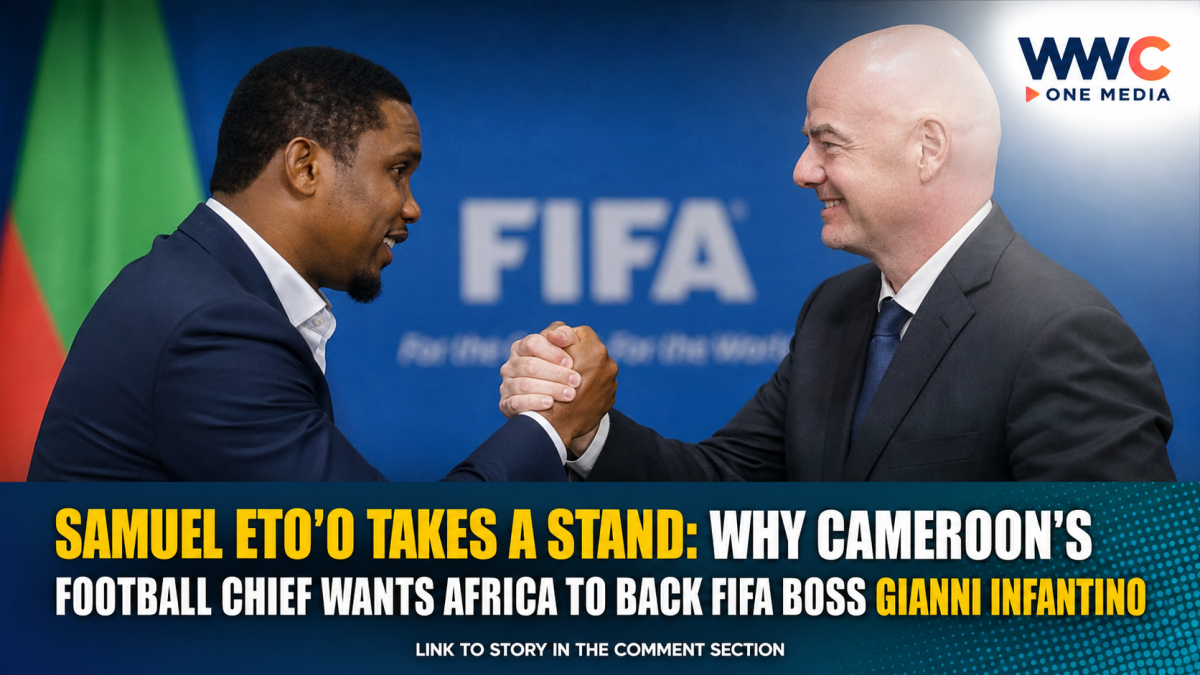
YAOUNDÉ, Cameroon — Cameroon football chief Samuel Eto’o has called on African football federations to support FIFA President Gianni Infantino, arguing that the Swiss-Italian administrator has significantly expanded opportunities and development for football across the continent.
In an interview with French sports newspaper L’Équipe, Eto’o credited Infantino with helping African football associations develop faster and increasing the number of African nations able to compete at the World Cup.
“President Gianni Infantino has changed football,” Eto’o said, according to Reuters.
The former Cameroon, Barcelona and Inter Milan star said African federations should recognize what he described as Infantino’s contribution to the continent and support him despite the growing criticism surrounding his leadership of world football.
AFRICA’S BIGGER WORLD CUP FOOTPRINT
One of the clearest changes under Infantino has been the expansion of the FIFA World Cup from 32 to 48 teams.
For the 2026 World Cup in Canada, Mexico and the United States, Africa received nine direct qualification places, compared with five for the 2022 tournament in Qatar.
Eto’o pointed to that expanded access as evidence that smaller football nations have gained greater opportunities under Infantino’s FIFA.
The Cameroon football chief also argued that African federations cannot necessarily view FIFA policy through the same lens as wealthier football associations.
He highlighted the financial disparities between African and European football, noting that some African federations operate with extremely limited budgets and remain heavily dependent on government support.
ETO’O: AFRICA NEEDS MORE MONEY TO KEEP ITS TALENT
Eto’o also connected football development to the continent’s struggle to retain elite young talent.
He argued that African nations lose promising players to European football partly because local football systems lack the financial resources available in major European countries.
Using France internationals Kylian Mbappé and Aurélien Tchouaméni, both of whom have Cameroonian family connections, Eto’o suggested that greater investment in Cameroon could have helped the country develop players of similar caliber.
His broader argument is that African football needs greater resources to develop academies, infrastructure and domestic competitions while giving young players more opportunities at home.
INFANTINO FACES GROWING GLOBAL PRESSURE
Eto’o’s intervention comes as Infantino faces an increasingly difficult political battle ahead of the next FIFA presidential election, scheduled for March 18, 2027.
Infantino has announced that he will seek another term.
His position has been challenged following controversy surrounding the now-abandoned FIFA Forward Enterprise (FFE) proposal. The plan involved transferring commercial rights connected to major FIFA competitions—including the men’s and women’s World Cups and the Club World Cup—to a new subsidiary that could have included outside investors.
FIFA ultimately withdrew the proposal, but the controversy has continued to fuel criticism of Infantino’s leadership.
UEFA AND OTHER FEDERATIONS PUSH BACK
The dispute has exposed a growing divide inside international football.
UEFA has taken an increasingly confrontational position toward Infantino, while concerns have also emerged from football authorities in Asia and the CONCACAF region.
The Associated Press reported that opposition to Infantino has intensified following the collapse of the private-investment proposal, with some football bodies calling for greater scrutiny of FIFA governance.
Reuters has likewise reported that Infantino continues to retain significant support in Africa and South America, even as opposition grows elsewhere. Saudi Arabia’s football federation has also publicly backed the FIFA president.
AFRICA REMAINS A CRUCIAL INFANTINO ALLY
Eto’o’s comments therefore carry significance beyond a personal endorsement.
The Confederation of African Football (CAF) has maintained support for Infantino, making Africa an important bloc as the FIFA president prepares for the 2027 election.
Eto’o has previously defended Infantino, arguing that criticism of the FIFA president is partly connected to the approaching election. He has also insisted that FIFA’s 211 member associations—not a small group of powerful football nations—should ultimately determine the organization’s leadership.
His latest remarks reinforce that position while highlighting a fundamental divide in world football: wealthy football nations may prioritize governance, transparency and control over FIFA’s commercial decisions, while many African federations place greater emphasis on development funding, infrastructure and increased access to international competitions.
THE BIGGER QUESTION FOR WORLD FOOTBALL
Eto’o’s backing does not end the controversy surrounding Infantino. Instead, it highlights how divided the football world has become over the FIFA president’s leadership.
For African football, however, the calculation may be different.
With increased World Cup access, FIFA development funding and infrastructure projects among the issues affecting national associations, Infantino retains important allies on the continent.
Eto’o’s message is therefore clear: African football should not automatically follow Europe’s lead when deciding the future of FIFA.
With the 2027 FIFA presidential election approaching, the battle for influence inside world football may only be beginning.
WWC ONE MEDIA MJE



Leave a Reply